
So, how many wheelbarrows in a yard of mulch? The answer is generally between 10 and 20 wheelbarrows of mulch per cubic yard, but this can vary significantly based on the size of your wheelbarrow and how full you pack it.
When you’re planning a landscaping project, one of the most common questions that pops into your head is how much mulch you’ll need. You’ve probably seen bags of mulch at your local garden center, but for larger jobs, you’ll be buying it in bulk, often by the cubic yard. This is where the trusty wheelbarrow comes in, acting as your personal transport system from the delivery pile to your garden beds. But how many trips will it take? This guide aims to demystify the wheelbarrow mulch volume and help you get a solid yard of mulch wheelbarrow estimate.
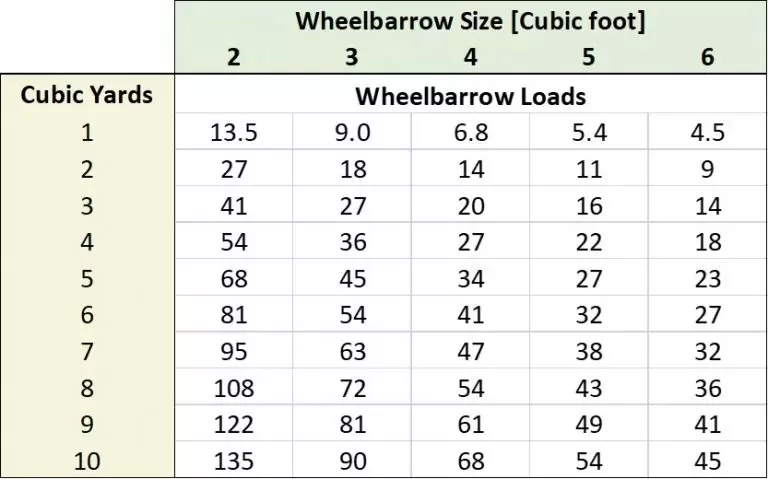
Image Source: www.appletreenursery.net
Deciphering the Cubic Yard
First, let’s get a handle on what a cubic yard actually is. A cubic yard is a unit of volume. Imagine a cube that is exactly three feet long, three feet wide, and three feet high. That’s one cubic yard. It’s a substantial amount of material, and when it comes to mulch, it can feel like a mountain.
The Variable Nature of Wheelbarrow Capacity
The biggest factor influencing how many wheelbarrows make up a cubic yard of mulch is, of course, the wheelbarrow capacity mulch you’re using. These are not standardized across the board. You’ll find smaller, lighter-duty wheelbarrows, and then you’ll find the heavy-duty contractor-grade ones.
Common Wheelbarrow Sizes
Most common garden wheelbarrows have a capacity ranging from 6 to 10 cubic feet. Some heavy-duty models can go up to 12 cubic feet or even more. It’s crucial to know the advertised capacity of your own wheelbarrow. This information is often found on a sticker on the wheelbarrow itself or in the product manual if you still have it.
Table 1: Typical Wheelbarrow Capacities
| Wheelbarrow Type | Typical Volume (Cubic Feet) |
|---|---|
| Lightweight Garden | 4-6 |
| Standard Garden | 6-8 |
| Heavy-Duty Contractor | 8-12+ |
Estimating Mulch Per Wheelbarrow
Knowing your wheelbarrow’s capacity is the first step in estimating mulch per wheelbarrow. However, there’s a small nuance: the advertised capacity is often for the “struck” level, meaning filled to the brim without any heaping. When you’re filling it with mulch, especially fluffy types, you’ll likely have some degree of “heaping.”
The “Heaping” Factor
The amount of “heaping” depends on a few things:
* Type of Mulch: Finer mulches tend to settle more, while chunkier barks or wood chips can be piled higher.
* How You Fill It: Are you carefully leveling it off, or are you trying to get every last bit in? For mulch conversion wheelbarrow calculations, it’s generally better to assume a slightly heaping load for more realistic wheelbarrow loads of mulch.
For our calculations, let’s assume a slightly heaping load, which might add an extra 10-20% to the stated capacity. So, a 6-cubic-foot wheelbarrow might effectively hold closer to 6.6 to 7.2 cubic feet when heaping.
The Crucial Conversion: Cubic Feet to Cubic Yards
To accurately calculate how many wheelbarrows are in a cubic yard of mulch, we need to convert units. We know that a cubic yard is 3 feet x 3 feet x 3 feet.
- 1 cubic yard = 27 cubic feet (3 x 3 x 3 = 27)
This is the cornerstone of our wheelbarrow math mulch problem.
Performing the Yard of Mulch Wheelbarrow Estimate
Now we can put it all together. Let’s take a common scenario: a standard garden wheelbarrow with a capacity of 8 cubic feet.
Scenario: You have an 8-cubic-foot wheelbarrow.
Calculation:
-
Convert wheelbarrow capacity to cubic yards:
- Your wheelbarrow capacity (cubic feet) / 27 cubic feet per cubic yard = Your wheelbarrow capacity in cubic yards.
- 8 cubic feet / 27 cubic feet/cubic yard ≈ 0.296 cubic yards per wheelbarrow.
-
Calculate wheelbarrows per cubic yard:
- 1 cubic yard / Your wheelbarrow capacity in cubic yards = Number of wheelbarrows per cubic yard.
- 1 cubic yard / 0.296 cubic yards/wheelbarrow ≈ 3.38 wheelbarrows.
This calculation suggests that for an 8-cubic-foot wheelbarrow, you’d need just under 3.5 full loads to equal one cubic yard if you were filling it precisely to its capacity. However, this doesn’t account for the “heaping” factor or practical filling.
Let’s refine this using our wheelbarrow mulch volume with a more realistic, heaping load. If an 8-cubic-foot wheelbarrow holds closer to 9 cubic feet when heaping:
-
Revised wheelbarrow capacity in cubic yards:
- 9 cubic feet / 27 cubic feet/cubic yard = 0.333 cubic yards per wheelbarrow.
-
Revised wheelbarrows per cubic yard:
- 1 cubic yard / 0.333 cubic yards/wheelbarrow = 3 wheelbarrows.
This makes intuitive sense: if you can get roughly a third of a cubic yard in each heaping wheelbarrow, it will take about three wheelbarrows to make a full cubic yard.
Factors Influencing Your Personal Estimate
While the math provides a framework, your personal estimating mulch wheelbarrow experience will depend on several factors:
Wheelbarrow Size Variations
As mentioned, wheelbarrow sizes vary. Let’s do a quick calculation for a couple of different scenarios:
Scenario 1: Smaller Wheelbarrow (6 cubic feet)
- Assume a heaping load of 7 cubic feet.
- Capacity in cubic yards: 7 cubic feet / 27 cubic feet/cubic yard ≈ 0.259 cubic yards.
- Wheelbarrows per cubic yard: 1 cubic yard / 0.259 cubic yards/wheelbarrow ≈ 3.86 wheelbarrows.
- So, approximately 4 wheelbarrows.
Scenario 2: Larger Wheelbarrow (10 cubic feet)
- Assume a heaping load of 11 cubic feet.
- Capacity in cubic yards: 11 cubic feet / 27 cubic feet/cubic yard ≈ 0.407 cubic yards.
- Wheelbarrows per cubic yard: 1 cubic yard / 0.407 cubic yards/wheelbarrow ≈ 2.46 wheelbarrows.
- So, approximately 2.5 to 3 wheelbarrows.
These examples illustrate why a single definitive number is hard to give. The wheelbarrow capacity mulch is the most significant variable.
Mulch Density and Compaction
Mulch is not a solid, incompressible material. Its density can change:
* Freshly Delivered Mulch: Often lighter and fluffier.
* Wet Mulch: Significantly heavier as it absorbs water. A cubic yard of wet mulch will feel much heavier and might take up slightly less volume per wheelbarrow load due to compaction.
* Type of Mulch: Wood chips versus shredded bark versus compost will have different densities.
When you’re first filling, your wheelbarrow might feel lighter and easier to mound. As you get deeper into the pile, the mulch might be more compacted, making it heavier and potentially filling the wheelbarrow slightly less.
Your Filling Technique
- Consistent Filling: If you consistently fill your wheelbarrow to a similar heaping level, your wheelbarrow loads of mulch will be relatively uniform.
- Overfilling: Trying to stuff too much in can lead to spills during transport, making your effort less efficient.
- Underfilling: Being too conservative will mean more trips.
Practical Tips for Wheelbarrow Mulch Transport
Here’s how to make your estimating mulch wheelbarrow task easier and more efficient:
Know Your Wheelbarrow’s True Volume
If possible, measure your wheelbarrow. You can do this by filling it with a known quantity of something like sand or gravel (if you have a way to measure that accurately) or even water. Mark the “full” line and then calculate the volume.
Consider Buying a Little Extra
It’s always better to have a bit of mulch left over than to run short. The calculation of how many wheelbarrows in a yard of mulch is an estimate, and real-world conditions can lead to minor discrepancies. If you’re doing a large area, rounding up your mulch order by half a yard can save you a return trip to the supplier.
Pace Yourself
Moving mulch is hard work! Don’t try to do it all in one go. Break it down into manageable loads and take breaks.
Use a Shovel and Rake
A good shovel will help you scoop efficiently, and a rake can help you roughly level or “heaping” the mulch into the wheelbarrow to a consistent level for each load. This aids in your yard of mulch wheelbarrow estimate.
The Importance of Spreading
Remember that mulch compacts significantly once it’s spread in your garden beds. The fluffy pile in your wheelbarrow will settle down. So, a “heaping” wheelbarrow load might only be a “level” layer once spread. This is a key aspect of mulch conversion wheelbarrow thinking – what you move is not exactly what stays in that fluffy state.
Putting It All Together: A Real-World Example
Let’s say you’re buying 3 cubic yards of mulch for your garden. You have a sturdy, 8-cubic-foot capacity wheelbarrow.
- Total Cubic Feet Needed: 3 cubic yards * 27 cubic feet/cubic yard = 81 cubic feet.
- Estimate of Wheelbarrow Capacity (Heaping): Let’s assume you can consistently get about 9 cubic feet per heaping wheelbarrow load.
- Number of Wheelbarrow Loads: 81 cubic feet / 9 cubic feet/wheelbarrow = 9 wheelbarrow loads.
So, for 3 cubic yards of mulch, and with a good-sized wheelbarrow filled reasonably full, you’d be looking at around 9 trips. This aligns with our earlier calculations that suggest 2.5 to 3 wheelbarrows per cubic yard for an 8-cubic-foot wheelbarrow.
Frequently Asked Questions (FAQ)
Q1: What is the average number of wheelbarrows in a yard of mulch?
A1: On average, you can expect between 10 and 20 wheelbarrows of mulch per cubic yard, depending heavily on the size of your wheelbarrow. Smaller wheelbarrows require more trips.
Q2: How much mulch does a typical wheelbarrow hold?
A2: A typical garden wheelbarrow holds between 6 to 10 cubic feet of material. When calculating for mulch, it’s often practical to assume slightly more due to heaping.
Q3: Can I estimate mulch per wheelbarrow without knowing its exact capacity?
A3: Yes, you can estimate. If you don’t know the capacity, try to visually compare it to a known volume, or estimate based on standard sizes (e.g., a common garden wheelbarrow is around 8 cubic feet).
Q4: How do I calculate wheelbarrow capacity mulch?
A4: To calculate wheelbarrow capacity mulch, you need to know the volume of your wheelbarrow in cubic feet. Then, divide that volume by 27 (the number of cubic feet in a cubic yard) to get its capacity in cubic yards.
Q5: What is the best way to approach estimating mulch wheelbarrow loads?
A5: The best approach is to first determine your wheelbarrow’s cubic foot capacity. Then, factor in a slight “heaping” for a more realistic estimate of how much mulch you can carry per load.
Q6: Will wet mulch change the number of wheelbarrow loads?
A6: Yes, wet mulch is significantly heavier and may compact more. This could mean you carry slightly less volume per wheelbarrow load, potentially requiring a few more trips.
Q7: Is there a standard for wheelbarrow mulch volume?
A7: No, there isn’t a strict standard for wheelbarrow mulch volume. Capacities vary widely by manufacturer and model, from lightweight garden models to heavy-duty contractor versions.
Q8: How do I convert cubic yards to wheelbarrow loads of mulch?
A8: To convert, divide the total cubic yards of mulch you need by the estimated cubic yards per wheelbarrow load. For example, if you need 2 cubic yards and estimate each wheelbarrow holds 0.3 cubic yards, you’d need approximately 6.7 wheelbarrow loads.
Q9: What are the key factors for yard of mulch wheelbarrow estimate?
A9: The key factors are the wheelbarrow capacity mulch, the type of mulch (affecting density and compaction), and your personal technique for filling the wheelbarrow.
Q10: What if I’m using a very large wheelbarrow?
A10: If you have a larger wheelbarrow, say 12 cubic feet, your mulch conversion wheelbarrow will be more efficient. A 12-cubic-foot wheelbarrow will hold approximately 0.44 cubic yards (12/27). This means you’d need around 2.3 wheelbarrow loads per cubic yard, or about 7 wheelbarrow loads for 3 cubic yards of mulch.
By now, you should have a much clearer picture of the wheelbarrow math mulch required for your next landscaping project. Happy mulching!