
Image Source: www.appletreenursery.net
Calculating Mulch: How Many Wheelbarrows of Mulch in Your Yard?
So, how many wheelbarrows of mulch do I need for my yard? The answer depends on the size of the area you want to cover, the desired depth of the mulch, and the specific wheelbarrow mulch capacity you’re working with. But don’t worry, this guide will break down the simple math to help you figure it out precisely. We’ll cover everything from estimating mulch needs to understanding mulch coverage and making sure you have enough mulch for landscaping projects of any size.
Why Calculate Your Mulch Needs?
Buying too little mulch means more trips to the store and potentially uneven coverage. Buying too much means wasted money and the hassle of storing excess material. A little planning goes a long way, ensuring your garden beds look fantastic and your plants get the benefits of a good mulch layer. Proper calculating mulch is key to a successful landscaping project.
Deciphering Mulch Measurements: Cubic Feet vs. Cubic Yards
You’ll typically buy mulch by the cubic yard, but you measure your garden beds in square feet. This is where the conversion comes in.
- Cubic Yard: A standard unit of volume, equal to 3 feet x 3 feet x 3 feet.
- Cubic Foot: A smaller unit of volume, equal to 1 foot x 1 foot x 1 foot.
There are 27 cubic feet in 1 cubic yard (3 x 3 x 3 = 27). This is a crucial number for our calculations.
Determining Your Mulch Needs: The Core Calculation
To start calculating mulch, you need to know two main things:
- The area you want to cover in square feet.
- The desired depth of your mulch layer.
A common and effective depth for most mulch applications is 3 inches. This depth helps suppress weeds, retain moisture, and insulate plant roots.
Step 1: Measure Your Area
Walk around your garden beds, trees, or any area you plan to mulch. Use a tape measure to find the length and width of each section.
- Rectangular or Square Areas: Multiply length by width to get the square footage.
- Example: A garden bed is 10 feet long and 4 feet wide. Area = 10 ft x 4 ft = 40 sq ft.
- Circular Areas: Use the formula: π (pi, approximately 3.14) x radius² (radius multiplied by itself). The radius is half the diameter of the circle.
- Example: A tree base has a diameter of 5 feet. The radius is 2.5 feet. Area = 3.14 x (2.5 ft x 2.5 ft) = 3.14 x 6.25 sq ft = 19.63 sq ft.
- Irregular Shapes: Break them down into smaller, manageable shapes (rectangles, squares, triangles, circles) and add their areas together.
Step 2: Convert Depth to Feet
Mulch is usually measured in inches, but our area is in feet. We need to work with the same units.
- 1 inch = 0.0833 feet
- 2 inches = 0.1667 feet
- 3 inches = 0.25 feet (This is our standard for this guide)
- 4 inches = 0.3333 feet
Step 3: Calculate Total Volume in Cubic Feet
Now, multiply the total area (in square feet) by the desired depth (in feet).
-
Formula: Total Area (sq ft) x Depth (ft) = Volume (cubic ft)
- Example Continued: For our 40 sq ft garden bed with a desired 3-inch (0.25 ft) depth:
Volume = 40 sq ft x 0.25 ft = 10 cubic feet.
- Example Continued: For our 40 sq ft garden bed with a desired 3-inch (0.25 ft) depth:
Step 4: Convert Cubic Feet to Cubic Yards
Remember, there are 27 cubic feet in 1 cubic yard. Divide your total cubic feet by 27.
-
Formula: Volume (cubic ft) / 27 = Volume (cubic yards)
- Example Continued:
Volume = 10 cubic ft / 27 = 0.37 cubic yards.
- Example Continued:
This means you need approximately 0.37 cubic yards of mulch for that specific garden bed.
Using a Mulch Calculator
Many websites and garden centers offer free mulch calculator tools. These are incredibly helpful and do all the math for you. You typically input your measurements (area, desired depth), and it spits out the cubic yards of mulch you need. They are a great way to quickly check your work or if you have complexly shaped areas.
Estimating Mulch Needs for Common Yard Features
Let’s look at a few common scenarios to get a better grasp of estimating mulch quantities for your yard.
Example 1: A Standard Flower Bed
- Dimensions: 20 feet long, 5 feet wide.
- Desired Depth: 3 inches (0.25 ft).
- Area: 20 ft x 5 ft = 100 sq ft.
- Volume (cubic ft): 100 sq ft x 0.25 ft = 25 cubic ft.
- Volume (cubic yards): 25 cubic ft / 27 = 0.93 cubic yards.
You’d likely round up to 1 cubic yard to be safe, especially if you have any odd corners or slight variations in depth.
Example 2: Around a Tree
- Tree Trunk Diameter: 1 foot.
- Mulch Area Radius: Extend mulch 3 feet out from the trunk.
- Mulch Area Diameter: 1 ft (trunk) + 3 ft (mulch radius on one side) + 3 ft (mulch radius on other side) = 7 feet.
- Mulch Area Radius: 7 ft / 2 = 3.5 feet.
- Desired Depth: 3 inches (0.25 ft).
- Area: 3.14 x (3.5 ft x 3.5 ft) = 3.14 x 12.25 sq ft = 38.47 sq ft.
- Volume (cubic ft): 38.47 sq ft x 0.25 ft = 9.62 cubic ft.
- Volume (cubic yards): 9.62 cubic ft / 27 = 0.36 cubic yards.
This is a smaller amount, so consider it when buying in bulk.
Example 3: A Large Garden Area
- Dimensions: 50 feet long, 10 feet wide.
- Desired Depth: 3 inches (0.25 ft).
- Area: 50 ft x 10 ft = 500 sq ft.
- Volume (cubic ft): 500 sq ft x 0.25 ft = 125 cubic ft.
- Volume (cubic yards): 125 cubic ft / 27 = 4.63 cubic yards.
You’d probably buy 4.5 or 5 cubic yards.
How Much Mulch is in a Wheelbarrow?
This is where the “how many wheelbarrows” question comes into play! The wheelbarrow mulch capacity varies greatly depending on the size and design of the wheelbarrow. However, we can work with typical estimations.
Standard Contractor Wheelbarrow Capacity:
- Commonly Cited Volume: Around 4 to 6 cubic feet.
- Let’s use 5 cubic feet as an average for calculation.
Converting Mulch Volume to Wheelbarrows:
To find out how many wheelbarrows you’ll need, divide the total cubic yards of mulch required by the volume of your wheelbarrow (converted to cubic yards).
-
First, convert wheelbarrow capacity to cubic yards:
- 5 cubic feet / 27 cubic feet/cubic yard = 0.185 cubic yards per wheelbarrow.
-
Now, divide your total mulch need by your wheelbarrow’s capacity:
-
Formula: Total Mulch Needed (cubic yards) / Wheelbarrow Capacity (cubic yards/wheelbarrow) = Number of Wheelbarrows
-
Example: If you need 4.63 cubic yards of mulch:
Number of Wheelbarrows = 4.63 cubic yards / 0.185 cubic yards/wheelbarrow = 25.03 wheelbarrows. -
So, for this project, you’ll need roughly 25 wheelbarrows of mulch.
-
Important Considerations for Wheelbarrow Capacity:
- Heaped vs. Level: Are you filling your wheelbarrow to the brim (heaped) or just up to the sides (level)? Heaped loads will hold more.
- Mulch Type: Some mulches are lighter and fluffier than others, meaning you might fit more volume into a wheelbarrow.
- Compaction: Mulch can compress slightly as you load it.
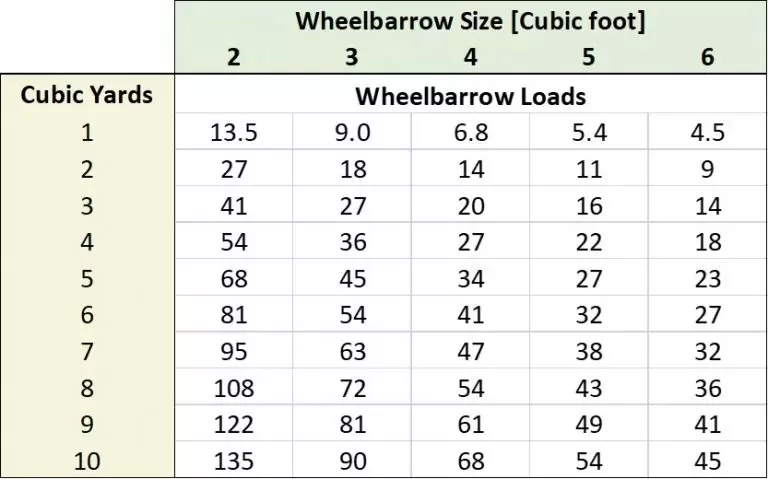
Table: Estimating Wheelbarrow Trips for Common Mulch Needs
| Total Mulch Needed (Cubic Yards) | Approximate Wheelbarrow Trips (using 0.185 cu yd capacity) |
|---|---|
| 1 | 5.4 |
| 2 | 10.8 |
| 3 | 16.2 |
| 4 | 21.6 |
| 5 | 27 |
| 6 | 32.4 |
| 7 | 37.8 |
| 8 | 43.2 |
| 9 | 48.6 |
| 10 | 54 |
Always round up to the nearest whole wheelbarrow trip! It’s better to have a little extra than to run out halfway through.
Factors Affecting Mulch Coverage and Depth
The amount of mulch you need isn’t just about square footage and depth; other factors play a role in mulch coverage.
Varying Mulch Depths
While 3 inches is standard, you might choose a different depth:
- Shallow Beds (1-2 inches): Good for areas with existing, healthy mulch or for purely aesthetic reasons. You’ll need less mulch.
- Deeper Beds (4-5 inches): Beneficial for new beds, areas with significant weed problems, or in climates with extreme temperatures. You’ll need more mulch.
Mulch Type and Its Bulk Density
Different types of mulch have different densities and can expand or contract differently.
- Wood Chips/Bark: Generally good at holding their shape and provide excellent mulch coverage.
- Shredded Bark/Pine Needles: Can be lighter and fluffier, potentially requiring a bit more volume for the same coverage.
- Compost/Organic Matter: Denser and can compact more easily.
Mulch coverage also refers to how much area a bag or a cubic yard will cover at a specific depth. Most mulch suppliers will specify this. For example, a cubic yard of mulch might state it covers 108 sq ft at a 3-inch depth (this is based on the conversion: 1 cubic yard = 27 cubic feet. 27 cubic feet / 0.25 ft depth = 108 sq ft).
Lawn Mulching Guide: Best Practices
Applying mulch correctly is as important as calculating the amount.
Preparing the Area
- Weed: Remove all existing weeds from the area before mulching. Mulch can help prevent new weeds, but it won’t kill established ones.
- Water: Water the soil thoroughly before applying mulch. This helps the soil retain moisture.
- Edge: Create a clean edge for your beds if desired.
Applying the Mulch
- Start with Your Calculated Volume: Begin spreading the mulch using your wheelbarrow and shovel.
- Maintain Even Depth: Aim for a consistent 3-inch layer across the entire area. Use a ruler or a stick marked at 3 inches to check your depth as you go.
- Avoid the Crown of Plants: Keep mulch a few inches away from the base of trees and shrubs. Piling mulch against the trunk (called “mulch volcanoes”) can lead to rot, disease, and pest problems. This is a crucial aspect of proper garden mulch volume application.
- Spread Gently: Use a rake to spread the mulch evenly.
When to Replenish Mulch
Mulch breaks down over time. You’ll typically need to top it up or replace it every 6 to 12 months, depending on the type of mulch and your climate. Check the depth periodically.
Purchasing Mulch: Bags vs. Bulk
Understanding how you’ll buy mulch is key to accurate calculating mulch needs.
Mulch in Bags
- Convenience: Easy to transport for smaller jobs.
- Standard Bag Size: Typically contains 2 or 3 cubic feet of mulch.
- Calculation: If a bag contains 2 cubic feet, and you need 10 cubic feet, you’ll need 10 / 2 = 5 bags.
- Note: Remember to convert your total cubic yard need to cubic feet for bag calculations (multiply cubic yards by 27).
Bulk Mulch Delivery
- Cost-Effective: Usually cheaper per cubic yard for larger quantities.
- Delivery Minimums: Many suppliers have minimum order requirements for bulk delivery.
- Calculation: You’ll order directly in cubic yards.
Common Mistakes to Avoid
- Underestimating Depth: Many people spread mulch too thinly, reducing its benefits.
- Overestimating Wheelbarrow Capacity: Assuming your wheelbarrow holds more than it does can lead to inaccurate trip counts.
- Ignoring Irregular Shapes: Not breaking down complex areas into simpler shapes can lead to measurement errors.
- Mulching Too Close to Trunks: This is a common and damaging mistake.
Frequently Asked Questions (FAQ)
Q: How do I calculate mulch for a sloped area?
A: For sloped areas, you might want to use a slightly thicker mulch layer (around 4 inches) to prevent erosion. The basic calculation of area times depth still applies, but consider the potential for the mulch to shift and adjust your depth accordingly.
Q: Can I mix different types of mulch?
A: Yes, you can mix different types of mulch. For instance, you might use a cheaper bulk mulch as a base layer and a more attractive, higher-quality mulch as the top dressing for better aesthetics.
Q: How much mulch do I need to cover 100 square feet at 3 inches?
A: To cover 100 square feet at a 3-inch depth, you will need 0.93 cubic yards of mulch (100 sq ft x 0.25 ft = 25 cu ft; 25 cu ft / 27 cu ft/cu yd = 0.93 cu yd). It’s best to buy 1 cubic yard.
Q: What is the average volume of a wheelbarrow?
A: The average volume of a contractor-style wheelbarrow is typically between 4 to 6 cubic feet. It’s always best to check the manufacturer’s specifications or measure your own if possible.
Q: Does mulch volume change after it rains?
A: Mulch can absorb water, making it heavier and potentially appearing to fill the space more, but its actual volume won’t significantly change due to rain alone. However, heavy rain can cause mulch to compact and erode from slopes.
By following these steps and using a mulch calculator, you can confidently determine how much mulch do I need, ensuring your lawn mulching guide is a success and your yard looks its best with proper mulch for landscaping. Happy mulching!