
What is a yard of mulch, and how much do I need? A yard of mulch refers to a volume measurement, specifically one cubic yard. This is the standard unit used for purchasing bulk mulch and helps you calculate how much landscape mulch you’ll need to cover your garden beds.
Mulch is a gardener’s best friend. It keeps weeds down, retains soil moisture, and makes your garden look neat and tidy. But buying mulch can be a bit tricky. If you buy too little, you’ll have bare spots. If you buy too much, you’ll have overflowing piles. Knowing how to measure a yard of mulch correctly ensures you get just the right amount for your project.
This guide will walk you through everything you need to know, from basic measurements to helpful pro tips. We’ll cover how to calculate your needs for different areas, convert common measurements, and use handy tools like a mulch calculator to make the process even easier. Let’s get started on calculating mulch!
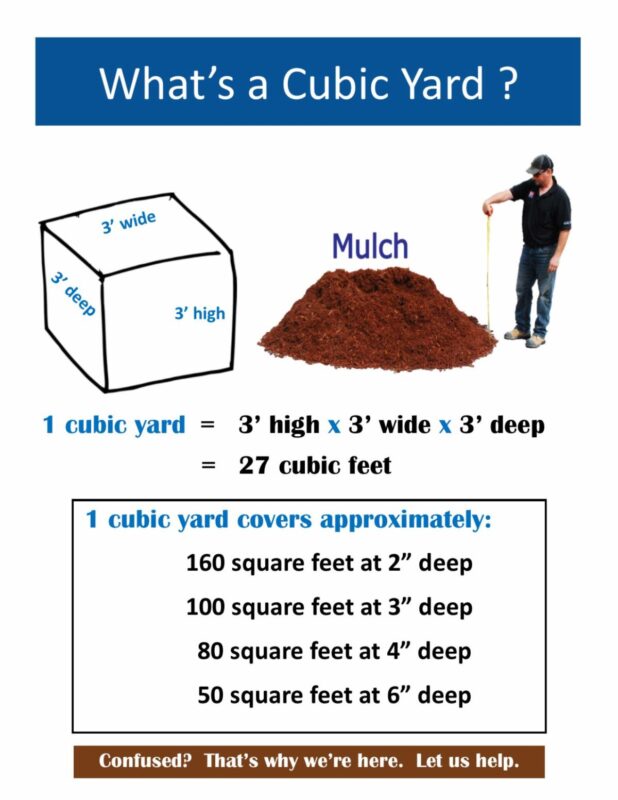
Image Source: stonegarden-nc.com
Why Accurate Mulch Measurement Matters
Getting the right amount of mulch is more than just avoiding a trip back to the garden center. It impacts your garden’s health, your budget, and the overall aesthetic of your landscape.
- Optimal Plant Health: The correct mulch depth is crucial for plants. Too thin, and it won’t suppress weeds or retain moisture effectively. Too thick, and it can suffocate roots by preventing air and water from reaching them.
- Cost Efficiency: Buying mulch in bulk is usually more economical than buying individual bags. However, ordering too much bulk mulch means you’re paying for material you won’t use, which can be a significant expense. Conversely, ordering too little means you’ll have to make another purchase, often at a higher per-unit cost, and spend more time and effort on delivery and spreading.
- Aesthetic Appeal: A well-mulched garden looks polished. Consistent and appropriate mulch coverage creates a uniform and attractive appearance across your landscape beds. Uneven or insufficient mulch can make your garden look unfinished or neglected.
- Time Savings: accurately measuring avoids the hassle of extra trips, extra work spreading unwanted material, or the frustration of needing more mulch mid-project.
Fathoming the Basics: Understanding Volume
When we talk about mulch, we’re talking about volume. This means we need to consider three dimensions: length, width, and depth.
- Length: How long is the area you want to cover?
- Width: How wide is the area you want to cover?
- Depth: How thick do you want the mulch layer to be?
The standard unit for purchasing mulch in bulk is the cubic yard mulch. This is a measurement of volume.
What is a Cubic Yard?
A cubic yard is a unit of volume in the imperial and U.S. customary systems. It’s a cube that measures 3 feet in length, 3 feet in width, and 3 feet in height.
1 Cubic Yard = 3 feet x 3 feet x 3 feet = 27 cubic feet
This is the fundamental measurement you’ll use when ordering bulk mulch. Many garden centers sell mulch by the cubic yard.
Converting Bagged Mulch to Cubic Yards
Most bagged mulch is sold in bags that cover a specific square footage at a certain depth. Knowing how to convert this to cubic yards is essential if you’re comparing prices or trying to estimate a bulk order.
A common bag size is 2 cubic feet. Let’s see how many bags make up a cubic yard:
- 1 cubic yard = 27 cubic feet
- If a bag contains 2 cubic feet of mulch, you’ll need 27 cubic feet / 2 cubic feet/bag = 13.5 bags to equal one cubic yard.
It’s often recommended to buy a little extra when using bags, as they can sometimes be compressed. So, for one cubic yard, you might aim for 14-15 bags.
Common Bag Coverage Rates
Many bags will state their coverage at a specific depth. For example, a 2 cubic foot bag might cover:
- 12 square feet at a depth of 2 inches.
- 8 square feet at a depth of 3 inches.
- 6 square feet at a depth of 4 inches.
To convert these coverage rates to cubic yards:
- Calculate the total cubic feet needed: Square footage x Depth (in feet)
- Convert cubic feet to cubic yards: Total cubic feet / 27 cubic feet per cubic yard
Example: You want to cover a bed that is 10 feet long and 4 feet wide with mulch 3 inches deep.
- Area: 10 feet x 4 feet = 40 square feet
- Depth in feet: 3 inches / 12 inches/foot = 0.25 feet
- Total cubic feet needed: 40 square feet x 0.25 feet = 10 cubic feet
- Total cubic yards needed: 10 cubic feet / 27 cubic feet/yard = 0.37 cubic yards
Since you can’t usually buy fractions of a cubic yard, you’d likely round up and order 0.5 cubic yards (which is half a yard).
Table: Common Bag Conversion Estimates
This table provides a general idea of how many 2 cubic foot bags you might need for one cubic yard, assuming an average mulch coverage at a common depth. Always check the specific bag for its coverage details.
| Mulch Depth | Square Feet Covered Per 2 cu. ft. Bag | Number of 2 cu. ft. Bags for 1 Cubic Yard (27 cu. ft.) |
|---|---|---|
| 2 inches | 12 sq. ft. | ~14 bags |
| 3 inches | 8 sq. ft. | ~20 bags (Note: This is higher than the general 13.5 as it implies a denser bag or is a common manufacturer estimate.) |
| 4 inches | 6 sq. ft. | ~27 bags |
Note: These are approximate numbers. Always verify the coverage stated on the bag.
Calculating Mulch Needs for Your Garden Beds
The most accurate way to measure for mulch is to calculate the soil volume required for your specific garden areas. This involves measuring the dimensions of each area you plan to mulch.
Step-by-Step Measurement Process
-
Measure the Area:
- For rectangular or square beds, measure the length and width in feet.
- For irregularly shaped beds, you can break them down into simpler shapes (rectangles, triangles, circles) and calculate the area of each, then add them together.
- Rectangle/Square: Area = Length x Width
- Circle: Area = π * (radius)² (where radius is half the diameter)
- Triangle: Area = 0.5 * base * height
-
Determine Desired Mulch Depth:
- The ideal mulch depth is typically 2 to 3 inches for most garden beds.
- For new plantings, 3 to 4 inches can be beneficial.
- Avoid piling mulch against the stems or trunks of plants, as this can lead to rot and disease.
-
Convert Depth to Feet:
- Since your length and width are in feet, you need to convert your desired mulch depth from inches to feet.
- Divide the depth in inches by 12.
- For 2 inches: 2 / 12 = 0.167 feet
- For 3 inches: 3 / 12 = 0.25 feet
- For 4 inches: 4 / 12 = 0.333 feet
-
Calculate Volume in Cubic Feet:
- Multiply the total area (in square feet) by the desired depth (in feet).
- Volume (cubic feet) = Area (sq. ft.) x Depth (ft.)
-
Convert Cubic Feet to Cubic Yards:
- Divide the total volume in cubic feet by 27 (since there are 27 cubic feet in 1 cubic yard).
- Volume (cubic yards) = Volume (cubic feet) / 27
Example Calculation: Rectangular Bed
Let’s say you have a flower bed that is 20 feet long and 5 feet wide, and you want to apply mulch 3 inches deep.
- Area: 20 feet x 5 feet = 100 square feet
- Depth in feet: 3 inches / 12 inches/foot = 0.25 feet
- Volume (cubic feet): 100 sq. ft. x 0.25 ft = 25 cubic feet
- Volume (cubic yards): 25 cubic feet / 27 cubic feet/yard = 0.926 cubic yards
Since you can’t order 0.926 cubic yards, you would round up to 1 cubic yard of mulch.
Example Calculation: Irregularly Shaped Bed
Imagine a bed shaped like a semi-circle with a diameter of 10 feet, plus an adjacent rectangle that is 8 feet long and 4 feet wide. You want mulch 2 inches deep.
Part 1: Semi-circle
- Radius = Diameter / 2 = 10 feet / 2 = 5 feet
- Area of a full circle = π * (radius)² = 3.14159 * (5 ft)² = 3.14159 * 25 sq. ft. = 78.54 sq. ft.
- Area of the semi-circle = 78.54 sq. ft. / 2 = 39.27 sq. ft.
Part 2: Rectangle
- Area = Length x Width = 8 feet x 4 feet = 32 sq. ft.
Total Area: 39.27 sq. ft. (semi-circle) + 32 sq. ft. (rectangle) = 71.27 sq. ft.
Desired Depth: 2 inches = 2 / 12 = 0.167 feet
Volume (cubic feet): 71.27 sq. ft. x 0.167 ft = 11.90 cubic feet
Volume (cubic yards): 11.90 cubic feet / 27 cubic feet/yard = 0.44 cubic yards
In this case, you would round up to 0.5 cubic yards of mulch.
Using a Mulch Calculator
For quick estimates or complex shapes, a mulch calculator can be a lifesaver. These online tools typically ask for the dimensions of your area (length, width, and desired depth) and automatically compute the cubic yards needed.
Many garden supply websites and landscaping resources offer free mulch calculators. Simply search for “mulch calculator” online, and you’ll find several options. They work by performing the calculations we’ve just discussed behind the scenes.
Pro Tips for Measuring and Ordering Mulch
Beyond the basic calculations, here are some tips from experienced gardeners and landscapers to ensure you get it right:
1. Account for Compaction and Settling
Mulch, especially organic types like wood chips or bark, will settle and compact over time. It also decomposes. When you first spread it, it might look a bit higher than your target depth.
- Recommendation: Add an extra 10-15% to your calculated amount to account for settling. If your calculation comes out to 1 cubic yard, consider ordering 1.1 to 1.2 cubic yards.
2. Consider the Mulch Type
Different mulch types have different densities and behaviors:
- Wood Chips/Bark: These are common and generally good for most applications. They can be bulky when dry but settle with moisture.
- Shredded Bark: Finer than wood chips, they can compact more easily and might require a slightly deeper application initially.
- Pine Needles/Straw: These are lighter and don’t compact as much. They provide good aeration.
- Compost/Soil Amendments: If you’re using compost as a top dressing, it will break down more quickly and might need replenishment sooner.
The mulch coverage rate can slightly vary based on the material’s consistency.
3. Know Your Delivery Options
- Bulk Delivery: When ordering in large quantities (typically 1 cubic yard or more), mulch is delivered in a large truck and often dumped in your driveway or a designated spot.
- Pro Tip: Have a tarp ready to place where the mulch will be dumped. This makes it easier to move the mulch and keeps your driveway cleaner.
- Pro Tip: Communicate clearly with the delivery service about the best access point to your property.
- Bagged Mulch: Convenient for smaller projects or if you need precise amounts for specific areas.
- Pro Tip: Keep track of how many bags you’ve used. A standard bag of mulch often covers a smaller area, so for larger projects, bulk is usually more cost-effective.
4. Measure Before You Buy, Not After
It’s tempting to eyeball it, but this is where most mistakes happen. Always measure your garden beds before heading to the supplier or placing an order.
5. Consistent Mulch Depth is Key for Spreading Mulch
When you’re actually spreading mulch, aim for an even layer. This ensures uniform moisture retention and weed suppression. Use a rake to distribute the material evenly.
- Pro Tip: Start by spreading the mulch to roughly your target depth and then go back over the area to fill in any thin spots or level out thick areas.
6. Think About Future Needs
If you have a large property, you might be ordering several cubic yards. It’s often more economical to order all your mulch at once to save on delivery fees.
7. Use a Consistent Unit of Measurement
When you’re measuring your garden beds, stick to feet for length and width, and inches for depth. This makes the conversion to cubic yards straightforward.
8. Don’t Forget Edging
If your garden beds have defined edges, measure the length of these edges. This will help you determine the perimeter of the area you need to cover.
Common Pitfalls to Avoid
- Eyeballing it: This is the most common mistake. Always measure!
- Forgetting depth: Only measuring length and width gives you square footage, not the volume of mulch needed.
- Not converting units: Mixing feet and inches without proper conversion will lead to incorrect calculations.
- Under-ordering: It’s almost always better to have a little extra mulch than not enough.
- Over-ordering: While better than under-ordering, excessive leftover mulch is wasteful.
Frequently Asked Questions (FAQ)
Q1: How much mulch is in a cubic yard?
A1: A cubic yard is a unit of volume equivalent to 27 cubic feet. It’s a cube measuring 3 feet by 3 feet by 3 feet.
Q2: Can I just guess how much mulch I need?
A2: While tempting, guessing is not recommended. Measuring your garden beds and using calculations or a mulch calculator ensures you buy the right amount, saving you time and money.
Q3: What is a typical mulch depth for garden beds?
A3: The ideal mulch depth for most garden beds is 2 to 3 inches. This depth effectively suppresses weeds, retains moisture, and insulates the soil without harming plant roots.
Q4: How many bags of mulch make a cubic yard?
A4: This depends on the size of the bag. A common 2 cubic foot bag of mulch requires about 13.5 to 14 bags to equal one cubic yard (27 cubic feet). Always check the coverage information on the bag for accuracy.
Q5: What if my garden bed is an unusual shape?
A5: You can break down irregular shapes into simpler geometric figures like rectangles, squares, circles, or triangles. Calculate the area of each section and then add them together to get your total square footage. Online mulch calculator tools can also help with complex shapes.
Q6: Does the type of mulch affect how much I need?
A6: Yes, slightly. Bulkier materials like wood chips might take up more space initially, while finer materials like shredded bark or compost can compact more. However, the primary measurement remains cubic yards for landscape mulch. The desired mulch depth is the most critical factor.
Q7: What does “mulch coverage” mean?
A7: Mulch coverage refers to the area (in square feet) that a specific amount of mulch (like a bag or a cubic yard) will cover at a given depth. Manufacturers usually provide this information on the product packaging.
Q8: Is it better to buy mulch in bags or in bulk?
A8: For larger areas, bulk mulch is generally more cost-effective and convenient for delivery. For smaller gardens or specific, isolated beds, bagged mulch might be more practical and easier to manage.
Q9: How do I convert square feet to cubic yards for mulch?
A9: First, determine the area of your garden bed in square feet and the desired mulch depth in feet (inches divided by 12). Multiply the area by the depth to get the volume in cubic feet. Then, divide the cubic feet by 27 to convert it into cubic yards.
Q10: What are some good resources for calculating mulch?
A10: Many garden centers, landscaping supply companies, and gardening websites offer free online mulch calculator tools. These are excellent resources for quickly estimating your needs.
By following these steps and tips, you can confidently measure and order the correct amount of mulch for your next gardening project. Happy mulching!