
How much does a yard of mulch cover? A cubic yard of mulch typically covers about 100-150 square feet at a depth of 2-3 inches. This guide will help you accurately determine your mulch needs.
Knowing how much mulch you need is crucial for a healthy and attractive landscape. Too little mulch and your plants won’t get the full benefits, while too much can be wasteful and even harmful. This comprehensive guide will walk you through the simple steps of calculating your mulch quantity, ensuring you buy just the right amount for your garden beds and planting areas. We’ll cover everything from measuring your space to converting those measurements into the cubic yards of mulch you’ll need.
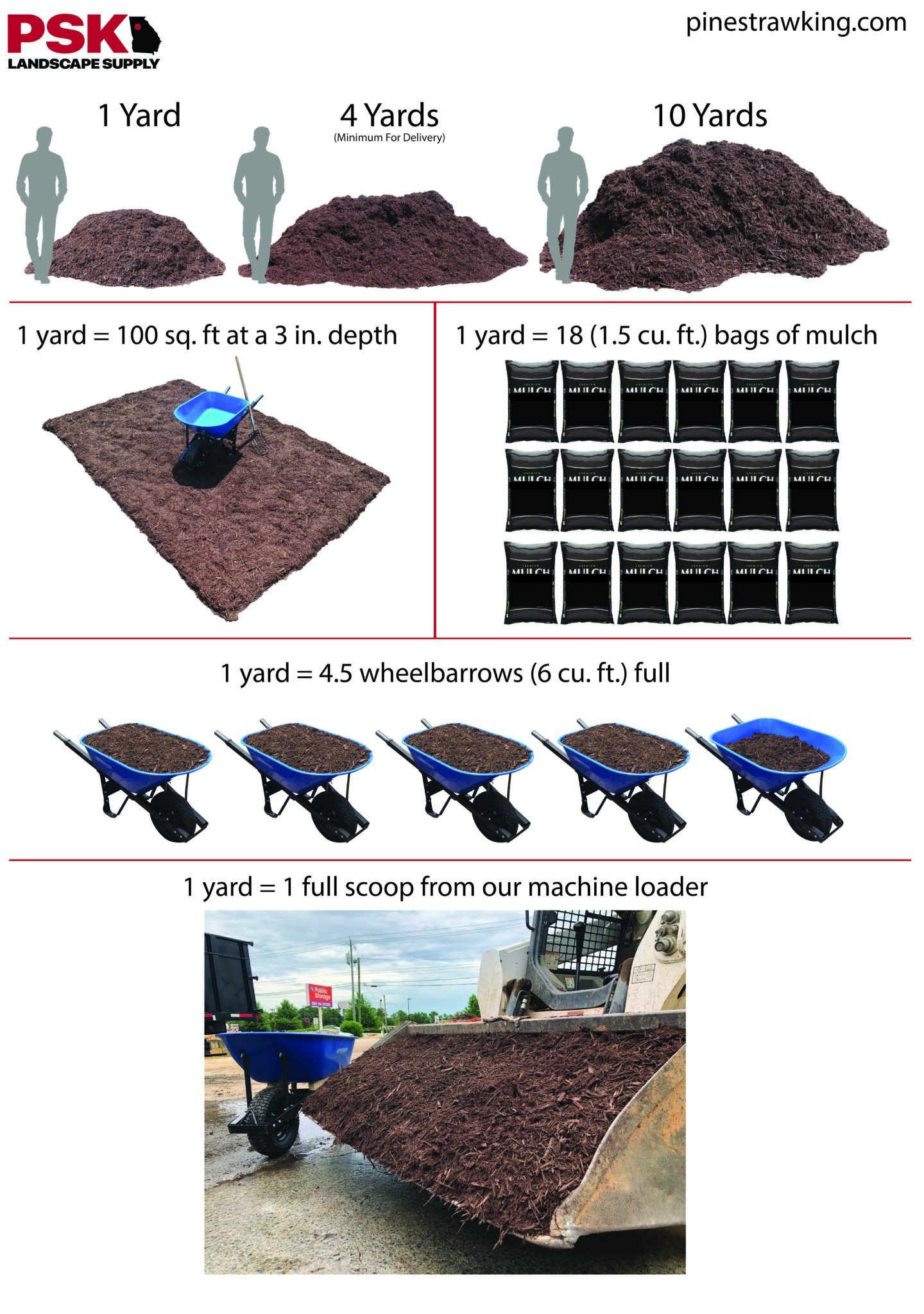
Image Source: pinestrawking.com
Measuring Your Mulch Project
Before you can figure out how much mulch to buy, you need to know the size of the area you want to cover. This is usually a straightforward process, but precision is key.
Calculating Area in Square Feet
Most landscaping projects involve irregular shapes, but we can break them down into simpler geometric forms. The most common shapes are rectangles and circles.
Rectangular Areas
To find the area of a rectangle, you simply multiply its length by its width.
- Formula: Area = Length × Width
Example: If you have a garden bed that is 10 feet long and 4 feet wide, its area is 10 feet × 4 feet = 40 square feet.
Circular Areas
For circular areas, like around a tree or a round garden bed, you’ll need to find the radius first. The radius is the distance from the center of the circle to its edge.
- Formula: Area = π × radius² (where π is approximately 3.14)
Example: If a tree has a drip line (the area where water drips from the leaves) that forms a circle with a diameter of 6 feet, the radius is 3 feet (diameter divided by 2). The area would be 3.14 × (3 feet)² = 3.14 × 9 square feet = 28.26 square feet.
Irregular Shapes
For more complex shapes, break them down into smaller, manageable geometric shapes (rectangles, squares, triangles, semi-circles). Calculate the area of each smaller shape and then add them all together.
- Tip: Use a long measuring tape to get accurate measurements of your garden beds. It’s better to measure twice and cut (or buy) once!
Determining the Ideal Mulch Depth
The depth at which you apply mulch significantly impacts its effectiveness and how far it will spread. Different types of mulch and different landscaping goals might suggest different depths.
Standard Mulch Depths
- General Garden Beds: 2-3 inches is a good starting point for most decorative mulches. This depth provides effective weed suppression and moisture retention without suffocating plant roots.
- Around Trees: 3-4 inches is often recommended for trees, but it’s crucial to keep mulch a few inches away from the trunk (creating a “mulch-free zone”) to prevent rot and pest issues. This is sometimes called “tree mulching.”
- Erosion Control: In areas prone to erosion, a slightly deeper layer might be beneficial, but always check the specific recommendations for the mulch type.
Why Mulch Depth Matters
- Weed Control: Thicker mulch layers are more effective at blocking sunlight, preventing weed seeds from germinating.
- Moisture Retention: Mulch acts like a blanket, reducing evaporation from the soil surface, which means less watering for you.
- Temperature Regulation: It insulates the soil, keeping it cooler in the summer and warmer in the winter, protecting plant roots from extreme temperature swings.
- Soil Health: As organic mulches decompose, they add nutrients and improve soil structure.
Calculating Mulch Quantity: The Math Behind It
Now that you know the area you need to cover and the desired depth, it’s time to do the math to determine how much mulch you actually need in cubic yards.
Converting Inches to Feet
Since area is measured in square feet, we need to convert our mulch depth from inches to feet. There are 12 inches in a foot.
- Formula: Depth in Feet = Depth in Inches / 12
Example: If you want a 3-inch mulch layer: 3 inches / 12 inches/foot = 0.25 feet.
Calculating Volume in Cubic Feet
Volume is calculated by multiplying the area (in square feet) by the depth (in feet). This gives you the total volume needed in cubic feet.
- Formula: Volume (cubic feet) = Area (square feet) × Depth (feet)
Example: For a garden bed that is 100 square feet and you want a 3-inch (0.25 feet) mulch layer: 100 square feet × 0.25 feet = 25 cubic feet.
Converting Cubic Feet to Cubic Yards
Mulch is sold by the cubic yard. There are 27 cubic feet in one cubic yard (3 feet × 3 feet × 3 feet = 27 cubic feet).
- Formula: Cubic Yards = Volume (cubic feet) / 27
Example: Continuing with the previous example, where you need 25 cubic feet of mulch: 25 cubic feet / 27 cubic feet/cubic yard = 0.93 cubic yards.
Using a Mulch Coverage Calculator
While doing the calculations manually is helpful for grasping the concepts, using a mulch coverage calculator can save you time and ensure accuracy. Many online gardening and landscaping websites offer these tools. You simply input your area’s square footage and the desired mulch depth, and the calculator will tell you how many cubic yards of mulch you need. Some calculators can even estimate how many bags of mulch you’ll require.
How a Mulch Calculator by Square Foot Works
A typical mulch calculator by square foot uses the same formulas we discussed. You’ll input:
- Area: The total square footage of the area to be mulched.
- Depth: The desired depth of mulch, usually in inches.
The calculator then performs the conversions and provides the result in cubic yards.
Estimating Mulch Needs: Practical Examples
Let’s work through a few scenarios to solidify your mulch quantity calculation.
Scenario 1: A Rectangular Garden Bed
- Dimensions: 15 feet long x 5 feet wide
- Desired Depth: 3 inches
- Calculate Area: 15 ft × 5 ft = 75 sq ft
- Convert Depth to Feet: 3 inches / 12 = 0.25 ft
- Calculate Volume in Cubic Feet: 75 sq ft × 0.25 ft = 18.75 cubic ft
- Convert to Cubic Yards: 18.75 cubic ft / 27 cubic ft/yard = 0.69 cubic yards
You would need approximately 0.75 cubic yards of mulch for this bed to be safe, as you often can’t buy fractions of a yard and it’s good to have a little extra.
Scenario 2: A Circular Planting Area
- Diameter: 8 feet
- Desired Depth: 4 inches
- Calculate Radius: 8 ft / 2 = 4 ft
- Calculate Area: 3.14 × (4 ft)² = 3.14 × 16 sq ft = 50.24 sq ft
- Convert Depth to Feet: 4 inches / 12 = 0.33 ft
- Calculate Volume in Cubic Feet: 50.24 sq ft × 0.33 ft = 16.58 cubic ft
- Convert to Cubic Yards: 16.58 cubic ft / 27 cubic ft/yard = 0.61 cubic yards
For this area, you’d likely want to purchase 0.75 cubic yards of mulch.
Scenario 3: Multiple Beds and Pathways
Let’s say you have several areas:
- Bed A: 20 ft x 6 ft = 120 sq ft
- Bed B: 10 ft x 4 ft = 40 sq ft
- Tree Circle (Diameter 10 ft): Radius 5 ft, Area = 3.14 × 5² = 78.5 sq ft
Total Area: 120 sq ft + 40 sq ft + 78.5 sq ft = 238.5 sq ft
Desired Depth: 3 inches (0.25 ft)
- Calculate Total Volume in Cubic Feet: 238.5 sq ft × 0.25 ft = 59.63 cubic ft
- Convert to Cubic Yards: 59.63 cubic ft / 27 cubic ft/yard = 2.21 cubic yards
In this case, you would need at least 2.25 to 2.5 cubic yards of mulch. It’s wise to round up to the nearest half or full yard to account for settling and any missed spots.
Bagged Mulch vs. Bulk Mulch
Mulch is typically sold in two ways: bagged mulch and bulk mulch. Knowing the difference and how to calculate your needs for each is important.
Bagged Mulch
Bagged mulch is convenient for smaller projects. The bags usually state their volume, often in cubic feet.
How Many Bags of Mulch Do I Need?
To figure out how many bags of mulch you need, you first need to know the volume of mulch in each bag. This is usually listed on the packaging.
- Common Bag Sizes: Bags can range from 1 cubic foot to 3 cubic feet.
Example: If you need 2 cubic yards of mulch and each bag contains 2 cubic feet:
- Convert Cubic Yards to Cubic Feet: 2 cubic yards × 27 cubic ft/yard = 54 cubic ft
- Calculate Number of Bags: 54 cubic ft / 2 cubic ft/bag = 27 bags
Mulch Coverage Per Bag
You can also think about it in terms of mulch coverage per bag. If a bag is 2 cubic feet and you’re applying a 3-inch (0.25 ft) depth, then:
- Coverage per Bag (cubic feet): 2 cubic ft
- Coverage per Bag (square feet): 2 cubic ft / 0.25 ft depth = 8 sq ft per bag.
If you have a 100 sq ft area needing 3-inch depth, you’d need 100 sq ft / 8 sq ft/bag = 12.5 bags. So, you’d buy 13 bags. This is a useful way to quickly estimate when buying bags.
Bulk Mulch
Bulk mulch is sold by the cubic yard and is usually more cost-effective for larger projects. It’s delivered by a truck and dumped in a convenient spot in your yard.
Calculating Cubic Yards of Mulch
The calculations we’ve covered so far directly address cubic yards of mulch. When you buy in bulk, you’ll typically order in increments of half or full cubic yards. Always round up to ensure you have enough.
Types of Mulch and Their Coverage
Different mulch materials have different densities and particle sizes, which can slightly affect their coverage, though the standard depth recommendations generally apply.
Wood Mulches (Chips, Bark, Shredded)
- Characteristics: Common, durable, good weed suppression and moisture retention.
- Coverage: Generally consistent, follow standard depth guidelines. Fine-textured mulches might settle slightly more than larger chips.
Organic Mulches (Compost, Pine Straw)
- Compost: Rich in nutrients, improves soil as it decomposes. Can be finer textured.
- Pine Straw: Lightweight, good for slopes, decomposes slowly. Landscape mulch calculation for pine straw might consider its tendency to blow around if not applied properly.
Inorganic Mulches (Gravel, Stone)
- Characteristics: Permanent, decorative, do not decompose. Require a different approach to determining mulch needs as they are not about soil improvement but ground cover.
- Coverage: Stone and gravel are usually sold by the cubic yard or by weight. Coverage varies significantly by stone size and type. A general rule of thumb for gravel is about 1 cubic yard covers 100-150 sq ft at a 2-inch depth.
Common Mistakes to Avoid When Calculating Mulch
Even with a good guide, mistakes can happen. Here are some common pitfalls:
- Underestimating Depth: Applying mulch too thinly means it won’t provide full benefits. Always aim for the recommended depth.
- Overestimating Depth: Applying mulch too deeply can suffocate roots and create a barrier that prevents water from reaching the soil.
- Forgetting to Convert Units: Mixing inches and feet in your calculations is a recipe for error. Always convert everything to the same unit before multiplying.
- Not Accounting for Settling: Organic mulches, especially fine-textured ones, will compact and settle over time. It’s wise to buy slightly more than your exact calculation.
- Ignoring Irregular Shapes: Trying to estimate irregular areas without breaking them down will lead to inaccurate measurements.
Frequently Asked Questions (FAQ)
Q1: How many square feet does one cubic yard of mulch cover?
A: One cubic yard of mulch will cover approximately 100-150 square feet at a depth of 2-3 inches.
Q2: What is the ideal mulch depth for garden beds?
A: For most garden beds, an ideal mulch depth is 2-3 inches.
Q3: How do I calculate mulch for garden beds with irregular shapes?
A: Break down irregular shapes into smaller, standard geometric shapes (rectangles, circles, triangles), calculate the area of each, and then add them together to get your total square footage.
Q4: If I buy mulch in bulk, how is it measured?
A: Bulk mulch is typically measured and sold by the cubic yard.
Q5: How can I quickly estimate how many bags of mulch I need?
A: Find out the cubic feet of mulch per bag from the packaging. Then, calculate the total cubic feet of mulch you need (Area in sq ft x Depth in ft) and divide that by the cubic feet per bag.
Q6: What is the mulch coverage per bag if a bag is 2 cubic feet and I want 3 inches of depth?
A: If a bag is 2 cubic feet and you want 3 inches (0.25 feet) of depth, the bag covers 2 cubic ft / 0.25 ft = 8 square feet.
Conclusion: Enjoy Your Beautiful, Mulched Landscape!
Calculating your mulch needs doesn’t have to be complicated. By following these steps – measuring your area accurately, deciding on the right mulch depth, and performing the simple volume calculations – you can confidently purchase the perfect amount of mulch for your next landscaping project. Whether you’re using a mulch coverage calculator, figuring out how many bags of mulch you require, or ordering cubic yards of mulch in bulk, having the right quantity ensures your plants thrive and your garden looks its best. Happy mulching!