
So, how many bags of cement in a yard? Generally, you’ll need about 6 to 9 bags of standard 94-pound (42.6 kg) cement for a cubic yard of concrete, depending on the mix. This guide will help you figure out the exact cement quantity for concrete projects, whether you’re pouring a cement for concrete slab or building a cement for foundation. We’ll cover the cement bags per cubic yard calculation, discuss estimating cement needs, and provide insights into calculating cement for construction.
When you’re planning a construction project, whether it’s a small patio or a large foundation, knowing how much material you need is key. One of the most fundamental materials is cement. Many DIYers and even some professionals wonder about the precise amount of cement required. This article aims to demystify the process of determining how many bags of cement go into a cubic yard of concrete. We’ll break down the factors that influence this number, offer practical calculation methods, and provide examples to ensure you have a clear picture of your cement quantity for concrete.
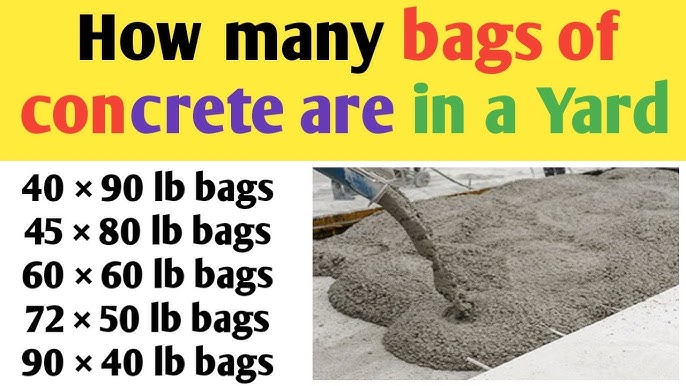
Image Source: i.ytimg.com
Fathoming Cement Needs: The Basics
At its core, concrete is a mixture of cement, aggregates (like sand and gravel), and water. Cement acts as the binder, the “glue” that holds everything together when it reacts with water. The amount of cement used directly impacts the strength and durability of the final concrete. Too little cement can result in weak concrete, while too much can be wasteful and can even lead to cracking.
Cement Bags Per Cubic Yard: A General Idea
The number of cement bags per cubic yard isn’t a fixed figure; it varies based on the desired strength of the concrete. This strength is often described by its compressive strength, measured in pounds per square inch (psi). Common concrete mixes for residential use range from 2500 psi to 4000 psi.
- For a 2500 psi mix: You might use around 5 bags of 94-pound cement per cubic yard.
- For a 3000 psi mix: Expect to use approximately 6 bags per cubic yard.
- For a 4000 psi mix: You’ll likely need about 7 to 8 bags per cubic yard.
It’s important to remember that these are approximations. The exact ratio of cement to other ingredients is crucial.
How Much Cement For 1 Yard Of Concrete: The Mix Ratio
The recipe for concrete is critical. This recipe is known as the concrete mix ratio, and it’s usually expressed as a series of numbers representing the proportions of cement, sand, and gravel (or coarse aggregate) by volume. A common starting point for a general-purpose concrete mix (around 3000 psi) is a 1:2:3 ratio. This means:
- 1 part Cement
- 2 parts Sand (fine aggregate)
- 3 parts Gravel (coarse aggregate)
Let’s delve into how this translates to actual volumes and bag counts.
Deciphering the Mix Ratio: Volume Calculations
To figure out how much cement for 1 yard of concrete, we need to understand how these parts convert to volume and then to bag weights. A standard bag of Portland cement weighs 94 pounds and has a volume of approximately 1 cubic foot when loose.
Consider our 1:2:3 mix ratio. The total parts in this mix are 1 + 2 + 3 = 6 parts.
If 1 part is cement, and we assume each part has a volume that, when dry, adds up to the final concrete volume (this is a simplification, as the actual volume of concrete produced is less than the sum of the dry ingredients due to voids and the chemical reaction of cement with water), we can make some estimates.
For one cubic yard of concrete (which is 27 cubic feet):
- Cement: 1 part of the mix.
- Sand: 2 parts of the mix.
- Gravel: 3 parts of the mix.
In our 1:2:3 ratio, cement makes up 1/6th of the total dry volume. If we assume this roughly corresponds to the final volume, then we would need approximately 1/6th of a cubic yard of cement.
Since 1 cubic foot of loose cement is roughly equal to one 94-pound bag:
- 1 cubic yard = 27 cubic feet.
- If cement is 1/6th of the volume, then 27 cubic feet / 6 = 4.5 cubic feet of cement.
- This would mean approximately 4.5 bags of cement.
However, this calculation is too simplistic. It doesn’t account for the fact that the volumes of sand and gravel are measured in bulk, and there are inefficiencies in packing. A more practical approach considers standard concrete mix designs where the amount of cement is specified per cubic yard.
Estimating Cement Needs: Practical Approaches
When estimating cement needs, builders and contractors often refer to established mix designs or use concrete calculators.
Standard Mix Designs and Bag Counts
Reputable concrete suppliers and construction guides provide standard mix designs. These are based on extensive testing and ensure predictable performance. For a typical 3000-psi concrete mix, it’s common to use between 564 to 650 pounds of cement per cubic yard.
Let’s do the math with a 94-pound bag:
- If you need 564 pounds of cement per cubic yard: 564 lbs / 94 lbs/bag ≈ 6 bags.
- If you need 650 pounds of cement per cubic yard: 650 lbs / 94 lbs/bag ≈ 6.9 bags.
This aligns with our initial estimate of 6 to 9 bags, with 6-7 bags being very common for standard mixes.
Using a Cement Calculator
To simplify calculating cement for construction, many online cement calculator tools are available. These calculators typically ask for:
- The dimensions of the project: Length, width, and depth (or height).
- The desired concrete strength (psi): This helps determine the mix ratio.
- The type of project: (e.g., slab, footing, post).
The calculator then uses pre-programmed mix designs to estimate the total volume of concrete needed and the required amount of cement, sand, gravel, and water.
Example:
Let’s say you need to pour a concrete slab that is 10 feet long, 10 feet wide, and 4 inches thick.
- Volume in cubic feet: 10 ft * 10 ft * (4/12) ft = 33.33 cubic feet.
- Volume in cubic yards: 33.33 cubic feet / 27 cubic feet/cubic yard = 1.23 cubic yards.
If a standard mix requires 6 bags of cement per cubic yard, then for 1.23 cubic yards, you would need:
- 1.23 cubic yards * 6 bags/cubic yard = 7.38 bags.
It’s always wise to round up to the nearest whole bag (so, 8 bags in this case) to account for any minor inaccuracies in measurement or slight over-mixing.
How Many Bags Of Cement In A Yard: Factors to Consider
Several factors influence the exact number of cement bags in a yard of concrete:
1. Concrete Strength (PSI)
Higher strength concrete requires a richer mix, meaning more cement per unit volume. A sidewalk might use a 2500-3000 psi mix, while a foundation for a multi-story building could require 4000 psi or more.
- Lower PSI (e.g., 2500): Fewer bags of cement (around 5-6 per cubic yard).
- Higher PSI (e.g., 4000): More bags of cement (around 7-9 per cubic yard).
2. Mix Ratio (Cement:Sand:Gravel)
As we discussed, different ratios yield different strengths. A 1:2:3 ratio will use less cement than a 1:1.5:2.5 ratio for the same volume.
3. Water-to-Cement Ratio (W/C Ratio)
This is a crucial factor for concrete strength and durability. A lower W/C ratio generally results in stronger, more durable concrete but can make the mix harder to work with. The amount of water needed depends on the moisture content of the aggregates.
- Lower W/C ratio: Generally requires more cement for workability, leading to more bags per yard.
- Higher W/C ratio: Requires less cement but can result in weaker concrete.
4. Aggregate Type and Size
The shape, size, and grading of aggregates (sand and gravel) affect the amount of cement paste needed to fill the voids and coat the aggregate particles. Well-graded aggregates with fewer voids require less cement.
5. Workability (Slump)
Workability refers to how easily the concrete can be mixed, placed, consolidated, and finished. A higher slump (more flowable concrete) often requires more cement or water-reducing admixtures.
6. Admixtures
Admixtures are chemicals added to concrete to modify its properties. They can improve workability, accelerate or retard setting, increase strength, or enhance durability. Some admixtures might influence the cement content required.
Bags of Cement for Foundation Projects
When pouring a foundation, the bags of cement for foundation work are critical because foundations bear the structural load of a building. This typically requires a stronger concrete mix, often in the 3000-4000 psi range.
For a typical residential foundation footing, a 1:2:3 or 1:2:4 mix might be used. For a foundation wall or slab, a richer mix might be specified.
Let’s estimate for a foundation:
- Project: Foundation footing (say, 50 linear feet of 16 inches wide by 8 inches deep trench).
- Volume: 50 ft * (16/12) ft * (8/12) ft = 44.44 cubic feet.
- Volume in cubic yards: 44.44 cubic feet / 27 cubic feet/cubic yard = 1.65 cubic yards.
- Estimated cement needed (using 7 bags/cubic yard for a 3500 psi mix): 1.65 cubic yards * 7 bags/cubic yard = 11.55 bags.
- Rounded up: 12 bags.
Always consult the structural engineer’s specifications for your foundation design, as they will dictate the exact concrete strength and mix requirements.
Cement Per Cubic Meter vs. Cement Per Cubic Yard
In many parts of the world, measurements are in metric units. A cement per cubic meter calculation is similar, but the units are different.
- 1 cubic meter (m³) is approximately equal to 1.31 cubic yards (yd³).
- 1 cubic meter is also approximately 35.31 cubic feet (ft³).
If a mix design specifies, for example, 300 kg of cement per cubic meter, and a bag of cement is 50 kg (common in metric regions):
- Number of bags per cubic meter = 300 kg / 50 kg/bag = 6 bags per cubic meter.
Using our earlier example of 6-9 bags per cubic yard:
- To convert bags per cubic yard to bags per cubic meter:
- 6 bags/yd³ * 1.31 yd³/m³ = 7.86 bags/m³
- 9 bags/yd³ * 1.31 yd³/m³ = 11.79 bags/m³
So, for metric regions, you might be looking at roughly 8 to 12 bags of 50 kg cement per cubic meter of concrete for general purposes.
Practical Tips for Calculating Cement Needs
- Always Measure Accurately: Double-check your dimensions (length, width, depth) for the project area.
- Use Standard Mix Ratios: When in doubt, refer to standard concrete mix ratios for the desired strength. A good starting point for general use is 1:2:3.
- Consider Wastage: Always add a little extra to your calculations (5-10%) to account for spills, over-mixing, or slight inaccuracies.
- Check Local Suppliers: Concrete suppliers often have calculators or can provide guidance on typical cement quantities for local conditions and common project types.
- Consult Project Plans: For structural elements like foundations or beams, always follow the specific mix designs provided by your engineer or architect.
Calculating Cement for a Concrete Slab
Pouring a cement for concrete slab is a common project. The thickness of the slab is a key variable.
- Thin Slabs (e.g., patios, sidewalks, 4 inches thick): Typically use mixes around 2500-3000 psi. Expect 5-7 bags of cement per cubic yard.
- Thicker Slabs (e.g., garage floors, structural slabs, 6 inches thick): May require 3000-4000 psi concrete. Expect 6-8 bags of cement per cubic yard.
Example for a 10ft x 10ft x 4-inch concrete slab:
We calculated this earlier as 1.23 cubic yards.
Using a 3000 psi mix requiring 6 bags per cubic yard:
1.23 yd³ * 6 bags/yd³ = 7.38 bags. Round up to 8 bags.
Example for a 10ft x 10ft x 6-inch concrete slab:
* Volume in cubic feet: 10 ft * 10 ft * (6/12) ft = 50 cubic feet.
* Volume in cubic yards: 50 cubic feet / 27 cubic feet/cubic yard = 1.85 cubic yards.
* Estimated cement needed (using 7 bags/cubic yard for a 3500 psi mix): 1.85 yd³ * 7 bags/yd³ = 12.95 bags.
* Rounded up: 13 bags.
Frequently Asked Questions (FAQ)
Q1: What is the typical number of 94lb cement bags in a cubic yard of concrete?
A1: Typically, you will need between 6 and 9 bags of 94lb cement per cubic yard of concrete, depending on the mix design and desired strength.
Q2: Can I use less cement than recommended?
A2: Using less cement than recommended will likely result in weaker concrete that may not meet the required strength or durability standards. It’s best to follow established mix designs or engineering specifications.
Q3: Who provides information on specific concrete mix designs?
A3: Structural engineers, architects, concrete suppliers, and construction material guides are good sources for specific concrete mix designs.
Q4: What is the difference between a 1:2:3 and a 1:3:4 concrete mix?
A4: A 1:2:3 mix has a higher proportion of cement to aggregate than a 1:3:4 mix. This means the 1:2:3 mix will generally produce stronger concrete but will require more cement per cubic yard.
Q5: How does water affect the cement calculation?
A5: The water-to-cement ratio is critical. Too much water weakens the concrete. While you need enough water to make the concrete workable, the amount is precisely controlled in mix designs, and this affects the total cement required for a given strength.
Q6: Do I need to account for the volume of the bags themselves?
A6: When calculating how many bags of cement in a yard, we assume a standard bag of cement weighs 94 lbs and occupies roughly 1 cubic foot of volume when loose. The calculations are based on the weight of cement needed for a cubic yard of concrete, which is then converted to the number of bags. The volume of the dry ingredients is what’s important for determining the final concrete volume, and the cement content is a key part of that recipe.
Q7: What if my project requires a very specific strength, like 5000 psi?
A7: For very high-strength concrete, you will need a much richer mix, potentially requiring 9-10 bags or more of cement per cubic yard. Always consult a concrete specialist or engineer for these requirements.
Q8: Can I buy pre-mixed concrete instead of calculating bags of cement?
A8: Yes, you can buy pre-mixed concrete (ready-mix concrete) delivered by truck. This is often the most convenient option for larger projects, as the supplier handles the precise mixing and quantities. However, for smaller projects, mixing your own concrete from bags of cement, sand, and gravel is common.
In conclusion, knowing how many bags of cement in a yard is essential for successful concrete projects. By understanding concrete mix ratios, consulting reliable sources, and using a cement calculator, you can accurately estimate your cement needs, whether you’re working on a small patio, a robust foundation, or any other construction endeavor. Always prioritize the specified mix ratios for the required strength and durability of your concrete work.