
A yard of concrete is measured by volume, specifically in cubic yards. To calculate this, you multiply the length, width, and depth of the area to be filled, ensuring all measurements are in feet, and then divide the total by 27. This metric ensures accurate concrete volume calculation for any project.
When embarking on a construction or renovation project that requires concrete, one of the most crucial aspects is accurately determining the quantity needed. Miscalculating can lead to costly overages or, worse, insufficient material, causing delays and compromising the integrity of your work. The standard unit of measurement for concrete is the cubic yard, and mastering how to measure it properly is essential for anyone involved in pouring concrete, from DIY enthusiasts to seasoned contractors.
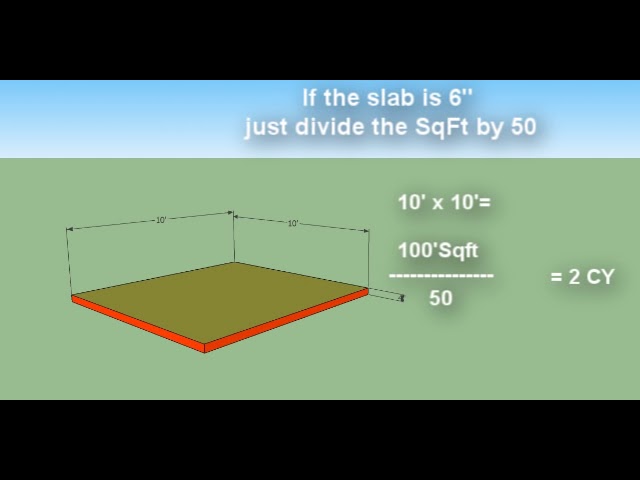
Image Source: i.ytimg.com
Deciphering Cubic Yard Dimensions
The term “cubic yard” might sound technical, but it’s straightforward once you break it down. A cubic yard represents a volume of space that is 3 feet long, 3 feet wide, and 3 feet high. Imagine a cube with each side measuring 3 feet; that cube contains exactly one cubic yard of material.
h4: The Core Calculation Formula
The fundamental formula for calculating the volume of a rectangular or square area, which is how most concrete projects are measured, is:
Volume = Length × Width × Depth
However, there’s a critical step: your measurements for length, width, and depth must all be in the same unit, typically feet, before you can convert them to cubic yards.
h4: Converting Measurements to Feet
If your measurements are in inches or any other unit, you must first convert them to feet.
- Inches to Feet: Divide the number of inches by 12.
- Example: 6 inches = 6 / 12 = 0.5 feet
h4: Calculating Concrete Volume
Once all your dimensions are in feet, you can apply the volume formula.
-
Example: You need to pour a concrete slab that is 10 feet long, 8 feet wide, and 4 inches deep.
- Convert Depth to Feet: 4 inches / 12 inches/foot = 0.333 feet (or 1/3 foot)
- Calculate Volume in Cubic Feet: 10 feet × 8 feet × 0.333 feet = 26.64 cubic feet
h4: The Crucial Conversion to Cubic Yards
Since concrete is sold by the cubic yard, you need to convert your cubic feet measurement. There are 27 cubic feet in 1 cubic yard (3 feet × 3 feet × 3 feet = 27 cubic feet).
-
Convert Cubic Feet to Cubic Yards: Divide the cubic feet by 27.
- Continuing the example: 26.64 cubic feet / 27 cubic feet/cubic yard = 0.987 cubic yards
Practical Application: Ordering Concrete
Accurate measurement is paramount when ordering concrete. It directly impacts the cost, the efficiency of your project, and the final quality of the concrete work.
h4: Estimating for Common Projects
- Sidewalks: Typically require a depth of 4 inches.
- Driveways: Often poured with a depth of 4 to 6 inches, with 5 inches being a good average for residential use.
- Patios: Similar to sidewalks, a 4-inch depth is common.
- Foundations/Footings: Depths vary greatly depending on building codes and soil conditions, but are usually more substantial, often 8 inches or more.
A good way to visualize concrete depth estimation is to think about how much material is needed. A 4-inch depth is 1/3 of a foot, a 6-inch depth is 1/2 of a foot, and so on.
h4: Using a Yardage Calculator
Many online tools and apps serve as a yardage calculator for concrete. These tools simplify the process. You input your length, width, and depth (often allowing you to select units like inches or feet), and the calculator automatically performs the conversion to cubic yards. While convenient, it’s always wise to double-check the calculator’s results with your own manual calculations.
h4: Accounting for Waste and Overages
It is standard practice to add a buffer of 5-10% to your calculated concrete volume. This accounts for:
- Uneven Subgrade: The ground beneath the concrete is rarely perfectly level, meaning you’ll need slightly more material to fill low spots.
- Formwork Bulge: Forms can sometimes bulge slightly under the pressure of wet concrete, increasing the overall volume needed.
- Spillage: Some minor spillage is inevitable during the pouring and finishing process.
- Job Site Variations: Unforeseen issues can arise.
Adding this buffer ensures you don’t run out of concrete mid-pour, which is a costly problem to resolve. If you are ordering concrete for a critical structural element, consulting with a structural engineer or experienced contractor is highly recommended for precise concrete depth estimation.
The Mechanics of Concrete Delivery
Understanding how concrete is delivered is also tied to its measurement.
h4: Standard Concrete Truck Load
A standard concrete truck load (also known as a mixer truck or ready-mix truck) typically carries between 8 to 11 cubic yards of concrete. However, they are often not legally allowed to carry more than 10 cubic yards due to weight restrictions on roads.
When you order concrete, you’ll specify the total cubic yards needed. If your project requires, for instance, 12 cubic yards, you will likely need two separate deliveries or two trucks if the pour is simultaneous. Knowing the concrete delivery size helps in planning your pour effectively.
h4: Smaller Deliveries and Minimum Orders
If your project requires less than a full truckload, you might still be charged for a minimum amount, often around 2-3 cubic yards, depending on the supplier. Be aware of these minimum order policies to avoid unexpected costs.
h4: Different Types of Concrete Delivery
- Ready-Mix Concrete: This is the most common type. It’s mixed at a plant and delivered to your site in a rotating drum truck. The concrete batching process at the plant ensures consistent quality.
- Bagged Concrete: For very small jobs, you can buy concrete in bags. Each bag contains a pre-measured amount of dry mix. You then add water on-site. This is less efficient for larger volumes and can lead to inconsistent results if not mixed carefully.
Addressing Non-Rectangular Shapes
While the length × width × depth formula works for simple rectangular areas, many projects involve curves or irregular shapes.
h4: Calculating for Curved Areas
For circular areas, like a concrete pad for a hot tub or a rounded patio:
- Calculate the Area: Area = π × radius² (where π is approximately 3.14159)
- Convert Radius to Feet: If your radius is in inches, divide by 12.
- Calculate Volume in Cubic Feet: Area (in sq ft) × Depth (in ft)
- Convert to Cubic Yards: Divide by 27.
- Example: A circular patio with a radius of 5 feet and a depth of 4 inches.
- Area = 3.14159 × (5 ft)² = 3.14159 × 25 sq ft = 78.54 sq ft
- Depth = 4 inches / 12 inches/ft = 0.333 ft
- Volume (cubic ft) = 78.54 sq ft × 0.333 ft = 26.15 cubic ft
- Volume (cubic yards) = 26.15 cubic ft / 27 cubic ft/cubic yard = 0.97 cubic yards
h4: Irregular Shapes and Division
For truly irregular shapes, the best approach is to break the area down into simpler geometric shapes (rectangles, squares, triangles, circles) as accurately as possible. Calculate the volume for each section and then sum them up.
Alternatively, you can use concrete square footage calculations for simpler areas and then factor in the depth. For example, if you know a section of your project is 100 square feet and needs to be 4 inches deep:
- Convert Depth to Feet: 4 inches / 12 inches/foot = 0.333 feet
- Calculate Volume in Cubic Feet: 100 sq ft × 0.333 ft = 33.3 cubic feet
- Convert to Cubic Yards: 33.3 cubic feet / 27 cubic feet/cubic yard = 1.23 cubic yards
h4: Estimating for Walls and Columns
- Walls: Calculate the length, height, and thickness (all in feet). Multiply these dimensions together to get cubic feet, then divide by 27.
- Example: A wall 20 ft long, 5 ft high, and 6 inches (0.5 ft) thick.
- Volume = 20 ft × 5 ft × 0.5 ft = 50 cubic feet
- Volume (cubic yards) = 50 cubic ft / 27 = 1.85 cubic yards
- Example: A wall 20 ft long, 5 ft high, and 6 inches (0.5 ft) thick.
- Columns: Calculate the cross-sectional area and the height.
- Square Column: Side × Side × Height (all in feet), then divide by 27.
- Round Column: Area of Circle (π × radius²) × Height (all in feet), then divide by 27.
Frequently Asked Questions (FAQ)
Q: What is a standard depth for a residential driveway?
A: For most residential driveways, a depth of 4 inches is the minimum, but 5 to 6 inches is recommended for better durability, especially if heavier vehicles will use it.
Q: How much extra concrete should I order?
A: It is advisable to order 5-10% more concrete than your calculated amount to account for waste, uneven subgrades, and formwork variations.
Q: Can I order less than a full yard of concrete?
A: Most suppliers have minimum order quantities, often around 2-3 cubic yards, even if your project requires less. You will likely be charged for the minimum amount.
Q: What happens if I order too much concrete?
A: If you have a significant amount of unused concrete, some suppliers may take it back, but often with a restocking fee. Small amounts might be usable for minor repairs or fill. It’s best to measure accurately to avoid this.
Q: Does concrete shrink as it dries?
A: Concrete does shrink slightly as it cures due to the chemical process of hydration and the evaporation of water. However, the volume measurement is based on the wet concrete delivered. The shrinkage is factored into the overall performance of the concrete, not the initial volume measurement for ordering.
Q: What is the difference between concrete and cement?
A: Cement is a binder, one of the key ingredients in concrete. Concrete itself is a composite material made from cement, water, sand (fine aggregate), and gravel or crushed stone (coarse aggregate). The concrete mix quantities are crucial for its final strength and properties.
Q: Can I calculate concrete needs for a basement floor?
A: Yes, a basement floor is typically a large, rectangular slab. Measure the length and width of the basement area and determine the desired thickness (usually 4 inches for residential basements). Apply the standard volume calculation formula.
Q: How do suppliers determine concrete mix quantities?
A: Suppliers use detailed mix designs that specify the precise proportions of cement, water, aggregates, and admixtures to achieve desired strength, workability, and durability. This is part of the concrete batching process.
Q: What is concrete square footage?
A: Concrete square footage refers to the surface area of a flat plane that the concrete will cover, measured in square feet. This is a preliminary step before calculating the volume by multiplying by the depth.
Q: Is there a way to measure concrete in cubic feet first?
A: Absolutely. All your measurements (length, width, depth) should be converted to feet, and then multiplied together to get the volume in cubic feet. You then divide this by 27 to get cubic yards. This is often how people start their concrete volume calculation.
By meticulously measuring your project dimensions and applying these calculations, you can confidently order concrete and ensure your project is completed successfully and efficiently. Always double-check your measurements and consider adding a small buffer for peace of mind.