
When asking “how do you measure a yard of concrete,” the answer is that you calculate its volume in cubic yards. This is the standard unit for ordering and estimating concrete for construction projects.
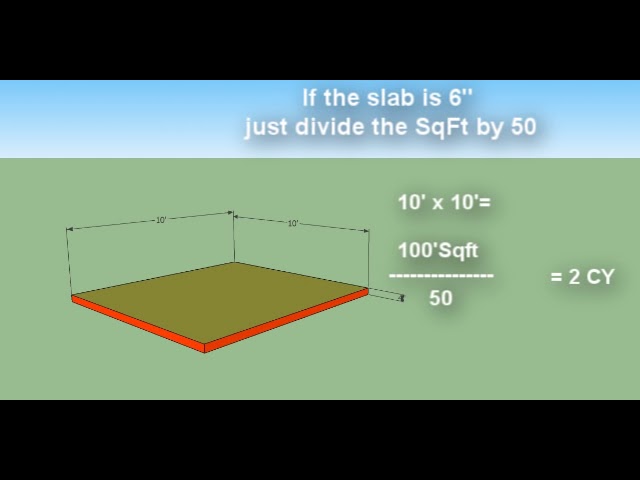
Image Source: i.ytimg.com
Comprehending Concrete Measurement Units
Concrete is a fundamental building material used in countless projects, from sidewalks and patios to foundations and large structures. To ensure you order the correct amount, it’s crucial to grasp the standard concrete measurement units. While projects are often described in “yards,” what we’re actually referring to is cubic yards. This unit represents a volume, specifically a cube with sides measuring one yard each.
Why Cubic Yards Matter
Ordering concrete by cubic yards is essential for several reasons:
- Accuracy: It prevents under-ordering (leading to project delays and extra delivery fees) or over-ordering (resulting in wasted material and unnecessary costs).
- Supplier Standardization: Ready-mix concrete suppliers universally use cubic yards as their standard measurement.
- Costing: The price of concrete is typically quoted per cubic yard.
Converting Between Units
While cubic yards are the standard, you might encounter measurements in other units, such as feet or inches, especially when calculating the volume of your specific project area. The key is to convert all your measurements to feet before you calculate the volume in cubic feet, and then convert that to cubic yards.
- 1 yard = 3 feet
- 1 square yard = 9 square feet
- 1 cubic yard = 27 cubic feet (3 feet x 3 feet x 3 feet)
Calculating Concrete Volume: The Foundation of Estimation
The core of determining how much concrete do I need lies in accurate concrete volume calculation. This involves measuring the dimensions of the area you intend to fill with concrete and then applying a straightforward formula.
The Basic Concrete Calculation Formula
The fundamental formula for calculating the volume of any rectangular or square prism (like a simple slab) is:
Volume = Length × Width × Depth (or Thickness)
However, to get this in cubic yards, you need to ensure all your measurements are in yards first. A more practical approach for most DIYers and contractors is to measure in feet and then convert to cubic yards.
Volume (in cubic feet) = Length (in feet) × Width (in feet) × Depth (in feet)
Once you have the volume in cubic feet, you convert it to cubic yards by dividing by 27:
Volume (in cubic yards) = Volume (in cubic feet) / 27
Step-by-Step Guide to Calculating Concrete Volume
Let’s break down the process with a common example, such as calculating concrete for driveway sections or a simple patio.
Step 1: Measure Your Project Area
- Length: Measure the longest dimension of the area.
- Width: Measure the shorter dimension of the area.
- Depth (Thickness): This is crucial. Decide how thick you want your concrete to be. Common thicknesses include:
- 4 inches for sidewalks, patios, and light-duty driveways.
- 6 inches for heavier-duty driveways, garage floors, or areas with heavy vehicle traffic.
- 8 inches or more for foundations and commercial applications.
Important Note: Always measure in feet. If your measurements are in inches, convert them to feet by dividing by 12 (e.g., 4 inches = 4/12 feet = 0.333 feet; 6 inches = 6/12 feet = 0.5 feet).
Step 2: Apply the Formula
Let’s say you’re planning a driveway section that is:
- Length = 20 feet
- Width = 10 feet
- Depth = 4 inches (which is 0.333 feet)
Now, plug these values into the formula:
Volume (in cubic feet) = 20 ft × 10 ft × 0.333 ft
Volume (in cubic feet) = 66.6 cubic feet
Step 3: Convert to Cubic Yards
Now, divide the volume in cubic feet by 27 to get the volume in cubic yards:
Volume (in cubic yards) = 66.6 cubic feet / 27
Volume (in cubic yards) ≈ 2.47 cubic yards
Accounting for Irregular Shapes
Most projects aren’t perfect rectangles. Here’s how to handle common irregular shapes:
-
Circular Slabs (e.g., for a round patio or pillar base):
- Measure the diameter (the distance across the circle through the center).
- Calculate the radius (radius = diameter / 2).
- Formula: Volume = π × radius² × Depth
- Remember to convert all measurements to feet and divide the final cubic feet by 27.
- Example: A circular patio with a 12-foot diameter (6-foot radius) and 4 inches (0.333 ft) thick:
- Volume (cu ft) = 3.14159 × (6 ft)² × 0.333 ft
- Volume (cu ft) = 3.14159 × 36 sq ft × 0.333 ft
- Volume (cu ft) ≈ 37.6 cubic feet
- Volume (cu yd) = 37.6 cu ft / 27 ≈ 1.39 cubic yards
-
Irregular Shapes: Break down complex shapes into simpler geometric figures (rectangles, squares, triangles, circles). Calculate the volume for each section and then sum them up.
Using a Concrete Estimator Tool
For more complex projects or if you prefer a quick check, many online resources offer a concrete estimator tool or cubic yard calculator. These tools often allow you to input your dimensions (length, width, depth) in feet or inches, and they will automatically perform the calculations and provide the total cubic yards needed. Using a concrete volume calculation tool can save time and reduce the chance of manual errors.
Ordering Concrete by Yard: Practical Considerations
Once you’ve calculated the volume, the next step is ordering concrete by yard. This involves understanding how ready-mix concrete is delivered and what extra factors you might need to consider.
The Waste Factor: A Crucial Addition
It’s standard practice to add a “waste factor” to your calculated volume. This accounts for:
- Uneven Subgrade: The ground beneath your concrete pour might not be perfectly flat, requiring slightly more material to fill low spots.
- Spillage: Some minor spillage can occur during the pour.
- Over-Excavation: Sometimes, more material is removed than strictly necessary.
- Formwork Variations: Forms might bow slightly under pressure.
A typical waste factor is between 5% and 10%. To calculate this:
Amount to Order = Calculated Volume (cu yd) × (1 + Waste Factor Percentage)
Using our driveway example:
Calculated Volume = 2.47 cubic yards
Let’s add a 10% waste factor:
Amount to Order = 2.47 cu yd × (1 + 0.10)
Amount to Order = 2.47 cu yd × 1.10
Amount to Order ≈ 2.72 cubic yards
When ordering, you’ll likely need to round up to the nearest quarter or half yard, depending on your supplier’s policies. In this case, you would likely order 2.75 or 3 cubic yards.
What if You Don’t Need a Full Yard?
Many suppliers have a minimum order quantity, often 1 cubic yard. If your calculation results in less than a cubic yard, you might still have to order a full yard. For very small projects, mixing concrete on-site using bags of pre-mix can be more economical.
Bags of Concrete vs. Ready-Mix
Concrete is sold in bags of various weights (e.g., 60 lb, 80 lb). Each bag yields a specific volume of concrete.
- A typical 80 lb bag yields about 0.6 cubic feet of concrete.
- A typical 60 lb bag yields about 0.45 cubic feet of concrete.
To figure out how many bags you need:
Number of Bags = Total Volume Needed (cu ft) / Volume per Bag (cu ft)
Using our driveway example (66.6 cubic feet needed before waste):
If using 80 lb bags (0.6 cu ft/bag):
Number of Bags = 66.6 cu ft / 0.6 cu ft/bag ≈ 111 bags
This is a significant number of bags, highlighting why ordering ready-mix by the cubic yard is preferred for larger projects like driveways.
The Concrete Mixing Calculator
For those planning to mix their own concrete from scratch (cement, sand, gravel, and water), a concrete mixing calculator can be invaluable. These calculators help determine the exact ratios of dry ingredients needed to achieve a specific volume and strength of concrete. However, for most projects requiring more than a few bags, ready-mix concrete is usually more convenient and consistent in quality.
Fathoming Concrete Slab Volume
A common project is pouring a concrete slab. Calculating the concrete slab volume follows the same principles as the general volume calculation, but it’s worth reinforcing the steps for clarity.
Essential Measurements for Slabs
- Length: The longest dimension of your slab area.
- Width: The shorter dimension of your slab area.
- Thickness: The desired depth of the concrete slab. This is critical for structural integrity. As mentioned, 4 inches is standard for many uses, but 6 inches offers more durability. Always convert this to feet for calculations.
Recalculating Slab Volume
Let’s consider a rectangular patio slab:
- Length = 15 feet
- Width = 12 feet
- Thickness = 4 inches = 0.333 feet
Calculation:
Volume (cu ft) = 15 ft × 12 ft × 0.333 ft
Volume (cu ft) = 180 sq ft × 0.333 ft
Volume (cu ft) = 59.94 cubic feet
Now, convert to cubic yards:
Volume (cu yd) = 59.94 cu ft / 27
Volume (cu yd) ≈ 2.22 cubic yards
Adding a 10% waste factor:
Amount to Order = 2.22 cu yd × 1.10
Amount to Order ≈ 2.44 cubic yards
You would likely order 2.5 cubic yards of concrete.
Factors Affecting Slab Thickness
When deciding on the thickness for your slab, consider:
- Intended Use: Will it be for foot traffic only, or will vehicles, heavy equipment, or furniture be placed on it?
- Sub-base Preparation: A well-compacted gravel sub-base is crucial for preventing cracking and settling, regardless of slab thickness.
- Reinforcement: For heavier loads or larger slabs, steel reinforcement (rebar or mesh) is often used. While this doesn’t change the volume calculation, it’s a critical component for slab longevity.
Frequently Asked Questions About Measuring Concrete
Q1: How much extra concrete should I order?
It’s generally recommended to order 5% to 10% more concrete than your calculated volume to account for waste, spillage, and minor inaccuracies in the subgrade.
Q2: What if my project area is not a simple rectangle?
For irregular shapes, break them down into smaller, manageable geometric shapes (rectangles, squares, triangles, circles). Calculate the volume for each section and then add them together. Online calculators can also assist with more complex geometries.
Q3: Can I just measure my project in inches and convert at the end?
While possible, it’s best practice to convert all dimensions to feet before calculating the volume in cubic feet. This prevents calculation errors, especially when multiplying three dimensions. For example, 4 inches should be converted to 0.333 feet, not used as 4 in the calculation.
Q4: How do ready-mix concrete suppliers typically deliver?
Ready-mix concrete is delivered in specialized trucks equipped with a rotating drum that keeps the concrete mixed. The volume is measured by the truck’s meter, which tracks the amount dispensed.
Q5: What is the smallest amount of concrete I can order?
Most ready-mix suppliers have a minimum order, often 1 cubic yard. For smaller projects requiring less than a cubic yard, purchasing pre-mixed concrete bags and mixing them on-site is usually more cost-effective.
Q6: How can I ensure accurate measurements for my concrete project?
Use a reliable measuring tape. For longer distances, a laser measure can be beneficial. Double-check all your measurements before finalizing your order. Measure at multiple points if the area isn’t perfectly uniform.
Q7: Does the slump of concrete affect the volume calculation?
The “slump” refers to the consistency or workability of the concrete mix (how wet or dry it is). While slump affects how the concrete behaves during placement, it does not change the calculated volume of the material you need. You still calculate the required cubic yards based on the physical dimensions of your project.
By following these steps and considerations, you can confidently calculate the amount of concrete you need for your project, ensuring a smooth and successful pour without costly mistakes.