
Figuring out how many square feet does 1 yard of mulch cover is a common question for anyone tackling a landscaping project. Generally, one cubic yard of mulch, when spread at the recommended depth of 3 inches, will cover approximately 108 square feet. This guide will break down the essential mulch calculations to help you determine exactly how much mulch you need for your garden beds and other landscaping areas, ensuring you get the best mulch coverage for your money and effort.
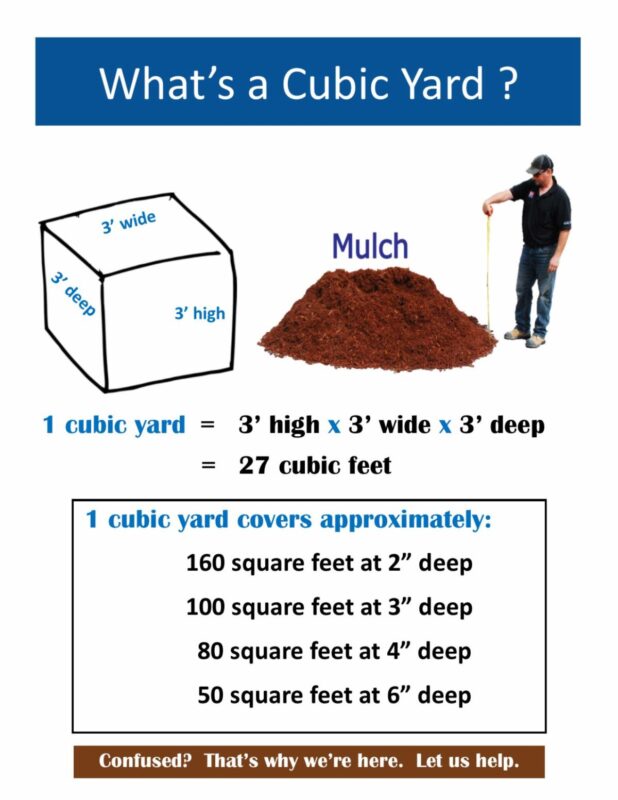
Image Source: stonegarden-nc.com
Deciphering Mulch Coverage: The Science Behind the Spread
When you purchase mulch, it’s typically sold by the cubic yard. This refers to the volume of the mulch, not its weight or the area it covers. The key to calculating yard of mulch square footage lies in understanding the desired depth of your mulch layer and the conversion from cubic yards to square feet.
The Role of Mulch Depth
The depth at which you spread your mulch significantly impacts its coverage. Too thin, and it won’t effectively suppress weeds or retain moisture. Too thick, and you might suffocate plant roots or waste product.
Recommended Mulch Depths:
- General Garden Beds: 2-4 inches. A 3-inch layer is a good standard.
- Around Trees: 2-3 inches, keeping it a few inches away from the trunk.
- Vegetable Gardens: 2-3 inches.
- Steep Slopes: 4 inches to prevent erosion.
Calculating Cubic Yards to Square Feet
A cubic yard is a unit of volume. To figure out how much area it covers, we need to consider the depth.
Formula:
Area (sq ft) = (Volume of mulch in cubic feet) / (Depth of mulch in feet)
Let’s break this down:
-
Convert Cubic Yards to Cubic Feet:
- 1 cubic yard = 27 cubic feet (since 1 yard = 3 feet, and volume is length x width x height, so 3ft x 3ft x 3ft = 27 cubic feet).
-
Convert Depth from Inches to Feet:
- To use the formula above, your depth needs to be in feet. Divide the desired depth in inches by 12 (since there are 12 inches in a foot).
Example:
Let’s say you want to spread mulch at a depth of 3 inches.
- Depth in feet = 3 inches / 12 inches/foot = 0.25 feet
Now, let’s use the formula with 1 cubic yard (27 cubic feet) of mulch:
- Area (sq ft) = 27 cubic feet / 0.25 feet = 108 square feet.
This is why the common rule of thumb is that 1 yard of mulch covers approximately 108 square feet when applied at a 3-inch depth.
Factors Influencing Mulch Coverage
While the 108 sq ft per cubic yard figure is a great starting point, several factors can influence your actual mulch coverage.
Mulch Type and Size
The physical characteristics of the mulch itself can play a role:
- Shredded Bark vs. Chips: Shredded bark tends to compact more, potentially covering a slightly larger area for the same volume if not packed down firmly. Wood chips might spread out more loosely.
- Particle Size: Finer mulches might settle and compact more readily than larger chunks, potentially leading to a slightly different coverage rate.
Soil Compaction
The existing condition of your soil can affect how the mulch settles. Very hard, compacted soil might require slightly more mulch to achieve the desired depth without it just sitting on top.
Application Technique
How you go about spreading mulch coverage can also make a difference:
- Evenness: A consistent, even spread is crucial. Patchy application means some areas will be too thin, and others might be too thick.
- Walking On It: While spreading, try to avoid walking on the freshly laid mulch as much as possible to maintain the intended depth.
Practical Mulch Calculations for Your Project
Now that you have the basic formula, let’s apply it to real-world landscaping scenarios. Having a mulch coverage calculator in mind can save you time and money.
Measuring Your Garden Beds
The first step is accurately measuring the areas you intend to mulch.
How to Measure:
-
Rectangular Beds:
- Measure the length and width in feet.
- Multiply length by width to get the area in square feet.
- Example: A bed that is 10 feet long and 5 feet wide has an area of 10 ft * 5 ft = 50 sq ft.
-
Circular Beds:
- Measure the diameter (the distance across the center) in feet.
- Calculate the radius (diameter divided by 2).
- Use the formula for the area of a circle: Area = π * radius² (where π is approximately 3.14).
- Example: A circular bed with a diameter of 6 feet has a radius of 3 feet. Area = 3.14 * (3 ft)² = 3.14 * 9 sq ft = 28.26 sq ft.
-
Irregularly Shaped Beds:
- Break down the irregular shape into smaller, simpler shapes (rectangles, squares, triangles, circles).
- Calculate the area of each individual shape.
- Add all the individual areas together to get the total area in square feet.
Calculating the Total Mulch Needed
Once you have the total square footage of all the areas you want to mulch, you can determine how many cubic yards you need.
Formula:
Cubic Yards Needed = (Total Area in Square Feet) / (Square Feet Covered Per Cubic Yard at Desired Depth)
Let’s use the standard mulch depth coverage of 3 inches (which covers 108 sq ft per cubic yard).
Example:
Suppose your garden has a total area of 300 square feet, and you want a 3-inch mulch layer.
- Cubic Yards Needed = 300 sq ft / 108 sq ft/cubic yard ≈ 2.78 cubic yards.
Pro Tip: Always round up your mulch order to the nearest full or half cubic yard to account for any minor variations in depth or coverage. In this case, you’d likely order 3 cubic yards.
Adjusting for Different Depths
If you plan to apply mulch at a depth other than 3 inches, you’ll need to adjust your calculations. This is where a precise mulch coverage calculator approach becomes essential.
Here’s how to find the square footage coverage for different depths per cubic yard:
Formula:
Square Feet per Cubic Yard = 27 cubic feet / (Depth in feet)
Table: Mulch Coverage at Different Depths (per Cubic Yard)
| Desired Mulch Depth (Inches) | Depth in Feet | Square Feet Covered per Cubic Yard |
|---|---|---|
| 1 | 0.083 | 325 |
| 2 | 0.167 | 162 |
| 3 | 0.250 | 108 |
| 4 | 0.333 | 81 |
| 5 | 0.417 | 65 |
| 6 | 0.500 | 54 |
Example: If you want a 4-inch mulch layer in a 200 sq ft area:
- From the table, 1 cubic yard covers 81 sq ft at 4 inches.
- Cubic Yards Needed = 200 sq ft / 81 sq ft/cubic yard ≈ 2.47 cubic yards.
- You would round up and order 2.5 to 3 cubic yards.
This detailed approach is vital for effective landscaping mulch volume management.
Understanding Mulch Bag Coverage vs. Bulk Mulch
Many gardeners start with bagged mulch, but for larger projects, bulk mulch is often more economical. It’s important to compare coverage correctly.
Mulch Bag Coverage
Mulch is commonly sold in bags that contain 2 cubic feet of mulch. This makes mulch bag coverage calculations straightforward.
Conversion:
- 1 cubic yard = 27 cubic feet
- Number of 2-cu ft bags per cubic yard = 27 cubic feet / 2 cubic feet/bag = 13.5 bags.
So, if you need 3 cubic yards of mulch, you’ll need approximately 3 * 13.5 = 40.5 bags. You’d round this up to 41 bags.
How much area does one bag cover?
Using the same 3-inch depth (0.25 feet):
- 2 cubic feet / 0.25 feet = 8 square feet.
- Therefore, one 2-cu ft bag of mulch covers about 8 square feet at a 3-inch depth.
This is a useful metric for smaller jobs and provides an alternative way to think about mulch coverage.
Bulk Mulch Advantages
- Cost-Effective: Bulk mulch is almost always cheaper per cubic yard than bagged mulch.
- Less Waste: You avoid the plastic bags, which are often an environmental concern.
- Easier Delivery: For large projects, having a truckload delivered is much easier than hauling dozens of bags.
When ordering bulk, always confirm the volume is in cubic yards.
Maximizing Your Mulch Investment: Tips for Spreading
Proper spreading mulch coverage ensures you get the best aesthetic and functional results.
Preparation is Key
- Weeding: Remove all existing weeds before applying new mulch. Mulch is a deterrent, not a miracle cure.
- Soil Aeration: Loosen compacted soil with a garden fork. This improves drainage and allows air and water to reach plant roots.
- Edging: Create a clean edge around your beds for a polished look.
The Spreading Process
- Start at the Back: Begin spreading mulch in the areas furthest from your access point and work your way back. This prevents you from walking over the freshly mulched areas.
- Use a Rake or Shovel: Distribute the mulch evenly. A garden rake with flexible tines is ideal for fluffing and spreading without damaging plants.
- Maintain Consistent Depth: Use your measuring tool (or just your eye) to ensure you’re achieving the desired depth across the entire area.
- Avoid Piling: Do not pile mulch directly against the trunks or stems of plants. This can lead to rot, disease, and pest problems. Leave a few inches of space.
- Watering: Lightly watering the mulch after application can help it settle and stay in place, especially on slopes or windy areas.
Common Mulch Calculation Mistakes to Avoid
Even with a good mulch coverage guide, mistakes can happen.
Over or Under-Estimating Area
- Mistake: Not accurately measuring all the areas or forgetting to add them up.
- Solution: Measure twice, calculate once. Draw a simple map of your yard and mark the dimensions of each area.
Ignoring Depth Requirements
- Mistake: Assuming 3 inches for every area or just spreading whatever looks “right.”
- Solution: Decide on the appropriate depth for each zone and stick to it, using your measurements and calculations.
Not Accounting for Compaction
- Mistake: Not buying enough to account for mulch settling over time or due to heavy rain.
- Solution: Always buy a little extra. It’s better to have a bit left over than to run out mid-project.
Confusion Between Square Feet and Cubic Feet
- Mistake: Thinking 1 cubic yard covers 108 “square” feet, but then trying to measure length and width in yards, or confusing the units.
- Solution: Stick to feet for all measurements before converting to cubic yards.
Frequently Asked Questions About Mulch Coverage
Here are some common questions people have about how much mulch per square foot is needed.
Q1: How much mulch do I need for a 4×8 foot garden bed at 3 inches deep?
A: A 4×8 foot bed is 32 square feet (4 ft x 8 ft). At a 3-inch depth, 1 cubic yard covers 108 square feet.
Cubic Yards Needed = 32 sq ft / 108 sq ft/cubic yard ≈ 0.3 cubic yards.
You would likely need to purchase at least half a cubic yard, or 5-6 bags (since each 2-cu ft bag covers about 8 sq ft, 32 sq ft / 8 sq ft/bag = 4 bags). It’s often better to buy a bit more, so consider 4 bags for a slightly deeper layer or just in case.
Q2: Can I use less mulch than recommended for cost savings?
A: While you can use less, it’s generally not recommended. A mulch layer that is too thin (less than 2 inches) won’t effectively suppress weeds, retain soil moisture, or insulate the soil from temperature extremes. You might end up spending more time and money on weed control or watering.
Q3: What is the difference between mulch coverage and mulch volume?
A: Mulch volume is the amount of space the mulch occupies, measured in cubic yards or cubic feet. Mulch coverage is the actual area (in square feet) that a specific volume of mulch can cover when spread to a particular depth.
Q4: How do I calculate mulch for a circular tree well?
A: Measure the diameter of the well. Calculate the radius (diameter/2). Use the area of a circle formula: Area = π * radius². Then, divide that area by the coverage rate for your desired depth (e.g., 108 sq ft per cubic yard for 3 inches).
Q5: Does the type of mulch affect how much I need?
A: Yes, to a small extent. While the volume remains the same, different mulch types might compact differently or have slightly varied particle sizes. However, for most practical purposes, the standard coverage rates are reliable for various common mulch types like bark, wood chips, or shredded mulch. The primary driver of mulch coverage is depth.
Q6: What happens if I apply mulch too thickly?
A: Applying mulch too thickly (more than 4-6 inches) can be detrimental. It can restrict water and air flow to the roots, leading to root suffocation, rot, and fungal diseases. It also increases the amount of mulch you need, making it more expensive.
Q7: Is there a tool to help with mulch calculations?
A: Yes, many garden centers and landscaping supply companies offer online mulch coverage calculators on their websites. These tools can simplify the process by allowing you to input your dimensions and desired depth, and they’ll provide an estimate of how many cubic yards or bags you need.
Conclusion: Your Go-To Mulch Coverage Guide
Accurately calculating your mulch needs is a fundamental aspect of successful landscaping. By consistently measuring your garden beds and applying the principles of mulch calculations, you can ensure optimal mulch depth coverage for healthier plants and a more beautiful garden. Remember, 1 cubic yard of mulch typically covers about 108 square feet at a 3-inch depth, but adjusting for your specific depth requirements is key. With this mulch coverage guide, you’re well-equipped to tackle any project, ensuring you buy the right amount of landscaping mulch volume and achieve that perfect, finished look. Happy mulching!