
A yard of mulch, when applied at the standard depth of 3 inches, will cover approximately 100 square feet. This guide will help you calculate exactly how much mulch you need for your garden beds and landscaping projects.
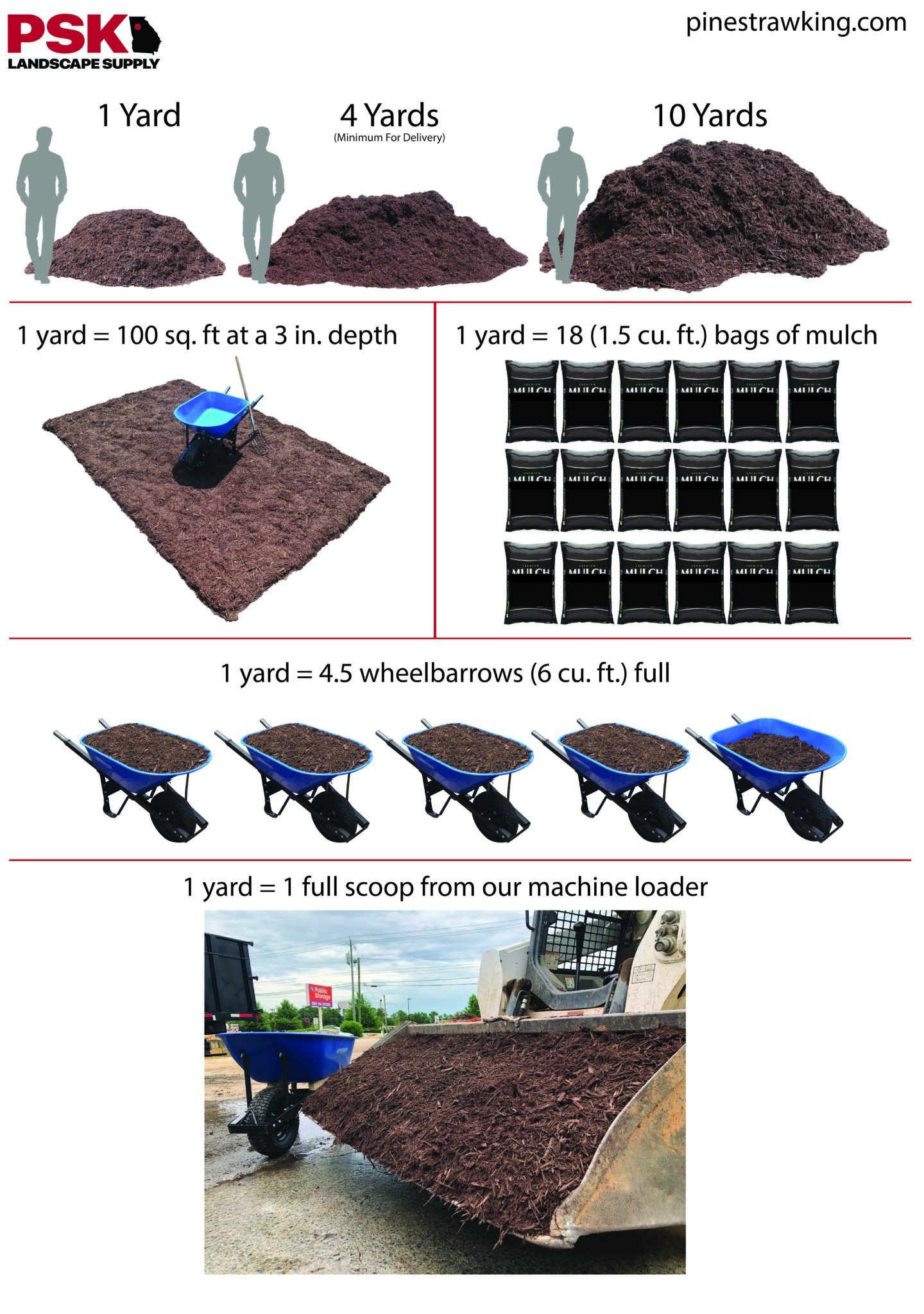
Image Source: pinestrawking.com
Deciphering Mulch Coverage: The Basics
Are you wondering how much does a yard of mulch cover? The answer is generally 100 square feet at a 3-inch depth. This is the most common and effective depth for most mulching applications. However, this number can change based on a few key factors. Let’s dive into how to accurately figure out your mulch needs.
The Magic Number: 100 Square Feet
Think of a cubic yard of mulch. It’s a large amount! When spread out evenly, it creates a good layer of protection and beauty for your plants. The standard recommendation for mulch application rate is 3 inches. This depth is ideal because it suppresses weeds effectively, retains soil moisture, and insulates plant roots from extreme temperatures.
Factors Affecting Coverage
While 100 square feet is a good benchmark, your actual coverage might vary. What influences this?
- Mulch Depth: This is the biggest factor. If you apply mulch thinner than 3 inches, you’ll cover more area. If you go deeper, you’ll cover less.
- Type of Mulch: Some mulches are bulkier than others. For example, shredded bark might fluff up more than fine wood chips, giving you a slightly different coverage.
- Compaction: Over time, mulch settles and compacts. The initial coverage might be slightly more than the coverage after a few months.
Calculating Your Mulch Needs: A Step-by-Step Approach
Knowing how much area you need to cover is the first step. Then, you can figure out the volume of mulch for garden beds.
Step 1: Measure Your Area
You need to know the total square foot of mulch you want to cover.
- Garden Beds: Measure the length and width of each garden bed. Multiply length by width to get the square footage for that bed.
- Paths or Other Areas: Do the same for any other areas you plan to mulch.
- Add Them Up: Sum the square footage of all the areas to get your total area to be mulched.
- Example: You have a rectangular garden bed that is 10 feet long and 5 feet wide. The area is 10 ft * 5 ft = 50 square feet. If you have another bed that is 12 feet by 6 feet, that’s 72 square feet. Your total area is 50 sq ft + 72 sq ft = 122 square feet.
Step 2: Determine Your Desired Mulch Depth
As mentioned, 3 inches is the standard. However, you might choose a different depth:
- Weed Suppression: 3-4 inches is best for serious weed control.
- Moisture Retention: 2-3 inches is usually sufficient.
- Aesthetics: You might prefer a thinner layer for a tidier look, say 2 inches.
- Heavy-Duty Protection: For very harsh climates or delicate plants, 4-5 inches might be beneficial.
Remember that applying mulch too deeply can harm plants by restricting air and water to the roots.
Step 3: Using a Mulch Coverage Calculator
Many online tools can help with landscape mulch calculations. These are often called a mulch coverage calculator. You simply input your area (in square feet) and the desired depth (in inches), and it tells you how many cubic yards you need.
If you don’t have a calculator handy, you can use this formula:
Cubic Yards Needed = (Total Square Footage × Desired Depth in Inches) / 324
The number 324 comes from the fact that a cubic yard is 27 cubic feet, and we’re converting inches to feet (3 inches / 12 inches/foot = 0.25 feet), and then using the standard coverage of 100 sq ft for 3 inches.
Let’s break down the math behind that 324:
- A cubic yard is 3 feet x 3 feet x 3 feet = 27 cubic feet.
- We want to cover an area at a certain depth.
- Let’s say we want to cover an area of 1 square foot to a depth of 3 inches (which is 0.25 feet). The volume needed is 1 sq ft * 0.25 ft = 0.25 cubic feet.
- How many such 0.25 cubic foot sections are in one cubic yard (27 cubic feet)? 27 / 0.25 = 108. This seems different from 324. Where does 324 come from?
Ah, the formula usually simplifies how many cubic feet in a yard of mulch are needed for a specific coverage area at a specific depth. The standard formula derivation usually looks like this:
- Area in square feet = A
- Desired depth in inches = D
- Volume in cubic feet = A * (D/12)
- Since 1 cubic yard = 27 cubic feet, then Cubic Yards = (A * (D/12)) / 27
- Cubic Yards = A * D / (12 * 27)
- Cubic Yards = A * D / 324
So, the formula Cubic Yards Needed = (Total Square Footage × Desired Depth in Inches) / 324 is correct.
Let’s re-calculate our example: 122 square feet at 3 inches.
Cubic Yards Needed = (122 sq ft * 3 inches) / 324
Cubic Yards Needed = 366 / 324
Cubic Yards Needed ≈ 1.13 cubic yards
Since you can’t usually buy fractions of a cubic yard, you’d round up to 2 cubic yards. It’s always better to have a little extra than not enough.
Understanding Cubic Feet and Yard Conversions
Knowing how many cubic feet in a yard of mulch is essential for accurate planning.
- 1 cubic yard = 27 cubic feet
This is a key conversion. When you buy mulch, it’s typically sold by the cubic yard. However, when you’re spreading it, you’re thinking about depth and area.
Calculating Volume in Cubic Feet
If you measure your area in square feet and your desired depth in feet, you can calculate the volume directly in cubic feet.
Volume (cubic feet) = Total Square Footage × Desired Depth (in feet)
To convert your desired depth from inches to feet, divide by 12.
- Example: For our 122 square feet area, at a 3-inch depth (0.25 feet):
Volume = 122 sq ft * 0.25 ft = 30.5 cubic feet.
Now, to find out how many cubic yards this is:
Cubic Yards = Volume (cubic feet) / 27
Cubic Yards = 30.5 cubic feet / 27 cubic feet/yard
Cubic Yards ≈ 1.13 cubic yards
This confirms our previous calculation.
Mulch Coverage Per Bag: What to Expect
Mulch is also sold in bags, often for smaller projects. The mulch coverage per bag varies significantly depending on the bag size and the type of mulch.
Common Bag Sizes and Coverage
- 2 cubic foot bag: This is a very common size. At a 3-inch depth (0.25 ft), a 2 cubic foot bag will cover:
Area = Volume / Depth
Area = 2 cubic feet / 0.25 feet
Area = 8 square feet. - 3 cubic foot bag:
Area = 3 cubic feet / 0.25 feet
Area = 12 square feet. - Larger bags (e.g., 4 cubic feet):
Area = 4 cubic feet / 0.25 feet
Area = 16 square feet.
Calculating Bags Needed
To figure out how many bags you need, first calculate your total square footage. Then, divide that by the coverage per bag.
- Example: You have 122 square feet to cover with mulch, and you’re using 2 cubic foot bags.
Number of Bags = Total Square Footage / Coverage per Bag
Number of Bags = 122 sq ft / 8 sq ft/bag
Number of Bags = 15.25 bags
Again, always round up. You’d need 16 bags.
Visualizing Coverage: A Cubic Yard in Action
It can be hard to picture a cubic yard of mulch. Imagine a cube that is 3 feet long, 3 feet wide, and 3 feet tall. That’s a lot of mulch!
Spreading a Cubic Yard
When you spread that cubic yard over 100 square feet to a depth of 3 inches, you’re creating a substantial layer.
- Depth: 3 inches is about the width of your thumb and forefinger held together.
- Area: 100 square feet could be a 10×10 foot square, or a 5×20 foot rectangle.
Depth for Optimal Coverage
The mulch depth for coverage is critical.
- Too Thin (less than 2 inches): Won’t effectively suppress weeds, and moisture retention will be poor. You’ll also see the black landscape fabric or bare soil underneath.
- Just Right (3 inches): Excellent weed suppression, good moisture retention, and a visually appealing, consistent layer.
- Too Thick (over 4 inches): Can suffocate plant roots, making it difficult for them to get oxygen and water. Can also create a barrier that prevents beneficial insects from reaching the soil.
When to Adjust Your Calculations
There are times when you might need to deviate from the standard 3-inch depth, impacting your determining mulch needed.
Specific Plant Needs
- Young Seedlings: Might prefer a slightly shallower layer (2 inches) to ensure they get enough sunlight and air.
- Established Shrubs and Trees: Can often handle 3-4 inches around their base, but always keep mulch a few inches away from the trunk to prevent rot and pest issues.
- Vegetable Gardens: Some gardeners prefer shallower mulch (2 inches) in vegetable beds to allow for easier soil warming in spring.
Weed Pressure
If you have particularly aggressive weeds, you might opt for a 4-inch depth in certain areas. Just be mindful of the plant health implications.
Soil Type
- Sandy Soils: Benefit from slightly deeper mulch (3-4 inches) to maximize moisture retention.
- Clay Soils: May require slightly shallower mulch (2-3 inches) to avoid waterlogging and poor aeration.
Common Mulching Mistakes to Avoid
Getting the amount of mulch right is important, but so is how you apply it.
Not Measuring First
Guessing is a sure way to either buy too much or too little. Always measure your space!
Applying Too Thinly or Too Thickly
As discussed, the depth is crucial for effectiveness and plant health.
Piling Mulch Against Stems and Trunks
This is a very common mistake that can lead to rot, fungal diseases, and pest infestations. Create a small buffer zone.
Forgetting to Account for Compaction
Mulch will settle over time. If you want it to look consistently good, you may need to top it up annually.
Summary Table: Cubic Yards to Square Feet Coverage (at 3-inch Depth)
This table gives you a quick reference for mulch coverage per cubic yard at the standard 3-inch depth.
| Cubic Yards of Mulch | Square Feet Covered (at 3″ depth) |
|---|---|
| 1 | 100 |
| 2 | 200 |
| 3 | 300 |
| 4 | 400 |
| 5 | 500 |
Remember, this is a guideline. If you aim for a 2-inch depth, you’ll cover approximately 150 square feet per cubic yard. If you aim for 4 inches, you’ll cover about 75 square feet per cubic yard.
Coverage Adjustment Chart
| Desired Depth | Coverage per Cubic Yard (approx. sq ft) |
|---|---|
| 2 inches | 150 |
| 3 inches | 100 |
| 4 inches | 75 |
| 5 inches | 60 |
Frequently Asked Questions (FAQ)
How much area does one cubic yard of mulch cover?
One cubic yard of mulch typically covers 100 square feet when applied at a depth of 3 inches.
What is the standard depth for applying mulch?
The standard and most recommended depth for applying mulch is 3 inches.
Can I use a mulch coverage calculator to estimate my needs?
Yes, using a mulch coverage calculator is a highly accurate and convenient way to estimate the amount of mulch you need.
How do I calculate the square foot of mulch needed for my garden?
Measure the length and width of your garden beds and multiply them together for each bed. Add the square footage of all your beds to get the total area.
How many cubic feet are in a yard of mulch?
There are 27 cubic feet in one cubic yard of mulch.
How much area does a 2 cubic foot bag of mulch cover?
A 2 cubic foot bag of mulch will cover approximately 8 square feet when applied at a 3-inch depth.
What is the best mulch depth for coverage and weed control?
A mulch depth of 3 to 4 inches is generally considered best for effective weed control and moisture retention.
How do I determine mulch needed for my specific landscaping project?
You determine mulch needed by measuring the total area you want to cover in square feet and deciding on your desired mulch depth in inches, then using a calculation or a mulch coverage calculator.
Is there a formula for calculating landscape mulch calculations?
Yes, the formula is: Cubic Yards Needed = (Total Square Footage × Desired Depth in Inches) / 324.
How much mulch do I need for my flower beds?
Calculate the total square footage of your flower beds and use the mulch coverage guidelines (e.g., 100 sq ft per cubic yard at 3 inches) to determine the volume. This calculation is often referred to as figuring out the volume of mulch for garden beds.