
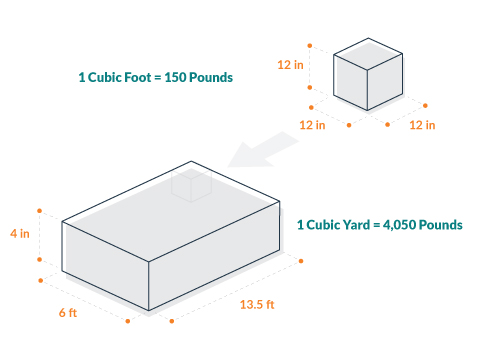
Image Source: www.dumpsters.com
How Much Does A Yard Of Cured Concrete Weigh? Find Out!
A cubic yard of cured concrete typically weighs between 3,000 and 4,500 pounds. This weight can fluctuate based on the specific mix design, including the types and amounts of aggregate, cement, and water used, as well as any admixtures added.
Deciphering Concrete’s Weight: The Cubic Yard Calculation
When embarking on any construction project, whether it’s a small patio or a large foundation, knowing the weight of your materials is crucial. Among the most fundamental materials is concrete, and a common question that arises is: how much does a yard of cured concrete weigh? This isn’t just idle curiosity; accurate concrete calculations are vital for everything from structural integrity to transportation logistics. The weight of concrete is a key factor in estimating concrete weight and utilizing a concrete material calculator effectively.
The Foundation of Concrete Weight: Density
The primary factor determining how much does concrete weigh is its concrete density. Density, in simple terms, is how much “stuff” is packed into a certain amount of space. For concrete, this “stuff” includes cement, sand, gravel (aggregate), and water. The density of cured concrete, also known as cured concrete density, is not a single fixed number. It varies significantly based on the proportions of these ingredients in the mix.
What Influences Concrete Density?
Several factors contribute to the overall concrete density:
- Aggregate Type: The type and size of the aggregate (gravel or crushed stone) used in the concrete mix have a substantial impact. Denser aggregates will result in heavier concrete. For example, using heavier stone like granite will lead to a denser, heavier concrete compared to using lighter aggregates like expanded shale.
- Aggregate Size and Shape: Larger, well-graded aggregates tend to pack more efficiently, potentially leading to denser concrete than mixes with uniformly small aggregates. The shape of the aggregate also plays a role; angular aggregates interlock better than rounded ones, which can affect the density of the compacted mix.
- Water-to-Cement Ratio: While water is essential for the chemical reaction (hydration) that cures concrete, using too much water can weaken the concrete and slightly reduce its density once cured. A lower water-to-cement ratio generally results in stronger, denser concrete.
- Air Entrapment: Air bubbles within the concrete mix, whether intentionally added (air-entrained concrete) or accidentally trapped, reduce the overall density. Air-entrained concrete is often used in colder climates to improve freeze-thaw resistance, but it will weigh less per cubic yard than non-air-entrained concrete.
- Admixtures: Various chemical admixtures can be added to concrete to modify its properties. Some admixtures might slightly alter the final density, though their primary purpose is usually related to workability, strength, or durability.
The Cubic Yard: A Standard Measurement
The cubic yard concrete weight refers to the weight of concrete that would fill a space one yard wide, one yard deep, and one yard high. This is a standard unit of measurement for concrete in many parts of the world, particularly in the United States. A cubic yard is equal to 27 cubic feet.
Converting Units: From Feet to Yards
To understand concrete volume weight, it’s helpful to visualize the measurements.
- 1 yard = 3 feet
- 1 cubic yard = 3 feet x 3 feet x 3 feet = 27 cubic feet
So, when you order concrete, you are ordering it by volume. However, for structural engineering and transportation, knowing the weight is often more critical.
Common Concrete Mixes and Their Approximate Weights
While cured concrete weight per yard can vary, there are general ranges for common concrete mixes. These are useful for initial concrete calculations and when using a concrete material calculator.
Standard Structural Concrete
This is the most common type of concrete used in general construction for foundations, slabs, walls, and beams.
- Typical Weight Range: 3,500 to 4,100 pounds per cubic yard.
- Density: Approximately 140 to 165 pounds per cubic foot.
A typical mix might consist of:
- Cement: ~564 pounds
- Sand: ~1,300 pounds
- Gravel: ~1,900 pounds
- Water: ~270 pounds (this varies with water-cement ratio)
Fathoming the Mix Components
Let’s break down why these components contribute to the weight:
- Cement: Portland cement is a finely ground powder. While it’s a key binder, its weight contribution per volume is less significant than the aggregates.
- Sand (Fine Aggregate): Sand is typically composed of silica and other minerals. It’s denser than cement powder.
- Gravel/Stone (Coarse Aggregate): This is the heaviest component. The type of rock used for gravel (e.g., limestone, granite, basalt) will significantly influence the overall weight.
Lightweight Concrete
Lightweight concrete is engineered to be less dense than standard concrete. It often uses lighter aggregates like expanded clay, shale, or pumice.
- Typical Weight Range: 2,000 to 3,500 pounds per cubic yard.
- Density: Approximately 80 to 130 pounds per cubic foot.
Lightweight concrete is used in applications where reducing dead load is important, such as in upper floors of buildings or for architectural features.
Heavyweight Concrete
Conversely, heavyweight concrete is designed for applications requiring extreme density, such as radiation shielding in nuclear power plants or defense structures. It uses very dense aggregates like barite or magnetite.
- Typical Weight Range: 4,500 to 15,000 pounds per cubic yard (or even higher).
- Density: Can exceed 200 pounds per cubic foot.
Calculating the Weight of Concrete: A Practical Approach
So, how much does concrete weigh? Let’s delve into the actual concrete calculations to arrive at the cubic yard concrete weight.
The Formula: Density x Volume
The fundamental formula for calculating the weight of any material is:
Weight = Density × Volume
In the case of concrete, we usually work with the cured concrete density expressed in pounds per cubic foot (lb/ft³).
- Step 1: Determine the Density: As established, this varies. For standard concrete, let’s use an average of 150 lb/ft³.
- Step 2: Know the Volume: You want to find the weight per cubic yard. We know 1 cubic yard = 27 cubic feet.
Example Calculation for Standard Concrete
Let’s use a common density for standard concrete, which is around 150 pounds per cubic foot.
- Density: 150 lb/ft³
- Volume: 1 cubic yard = 27 ft³
Weight per cubic yard = Density × Volume
Weight per cubic yard = 150 lb/ft³ × 27 ft³
Weight per cubic yard = 4,050 pounds
This calculation shows that a cubic yard of concrete with a density of 150 lb/ft³ weighs 4,050 pounds. This falls squarely within the typical range for structural concrete.
Using a Concrete Material Calculator
For ease of use, many online tools and concrete material calculators are available. These tools typically ask for the dimensions of your project (length, width, depth) to calculate the total volume needed in cubic feet or cubic yards. Some advanced calculators might even allow you to specify the type of concrete or desired strength, which can help in estimating concrete weight more accurately by using pre-programmed cured concrete density values.
Inputting Project Dimensions
Imagine you need to pour a rectangular slab that is:
- Length: 10 feet
- Width: 10 feet
- Depth: 6 inches (which is 0.5 feet)
-
Calculate Volume in Cubic Feet:
Volume = Length × Width × Depth
Volume = 10 ft × 10 ft × 0.5 ft
Volume = 50 cubic feet -
Convert Cubic Feet to Cubic Yards:
Volume in cubic yards = Volume in cubic feet / 27
Volume in cubic yards = 50 ft³ / 27 ft³/yd³
Volume in cubic yards ≈ 1.85 cubic yards -
Estimate the Weight:
Using our standard concrete density of 150 lb/ft³:
Total weight = Volume in cubic feet × Density
Total weight = 50 ft³ × 150 lb/ft³
Total weight = 7,500 poundsOr, using the weight per cubic yard:
Total weight = Volume in cubic yards × Weight per cubic yard
Total weight = 1.85 yd³ × 4,050 lb/yd³ (using our calculated 4,050 lb/yd³ for 150 lb/ft³ density)
Total weight ≈ 7,492.5 pounds
The slight difference is due to rounding. This demonstrates the importance of accurate concrete calculations.
Factors Affecting the “Cured” Weight
The term “cured concrete” is important. Freshly mixed concrete is significantly lighter than cured concrete. As concrete cures, it undergoes a chemical process called hydration. Water reacts with cement to form a hardened paste that binds the aggregates together.
The Curing Process and Weight
- Water Content: Fresh concrete contains a substantial amount of water. This water contributes to its volume but is not fully incorporated into the solid matrix after curing.
- Evaporation: Some water will evaporate from the surface during the curing process, especially if not properly protected.
- Chemical Transformation: While hydration creates a solid, the overall density change due to water reduction and chemical bonding is what leads to the final cured weight.
Therefore, when asking how much does a yard of cured concrete weigh, we are referring to the material after it has fully hardened and stabilized, typically after about 28 days of proper curing.
Why is Knowing the Weight of Concrete Important?
The weight of concrete has practical implications across various stages of a project:
Structural Design
Engineers need to know the dead load of concrete elements (like beams, columns, and slabs) to design structures that can safely support the weight. Accurate concrete density is essential for these calculations.
Transportation and Logistics
- Truck Capacity: Understanding the weight of concrete helps determine how much concrete can be transported in a single truckload. A standard concrete mixer truck typically carries between 8 to 11 cubic yards of concrete. Knowing the cubic yard concrete weight is crucial for load calculations to avoid exceeding legal weight limits.
- Delivery Costs: The weight can sometimes indirectly influence delivery costs, especially for long-distance transport or if special heavy-duty vehicles are required.
Site Preparation and Support
- Ground Load: For large structures, the weight of the concrete foundation and the building it supports can exert significant pressure on the ground. Geotechnical engineers use this information to assess soil bearing capacity.
- Temporary Structures: During construction, temporary supports for concrete pours need to be designed to hold the weight of the wet concrete.
Material Estimation
When ordering concrete, you need to know the volume required. Using a concrete material calculator and knowing the typical cured concrete weight per yard helps confirm quantities and budget estimations. If you’re ordering a specific type of concrete, like lightweight or heavyweight, you need to adjust your weight estimations accordingly.
Common Misconceptions and Clarifications
It’s important to distinguish between wet and dry weights, and between different types of concrete.
Wet vs. Cured Concrete
- Wet Concrete: Freshly mixed concrete is lighter than cured concrete because it contains free water that has not yet reacted or evaporated.
- Cured Concrete: This refers to concrete that has undergone the hydration process and reached its intended strength and density.
Density Variations Explained
As mentioned earlier, the cured concrete density is not uniform.
- A very lean mix (less cement and aggregate, more water) will weigh less than a rich mix (more cement and aggregate).
- The specific gravity of the aggregate is a significant factor.
Frequently Asked Questions (FAQ)
Here are some common questions related to the weight of concrete:
Q1: What is the average weight of a cubic yard of concrete?
A1: The average weight of a cubic yard of standard cured concrete is between 3,000 and 4,500 pounds, with 4,000 pounds being a common estimate.
Q2: Does the water-cement ratio affect the weight of concrete?
A2: Yes, a higher water-cement ratio can slightly reduce the density and thus the weight of cured concrete, while also affecting its strength.
Q3: Can I use the weight of concrete to estimate its strength?
A3: While there’s a correlation – denser concrete is often stronger – it’s not a direct measure. Concrete strength is primarily determined by the mix design (especially the water-cement ratio) and curing conditions, not just its weight.
Q4: How much does a bag of concrete weigh, and how many cubic yards does it make?
A4: Standard bags of concrete mix vary. A 60-pound bag typically yields about 0.5 cubic feet of concrete, and a 80-pound bag yields about 0.67 cubic feet. You would need many bags to reach a cubic yard. For instance, you’d need approximately 4.5 bags of 80-pound mix to yield one cubic foot, and then about 122 bags of 80-pound mix to yield one cubic yard (since 1 cubic yard = 27 cubic feet). The weight of that cubic yard from bags would then be around 27 cubic feet * 150 lb/ft³ = 4,050 pounds.
Q5: What factors influence the cured concrete density?
A5: The primary factors are the type and amount of aggregate, the water-cement ratio, and the presence of any air entrainment or admixtures.
Q6: Is there a simple formula for estimating concrete weight?
A6: The basic formula is Weight = Density × Volume. For concrete, density is often around 140-165 lb/ft³, and the volume is measured in cubic feet or yards. A concrete material calculator can simplify this.
Q7: How does lightweight concrete differ in weight from standard concrete?
A7: Lightweight concrete uses lighter aggregates and can weigh between 2,000 to 3,500 pounds per cubic yard, significantly less than standard concrete.
Conclusion
When tackling projects involving concrete, grasping how much does a yard of cured concrete weigh is a fundamental piece of knowledge. This weight, typically ranging from 3,000 to 4,500 pounds per cubic yard, is dictated by the cured concrete density, which in turn is influenced by the specific mix design. Accurate concrete calculations, whether performed manually or with a concrete material calculator, are essential for ensuring structural integrity, managing logistics, and accurately budgeting for your construction needs. By considering the various components and factors that contribute to concrete volume weight, you can approach your projects with greater confidence and precision.