
A yard of wet concrete typically weighs around 4,000 pounds. This weight can vary based on the mix design, but this is a standard figure to keep in mind for planning and logistics.
Knowing how much does a yard of concrete weigh is crucial for anyone involved in construction, landscaping, or even DIY projects. Whether you’re ordering a concrete delivery, planning a foundation, or calculating load-bearing capacities, understanding the weight of wet concrete is fundamental. This comprehensive guide will delve into the specifics, helping you decipher the numbers and make informed decisions. We’ll explore the factors influencing this weight, provide estimations, and offer insights into wet concrete calculation.
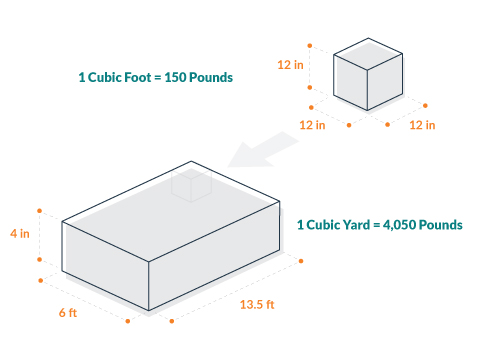
Image Source: www.dumpsters.com
Fathoming the Weight of Concrete
Concrete is a composite material, a blend of cement, aggregate (like gravel and sand), water, and sometimes admixtures. When these ingredients combine, they create a substance that is strong and durable once it cures. However, before it hardens, it’s a malleable, heavy material. The concrete density wet is what dictates its weight.
What Affects the Weight of Wet Concrete?
Several elements contribute to the overall weight of a cubic yard of wet concrete. Understanding these can help explain why you might see slight variations in figures.
The Mix Design
The exact proportions of cement, sand, gravel, and water in a concrete mix are the most significant factors.
- Aggregate Type and Size: The type of stone or gravel used as aggregate plays a big role. Denser aggregates, like granite or crushed stone, will result in heavier concrete compared to lighter aggregates like limestone or lightweight expanded shale. The size of the aggregate also matters; larger aggregates can create voids, potentially reducing the overall density slightly, though this is often counteracted by the weight of the stone itself.
- Water-Cement Ratio: The amount of water used in the mix is critical. More water generally leads to a more workable (wetter) mix, but it can also decrease the concrete’s ultimate strength and, in some cases, slightly alter its density per cubic yard.
- Admixtures: Additives like air-entraining agents, water reducers, or specialty chemicals can be incorporated. While their primary purpose isn’t to change the weight dramatically, some admixtures might subtly influence the final wet concrete weight per cubic yard.
Moisture Content
This might seem obvious given we’re discussing “wet” concrete, but the precise moisture content from the water added during mixing is directly accounted for in its weight.
Air Entrapment
During mixing, tiny air bubbles can become incorporated into the concrete. While intended to improve durability (especially against freeze-thaw cycles), these air pockets occupy space that would otherwise be filled with denser material, thus slightly reducing the overall weight per cubic yard.
The Standard Calculation: Concrete Weight Per Yard Wet
For typical residential and commercial construction, standard concrete mixes have a predictable weight. This is why you’ll often hear figures that are very close to each other when people discuss concrete weight per yard wet.
A common reference point is that a standard cubic yard of concrete weighs approximately 4,000 pounds. This figure is a good general guideline.
Breakdown of Components and Their Weights
To better grasp how much does a yard of concrete weigh, let’s look at the components that make up a typical concrete mix and their approximate densities:
- Cement: Dry Portland cement has a density of about 94 pounds per cubic foot.
- Sand (Fine Aggregate): Dry sand typically weighs around 100-110 pounds per cubic foot.
- Gravel (Coarse Aggregate): Gravel can range from 100-120 pounds per cubic foot, depending on the type and packing.
- Water: Water weighs approximately 62.4 pounds per cubic foot.
A typical concrete mix might use roughly these proportions (by volume, which is then converted to weight):
- 1 part cement
- 2 parts sand
- 3 parts gravel
- 0.5 parts water
When these are combined and considered in their wet state, the aggregate and cement are the primary contributors to the bulk weight, with water adding to the overall mass without significantly increasing volume.
Estimating the Weight: A Concrete Wet Weight Estimator
Using a concrete wet weight estimator is often as simple as recalling the standard figures. However, for more precise needs, you can perform a basic calculation.
How to Calculate Wet Concrete Weight
To calculate the concrete volume to weight wet, you need to know the density of the specific concrete mix. If you don’t have this information from the concrete supplier, you can use the general density figures.
Let’s do a simple wet concrete calculation for a standard mix:
- Volume Conversion: A cubic yard is equal to 27 cubic feet.
- Density Approximation: A common concrete density wet is around 150 pounds per cubic foot. This density already factors in the aggregate, cement, water, and typical air entrainment.
Therefore, to find the wet concrete weight per cubic yard:
- Weight = Volume × Density
- Weight = 27 cubic feet/cubic yard × 150 pounds/cubic foot
- Weight = 4,050 pounds per cubic yard
This 4,050 pounds is a widely accepted figure for how much does a yard of concrete weigh wet.
Table: Typical Weights of Concrete Components (per cubic foot)
| Component | Dry Weight (lbs/cu ft) | Notes |
|---|---|---|
| Cement | 94 | Dry, loose cement |
| Sand | 100-110 | Dry, loose |
| Gravel | 100-120 | Dry, loose, depends on type and size |
| Water | 62.4 | Standard density |
| Wet Concrete (Standard Mix) | ~145-155 | Approximate density, includes all components |
Practical Implications of Wet Concrete Weight
The weight of concrete has significant practical implications:
Transportation
- Truck Capacity: Concrete trucks (cement mixers) have weight limits. Knowing the weight of concrete is essential for ensuring trucks are not overloaded, which is a safety hazard and can lead to fines. A typical concrete truck can carry 9-11 cubic yards. For 10 cubic yards, this would be around 40,000 pounds of concrete alone, not including the weight of the truck itself.
- Delivery Logistics: For smaller jobs requiring less than a full truckload, knowing the weight helps in coordinating deliveries and understanding potential costs.
Structural Support
- Foundations and Slabs: The weight of concrete directly impacts the load on the ground and any supporting structures. Engineers use the concrete weight per yard wet to calculate foundation requirements and ensure the ground can support the intended structure.
- Formwork and Scaffolding: During the pouring process, the wet concrete exerts significant pressure on its forms. Knowing the weight helps in designing formwork that can withstand this pressure.
Lifting and Handling
- Precast Concrete: For precast concrete elements (like slabs, beams, or walls), their weight is critical for determining the lifting equipment required. A cubic yard concrete weight wet of 4,000 pounds means even small sections can be very heavy.
Variations in Concrete Weight
While 4,000 pounds per cubic yard is a common benchmark, it’s not absolute.
Lightweight Concrete
Special mixes designed to be lighter exist. These often use lightweight aggregates like expanded clay, shale, or pumice. They can weigh as little as 90-115 pounds per cubic foot, translating to roughly 2,400-3,100 pounds per cubic yard. These are used in applications where reducing dead load is important, such as in high-rise buildings or bridge decks.
Heavyweight Concrete
Conversely, concrete can be made denser. Using heavy aggregates like barite or magnetite can increase the density to 200-300 pounds per cubic foot or more (5,400-8,100+ pounds per cubic yard). This type of concrete is used for radiation shielding or in specialized structural applications.
How to Find the Exact Weight for Your Project
The most accurate way to determine the weight of your concrete is to ask your concrete supplier for the concrete density wet of the specific mix you are ordering. They can provide a precise specification based on their batching process.
If you’re mixing concrete yourself, you’ll need to know the exact quantities and densities of the materials you are using. This allows for a more accurate how to calculate wet concrete weight.
Example of a DIY Calculation (Simplified)
Let’s assume you are mixing 1 cubic yard of concrete (27 cubic feet) with:
- 6 bags of cement (94 lbs/bag) = 564 lbs
- 1000 lbs of sand
- 1600 lbs of gravel
- Water (enough to achieve workability, let’s estimate 30 gallons, which is about 250 lbs)
Total dry ingredients weight = 564 + 1000 + 1600 = 3164 lbs.
Total wet weight = 3164 lbs + 250 lbs (water) = 3414 lbs.
This seems low. This is where the concept of density per cubic foot becomes crucial, as dry ingredients don’t perfectly fill the volume, and the water fills voids.
A better approach for DIY:
- Determine the volume of each component: For a 1:2:3 mix by volume, if you aim for 1 cubic yard of concrete, the total dry volume components would be roughly 6 cubic yards (1+2+3), but this is simplified. A more accurate batching method is required.
- Use a proven recipe: Many concrete calculators are available online that guide you through proportions for a specific volume of concrete. These recipes are based on established densities.
For example, for one cubic yard of concrete (27 cubic feet), a typical dry mix might require:
- Cement: ~470-500 lbs
- Sand: ~1,250-1,350 lbs
- Gravel: ~1,750-1,850 lbs
- Water: ~220-250 lbs
Total weight of dry ingredients = 470 + 1250 + 1750 = 3470 lbs.
Total wet concrete weight = 3470 lbs + 220 lbs (water) = 3690 lbs.
This calculation is still an approximation because the bulk densities of dry aggregates when mixed are not simply additive of their loose densities due to how they pack. This is why relying on the supplier’s stated density or a pre-calculated mix design is best.
The Role of Water in Wet Concrete Weight
Water is a key ingredient. It hydrates the cement, allowing it to harden and bind the aggregates together. The amount of water added affects:
- Workability: More water makes the concrete easier to mix and pour.
- Strength: Too much water weakens the concrete. The water-cement ratio is a critical factor.
- Weight: As mentioned, water adds mass. The weight of the water in a cubic yard is included in the total wet concrete weight.
If you have a recipe that specifies water by volume (e.g., gallons), remember that 1 gallon of water weighs about 8.34 pounds.
Converting Gallons of Water to Pounds
- 1 gallon of water ≈ 8.34 lbs
- If your mix uses 30 gallons of water per cubic yard: 30 gallons × 8.34 lbs/gallon ≈ 250.2 lbs of water.
Using a Concrete Weight Per Yard Wet Estimator Tool
Online tools can be helpful. You input the type of concrete (e.g., standard, high-strength, lightweight) and the volume (e.g., cubic yards), and they provide an estimated weight. These tools typically use the standard densities we’ve discussed. They are excellent for initial planning and estimations.
Summary: Key Takeaways on Wet Concrete Weight
- Standard Weight: A cubic yard of wet concrete typically weighs around 4,000 pounds.
- Density is Key: The concrete density wet is approximately 150 pounds per cubic foot.
- Influencing Factors: Mix design (aggregates, cement, water) and admixtures affect the weight.
- Supplier Information: Always ask your concrete supplier for the specific weight or density of your chosen mix.
- Calculation: Weight = Volume (cubic yards) × 27 (cu ft/cu yd) × Density (lbs/cu ft).
Frequently Asked Questions (FAQ)
Q1: How much does a cubic yard of concrete weigh if it’s dry?
A1: Dry concrete, meaning after it has cured and lost all excess moisture, will weigh slightly less than wet concrete. However, “dry” in concrete terminology usually refers to the material before water is added. Once cured, the moisture content is minimal and accounted for in the cured density. The term “wet” specifically refers to the freshly mixed state.
Q2: Does the color of concrete affect its weight?
A2: Pigments used to color concrete are typically added in very small quantities relative to the total volume. Therefore, they have a negligible impact on the overall weight of wet concrete per cubic yard.
Q3: How can I estimate the weight of concrete for my project?
A3: Use the general guideline of 4,000 pounds per cubic yard for standard mixes. For more precision, consult your concrete supplier or use online concrete wet weight estimator tools that factor in different mix types.
Q4: Why is knowing the wet concrete weight important?
A4: It’s crucial for transportation logistics (truck weight limits), structural engineering calculations (load bearing), formwork design, and ensuring safety during construction.
Q5: What if I need a lighter or heavier concrete mix?
A5: You can order specialty mixes. Lightweight concrete uses lighter aggregates, and heavyweight concrete uses denser aggregates for specific applications like radiation shielding. Always discuss your specific needs with your concrete supplier.
Q6: Is the weight of a concrete truck included in the weight of the concrete itself?
A6: No, when people refer to the wet concrete weight per cubic yard, they are referring solely to the mass of the concrete mixture itself, not the vehicle transporting it. The truck’s weight is separate.
By keeping these facts in mind, you can confidently navigate the practicalities of working with concrete, ensuring your projects are safe, efficient, and structurally sound.