
A yard of mulch typically covers approximately 100 square feet at a 3-inch depth, which is the recommended depth for most landscaping applications. This is a crucial piece of information for anyone embarking on a landscaping project, whether it’s a small garden bed or a larger outdoor space. Knowing your mulch coverage helps you avoid overspending or making multiple trips to the garden center. We’ll delve into the specifics of how many square feet will a yard of mulch cover and provide you with the tools and knowledge to accurately estimate your needs.
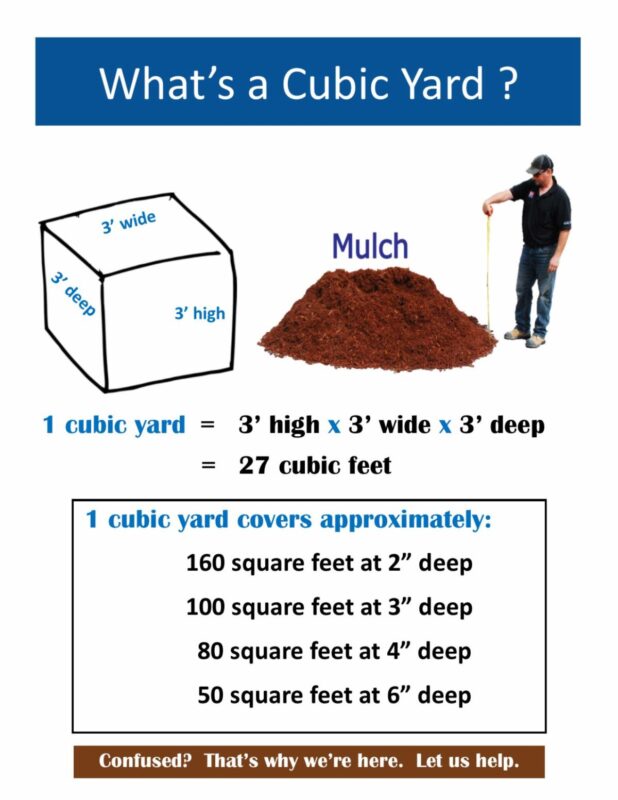
Image Source: stonegarden-nc.com
Deciphering Mulch Volume: From Cubic Feet to Square Feet
Before we can determine how much area a yard of mulch will cover, we need to grasp a fundamental concept: the difference between volume and area. Mulch is sold by volume, usually in cubic yards or cubic feet. Your garden beds, however, are measured by area, in square feet. The key to calculating mulch needs lies in converting these units and accounting for the desired depth.
The Math Behind Mulch Coverage
The conversion from cubic feet to square feet mulch coverage is based on depth. Think of it like spreading a blanket over a floor. The size of the blanket (volume) and how thick you lay it down (depth) will determine how much of the floor (area) it covers.
A standard cubic yard of mulch contains 27 cubic feet (3 feet x 3 feet x 3 feet = 27 cubic feet).
When we talk about landscaping mulch coverage, we’re generally considering a depth of 2 to 4 inches. For most applications, 3 inches is the sweet spot. It’s deep enough to suppress weeds and retain moisture but not so deep that it suffocates plant roots.
Let’s break down the calculation for a common scenario:
- Desired Mulch Depth: 3 inches (which is 0.25 feet, or 3/12)
- Volume of Mulch: 1 cubic yard = 27 cubic feet
To find the area covered, we use the formula:
Area = Volume / Depth
So, for 1 cubic yard of mulch:
Area = 27 cubic feet / 0.25 feet
Area = 108 square feet
This calculation demonstrates why the general rule of thumb is around 100 square feet per cubic yard. Slight variations in calculations or slight differences in how mulch settles can account for this minor difference.
Factors Influencing Mulch Coverage
While the 100 sq ft per cubic yard rule is a good starting point, several factors can affect your actual mulch coverage:
- Desired Mulch Depth: This is the most significant factor. If you opt for a deeper layer, your mulch will cover a smaller area. Conversely, a shallower layer will extend your coverage.
- Type of Mulch: Some mulches are fluffier and less dense, meaning they will compress more and potentially cover a slightly larger area. Denser mulches might settle more, requiring a bit more to achieve the same depth.
- Compaction: As mulch settles over time due to rain and foot traffic, it becomes more compacted. This means an initial application might appear to cover more area than it does after a few weeks.
- Uneven Terrain: Sloping or uneven garden beds can make it challenging to maintain a consistent mulch depth, which can impact your overall coverage.
Calculating Your Mulch Needs: A Step-by-Step Guide
Accurate calculating mulch needs is key to an efficient and cost-effective landscaping project. You don’t want to run out halfway through, nor do you want to be left with excess bags you won’t use.
Step 1: Measure Your Area
First, you need to determine the total square footage of the areas you plan to mulch. This usually involves measuring the length and width of each garden bed or planting area.
- Rectangular Areas: Multiply length by width.
- Example: A garden bed that is 10 feet long and 4 feet wide has an area of 10 ft * 4 ft = 40 square feet.
- Circular Areas: Use the formula: π * radius² (where π is approximately 3.14 and radius is half the diameter).
- Example: A circular garden bed with a diameter of 6 feet has a radius of 3 feet. The area is 3.14 * (3 ft)² = 3.14 * 9 sq ft = 28.26 square feet.
- Irregular Shapes: Break down the irregular shape into smaller, manageable geometric shapes (rectangles, squares, triangles, circles). Calculate the area of each shape and add them together.
Tip: Sketching your garden layout and marking the dimensions can be very helpful.
Step 2: Determine Your Desired Mulch Depth
As mentioned, 2-4 inches is typical. For new plantings or areas with persistent weeds, 3-4 inches is often recommended. For established beds as a top-up, 2-3 inches might suffice. Your mulch depth calculator will rely heavily on this measurement.
Step 3: Convert Depth to Feet
Since mulch is sold in cubic yards or cubic feet, and areas are measured in square feet, you need to ensure your depth measurement is in feet.
- 1 inch = 1/12 feet
- 2 inches = 2/12 feet = 1/6 feet ≈ 0.167 feet
- 3 inches = 3/12 feet = 1/4 feet = 0.25 feet
- 4 inches = 4/12 feet = 1/3 feet ≈ 0.333 feet
Step 4: Calculate Total Cubic Feet Needed
Now you can calculate the total volume of mulch you need in cubic feet using this formula:
Total Cubic Feet = Total Square Footage × Desired Depth in Feet
- Example: If you have 120 square feet to cover and want a 3-inch (0.25 ft) depth:
Total Cubic Feet = 120 sq ft * 0.25 ft = 30 cubic feet
Step 5: Convert Cubic Feet to Cubic Yards
Since mulch is often sold in cubic yards, convert your total cubic feet to cubic yards by dividing by 27 (since 1 cubic yard = 27 cubic feet).
Total Cubic Yards = Total Cubic Feet / 27
- Example (continuing from above):
Total Cubic Yards = 30 cubic feet / 27 ≈ 1.11 cubic yards
Important Note: Always round up your cubic yardage to the nearest half or full yard. It’s better to have a little extra mulch than to run out.
Mulch Bag Coverage: What to Expect from Pre-Packaged Mulch
Many homeowners opt for bagged mulch for smaller projects. Understanding mulch bag coverage is crucial for efficient purchasing.
Bagged mulch typically comes in sizes like 2 cubic feet or 3 cubic feet. The packaging usually states the coverage area at a specific depth. However, it’s always good to know how to calculate it yourself.
Let’s consider a common scenario: a 2 cubic foot bag of mulch.
If you aim for a 3-inch (0.25 ft) depth:
Area per bag = Volume of bag (in cubic feet) / Desired depth (in feet)
Area per bag = 2 cubic feet / 0.25 feet
Area per bag = 8 square feet
So, one 2 cubic foot bag of mulch should cover approximately 8 square feet at a 3-inch depth.
If you’re using a 3 cubic foot bag:
Area per bag = 3 cubic feet / 0.25 feet
Area per bag = 12 square feet
This means a 3 cubic foot bag will cover about 12 square feet at a 3-inch depth.
Table: Mulch Bag Coverage at 3-inch Depth
| Bag Size (Cubic Feet) | Estimated Area Covered (Square Feet) |
|---|---|
| 2 | 8 |
| 3 | 12 |
When you’re at the store, check the bag for coverage information. If it’s not listed, you can use these calculations. Remember that these are estimates, and actual coverage can vary.
Using a Mulch Coverage Calculator
To simplify the estimating mulch coverage process, many online resources offer a mulch coverage calculator. These tools are incredibly handy. You typically input the dimensions of your garden beds (length, width, and sometimes shape) and your desired mulch depth, and the calculator provides an estimate in cubic feet or cubic yards.
These calculators essentially perform the calculations we’ve outlined above. They are a great way to double-check your own math or to quickly get an estimate for multiple areas. When using a mulch volume calculator, ensure you input accurate measurements for the best results.
The Importance of Correct Mulch Depth
Choosing the right mulch depth is as important as calculating the right amount. A mulch depth calculator is more than just a tool for calculating quantity; it helps ensure you’re applying it effectively.
Benefits of Proper Mulch Depth:
- Weed Suppression: A 3-4 inch layer is generally effective at blocking sunlight, preventing weed seeds from germinating. A shallower layer might not be as effective.
- Moisture Retention: Mulch acts like a blanket, reducing evaporation from the soil surface. The correct depth ensures this moisture-saving benefit is maximized.
- Temperature Regulation: Mulch helps keep soil temperatures more stable, protecting plant roots from extreme heat and cold.
- Erosion Control: A good layer of mulch helps hold soil in place, especially on slopes, preventing it from being washed away by rain.
- Aesthetics: A consistent, well-maintained mulch layer gives garden beds a tidy and professional appearance.
Risks of Incorrect Mulch Depth:
- Too Shallow: Ineffective weed suppression, faster drying of soil, and less temperature regulation.
- Too Deep (over 4 inches): Can suffocate plant roots by limiting oxygen and moisture exchange. It can also encourage root rot and fungal diseases. Some mulches, like fine bark, can become too compacted when applied too deeply, hindering water penetration.
When spreading mulch, use a measuring tape to check your depth periodically. This ensures you’re achieving the desired coverage and depth consistently across your garden.
Types of Mulch and Their Coverage Characteristics
While the basic math for mulch coverage remains the same, different mulch types can behave slightly differently in terms of density and how they spread.
Organic Mulches:
- Wood Chips/Bark Mulch: Very common and popular. Available in various sizes (fine, medium, coarse). Coarser chips tend to be less dense and might spread a bit further. Bark mulches can decompose over time, adding nutrients to the soil.
- Shredded Bark: Often made from pine or cedar. It tends to be lighter and can interlock, providing good coverage.
- Composted Bark/Wood Fines: Finer textured, can be denser.
- Straw/Hay: Excellent for vegetable gardens and erosion control. Very lightweight and can spread widely, but decomposes relatively quickly.
- Pine Needles (Pine Straw): Lightweight and acidic, good for acid-loving plants. Spreads easily.
- Grass Clippings: Free and readily available, but can mat down and become hydrophobic if applied too thickly. Best used in thin layers.
- Leaf Mold/Shredded Leaves: Decomposed leaves are excellent soil conditioners. They can be bulky when first shredded but will break down.
Inorganic Mulches:
- Gravel/Stone: Does not decompose. Provides excellent drainage and weed suppression. Coverage is primarily about volume filling the space. Can be heavier, so distribution is more about how much mass you’re adding.
- Rubber Mulch: Made from recycled tires. Durable and long-lasting. Density can vary.
When considering landscaping mulch coverage, think about the intended lifespan and maintenance. Organic mulches will need replenishing more often than inorganic ones, but they also enrich the soil.
Tips for Efficient Mulch Application
Proper spreading mulch techniques can ensure you get the best coverage and the most benefit from your purchase.
Preparing Your Beds:
- Weed Thoroughly: Remove all existing weeds and their roots before applying mulch. This is crucial for effective weed suppression.
- Loosen Compacted Soil: Gently loosen the soil surface with a garden fork. This improves drainage and aeration.
- Edge Your Beds: Create a clean edge along your garden beds. This makes mulching easier and gives a neater appearance.
Application Techniques:
- Work in Sections: Don’t try to mulch an entire large area at once. Break it down into manageable sections.
- Use a Shovel and Rake: Use a shovel to transfer mulch from a wheelbarrow to the garden bed. A garden rake is excellent for spreading and leveling the mulch evenly.
- Maintain the “Donut Hole”: Keep mulch a few inches away from the base of plant stems and tree trunks. This prevents rot and fungal diseases. This is a critical aspect of proper mulching, even beyond basic mulch coverage.
- Check Depth as You Go: Use a ruler or a trowel to periodically check the depth of the mulch. Aim for your desired thickness across the entire area.
- Overlap Slightly: If you’re using multiple bags or a bulk delivery, slightly overlap the edges of your mulch application to ensure continuous coverage.
Frequently Asked Questions (FAQ)
Q1: How much area will one bag of mulch cover?
A typical 2 cubic foot bag of mulch will cover approximately 8 square feet at a 3-inch depth. A 3 cubic foot bag will cover about 12 square feet. Always check the bag for specific coverage information, but these are good general estimates for mulch bag coverage.
Q2: Can I use a mulch depth calculator for different types of mulch?
Yes, the principle of mulch coverage remains the same regardless of the mulch type. The calculator helps you determine the volume needed for a specific area and depth. However, the density and settling characteristics of different mulches might mean you adjust your depth slightly in practice.
Q3: How do I calculate mulch for a very large area?
For large areas, it’s often more economical to purchase mulch in bulk (by the cubic yard). Use the steps outlined in the “Calculating Your Mulch Needs” section. You can use a mulch volume calculator or perform the calculations manually. Remember to measure accurately and round up your order.
Q4: What is the best mulch depth for weed control?
Generally, a mulch depth of 3 to 4 inches is considered optimal for effective weed suppression. Any less, and weeds can germinate. Any more, and you risk plant root suffocation. Your mulch depth calculator should help you achieve this.
Q5: Do I need to factor in mulch settling when calculating coverage?
While it’s hard to predict precisely how much mulch will settle, it’s wise to consider it. If you’re aiming for a precise depth, applying slightly more initially and then adjusting can be helpful. The estimates provided, especially the 100 sq ft per cubic yard for 3-inch depth, account for some typical settling. For accurate estimating mulch coverage, it’s good to have a small buffer.
Q6: How do I convert cubic feet to square feet for mulch?
To convert cubic feet to square feet mulch, you divide the total cubic feet of mulch by your desired depth in feet. For example, if you have 27 cubic feet of mulch and want a 3-inch (0.25 ft) depth, you divide 27 by 0.25 to get 108 square feet of coverage. This is the core of calculating mulch needs.
By now, you should have a clear grasp of how to determine exactly how many square feet a yard of mulch will cover. With accurate measurements and the right tools, like a mulch coverage calculator, you can efficiently plan your landscaping projects and achieve beautiful, healthy results. Happy mulching!