
A yard of mulch typically covers about 100 square feet at a depth of 3 inches. This handy guide will delve into the specifics of mulch coverage, helping you figure out exactly how much you need for your next landscaping project. We’ll explore how to calculate mulch needs, the factors influencing coverage, and provide practical tips for purchasing and applying.
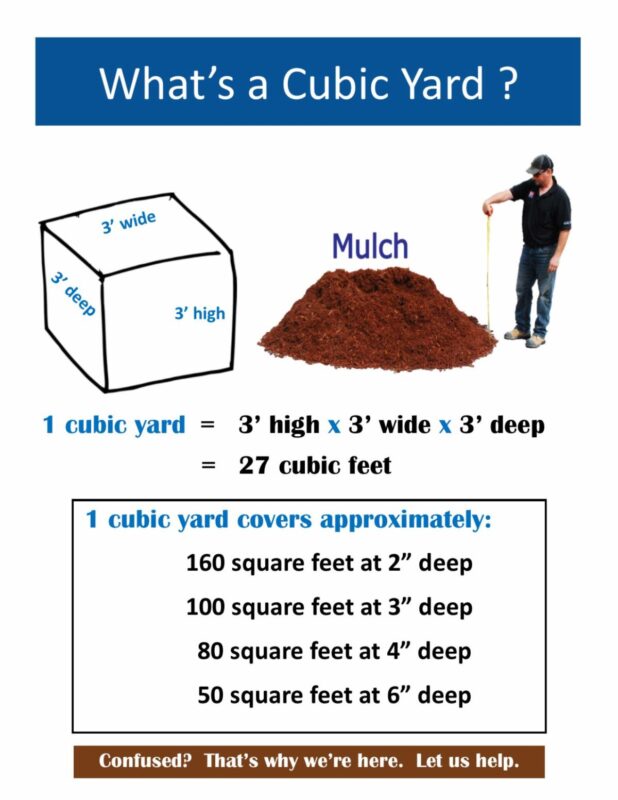
Image Source: stonegarden-nc.com
Deciphering Mulch Coverage: The Basics
When you’re planning a garden bed or a new landscape feature, knowing how much mulch to buy is crucial. Too little, and your plants won’t get the full benefits. Too much, and you’ve wasted money and effort. The core question on many gardeners’ minds is: How many square feet does a yard of mulch cover? The most common answer, assuming a standard 3-inch depth, is approximately 100 square feet. However, this is a general guideline, and several factors can influence the actual mulch area coverage.
What is a “Yard” of Mulch?
Before we dive into calculations, it’s essential to clarify what a “yard” of mulch means in this context. When landscapers or garden centers talk about a “yard” of mulch, they are referring to a cubic yard. A cubic yard is a unit of volume, measuring 3 feet by 3 feet by 3 feet. This volume contains 27 cubic feet. So, when you purchase a yard of mulch, you are buying a specific volume, not a length.
The Importance of Depth
The depth at which you apply mulch is perhaps the most significant factor determining its coverage. While 3 inches is a standard recommendation for most applications, you might choose a different depth.
- Shallow applications (1-2 inches): This might be suitable for areas with annual flowers or as a light top dressing. However, it offers less weed suppression and moisture retention. You’ll get more square feet of mulch coverage with shallower depths.
- Standard applications (3 inches): This is generally the sweet spot. It provides excellent weed control, helps retain soil moisture, moderates soil temperature, and improves soil structure as it decomposes. This is where the 100 sq ft per cubic yard figure typically comes from.
- Deep applications (4+ inches): This can be beneficial for trees and shrubs, especially in areas with compacted soil or significant weed pressure. However, applying mulch too deeply around the base of plants can suffocate roots and promote rot, so caution is advised. Deeper application means less square feet of mulch coverage per cubic yard.
Factors Affecting Mulch Coverage
Several variables can influence how much area your mulch will cover:
- Application Depth: As discussed, this is the primary determinant.
- Type of Mulch: While the volume remains the same, the way different mulches settle can slightly alter coverage. For instance, larger, chunkier mulches might not compact as much as finer mulches, potentially covering a slightly larger area at the same visual depth.
- Ground Texture: Uneven or very loose soil might require slightly more mulch to achieve a consistent depth compared to firm, level ground.
- Desired Aesthetic: Some prefer a thicker, more luxurious look, while others opt for a lighter spread.
Calculating Your Mulch Needs: A Step-by-Step Approach
Accurately determining how much mulch do I need is a straightforward process if you break it down. The key is to calculate the area you want to cover and then decide on the desired depth.
Step 1: Measure Your Area
Before anything else, you need to know the dimensions of the space you intend to mulch.
-
Rectangular or Square Areas:
- Measure the length of the area in feet.
- Measure the width of the area in feet.
- Multiply length by width to get the square footage.
- Formula: Length (ft) × Width (ft) = Area (sq ft)
-
Circular Areas:
- Measure the diameter of the circle in feet (the distance across the widest part, passing through the center).
- Divide the diameter by 2 to find the radius.
- Use the formula for the area of a circle: Area (sq ft) = π × radius² (ft) (where π is approximately 3.14).
-
Irregular Shapes:
- Break down the irregular shape into smaller, more manageable geometric shapes (rectangles, squares, circles, triangles).
- Calculate the area of each individual shape.
- Add the areas of all the individual shapes together to get the total square footage.
Example:
Let’s say you have a rectangular garden bed that is 10 feet long and 5 feet wide.
Area = 10 ft × 5 ft = 50 sq ft.
If you have a circular flower bed with a diameter of 6 feet:
Radius = 6 ft / 2 = 3 ft
Area = 3.14 × (3 ft)² = 3.14 × 9 sq ft = 28.26 sq ft.
Step 2: Determine Your Desired Mulch Depth
As discussed, the standard recommendation is 3 inches. However, you might choose differently. Convert your desired depth into feet for easier calculation.
- Conversion: 1 inch = 1/12 feet.
- So, 3 inches = 3/12 feet = 0.25 feet.
- 1 inch = 0.083 feet.
- 2 inches = 0.167 feet.
- 4 inches = 0.333 feet.
Step 3: Calculate the Volume of Mulch Needed
Now that you have the area and the desired depth, you can calculate the volume of mulch required. The formula for volume is:
- Volume (cubic feet) = Area (sq ft) × Depth (ft)
Example (Continuing from Step 1):
For the rectangular bed (50 sq ft) and a desired depth of 3 inches (0.25 ft):
Volume = 50 sq ft × 0.25 ft = 12.5 cubic feet.
Step 4: Convert Cubic Feet to Cubic Yards
Most mulch is sold by the cubic yard. Since there are 27 cubic feet in a cubic yard, you’ll need to convert your calculated volume.
- Volume (cubic yards) = Volume (cubic feet) / 27
Example (Continuing):
For our rectangular bed needing 12.5 cubic feet:
Volume (cubic yards) = 12.5 cubic feet / 27 ≈ 0.46 cubic yards.
Since you can’t typically buy fractions of a cubic yard, you would round up to the nearest purchase increment, which is usually a full cubic yard or half cubic yard. In this case, you’d likely buy 0.5 cubic yards or 1 cubic yard to be safe.
Handy Conversion Tools and Estimators
While manual calculation is effective, several tools can simplify the process.
Mulch Coverage Calculator
Many gardening websites and landscape supply companies offer free mulch coverage calculator tools. You simply input your dimensions (length, width, and sometimes shape) and desired depth, and the calculator instantly tells you how many cubic yards or bags of mulch you need. These are incredibly useful for quickly estimating for larger or more complex areas.
Mulch Estimator
Similar to a calculator, a mulch estimator helps you gauge your needs. Some estimators even allow you to select the type of mulch, and they might factor in common settling rates. They often provide a breakdown of how many bags you’ll need if you’re buying in pre-packaged quantities, considering the cubic feet of mulch per bag.
The Yard of Mulch to Square Feet Ratio
To reiterate the core of the question: How many square feet does a yard of mulch cover?
A general rule of thumb is:
- 1 cubic yard of mulch covers approximately 100 square feet at a 3-inch depth.
- 1 cubic yard of mulch covers approximately 150 square feet at a 2-inch depth.
- 1 cubic yard of mulch covers approximately 75 square feet at a 4-inch depth.
This can be visualized with a simple table:
| Desired Depth | Coverage per Cubic Yard (approximate) |
|---|---|
| 2 inches | 150 sq ft |
| 3 inches | 100 sq ft |
| 4 inches | 75 sq ft |
This table can serve as a quick reference for your mulch coverage guide.
Practical Tips for Buying and Applying Mulch
Once you’ve calculated your needs, consider these practical aspects:
Bagged vs. Bulk Mulch
Mulch is available in both bagged and bulk quantities.
-
Bagged Mulch:
- Typically sold in bags containing 2 or 3 cubic feet of mulch.
- Convenient for smaller projects or for topping up existing beds.
- Easier to transport if you don’t have a truck or trailer.
- Often more expensive per cubic foot than bulk mulch.
- You’ll need to know the cubic feet of mulch per bag to calculate how many bags you need. For example, if you need 2 cubic yards (54 cubic feet) and bags are 2 cubic feet each, you’d need 54 / 2 = 27 bags.
-
Bulk Mulch:
- Sold by the cubic yard.
- Requires a truck, trailer, or delivery service.
- Generally more cost-effective for larger areas.
- Delivered directly to your home, saving you the effort of loading multiple bags.
Choosing the Right Mulch Type
Different types of mulch offer varying benefits and aesthetics:
- Wood Mulches (Bark, Chips, Shredded Bark): Durable, long-lasting, excellent for weed suppression and moisture retention. Available in various colors and textures.
- Shredded Bark Mulch: Often made from pine or cedar, it’s lightweight and has a pleasant aroma. It decomposes slowly.
- Wood Chips: Larger pieces, often from hardwood. They offer good drainage and can be quite decorative.
- Sawdust: Decomposes quickly and can tie up nitrogen in the soil as it breaks down, so it’s often best used as a compost ingredient.
- Organic Mulches (Straw, Grass Clippings, Leaves): Readily available and inexpensive if you produce them yourself. They decompose quickly, adding nutrients to the soil. Best for vegetable gardens or areas where frequent replenishment is desired.
- Inorganic Mulches (Gravel, Stones, Rubber Mulch): Not for soil improvement but for decorative purposes and weed suppression. They don’t decompose but can sometimes retain too much heat.
Application Best Practices
Applying mulch correctly maximizes its benefits and prevents potential problems:
- Prepare the Area: Remove weeds, grass, and debris from the area you intend to mulch.
- Moisten the Soil: Lightly water the soil before applying mulch, especially if it’s dry.
- Apply Evenly: Spread the mulch evenly over the area to your desired depth. Use a rake to distribute it.
- Avoid the Crown of Plants: Keep mulch a few inches away from the base of tree trunks and the stems of plants. This “mulch volcano” can trap moisture and lead to rot and disease.
- Layering: For bagged mulch, ensure you’re getting the stated volume. Sometimes bags can be compressed. Fluffing it up can reveal the true amount.
Advanced Calculations and Considerations
For more precise landscaping, you might need to consider these points.
Calculating Mulch Needed for Specific Projects
Let’s look at a few common project types:
Landscaping Beds
These are typically the most common areas for mulching.
Example: A long, winding flower bed.
* Measure the total length in feet.
* Estimate the average width in feet.
* Calculate the area: Length × Average Width = Square Footage.
* Then, use the mulch volume calculation as outlined earlier.
Around Trees
Mulching around trees helps conserve moisture and protect roots.
* Measure the diameter of the tree’s canopy spread (the widest point).
* Calculate the area of the circle: π × (Canopy Diameter / 2)² = Square Footage.
* Apply mulch from the trunk outwards to the edge of the canopy, keeping it a few inches away from the trunk itself.
Vegetable Gardens
Mulch in vegetable gardens helps suppress weeds, retain moisture, and keep produce clean.
* Measure the length and width of rows or beds.
* Calculate the total square footage.
* For vegetable gardens, a slightly thinner layer (2-3 inches) is often sufficient.
Understanding Mulch Coverage Tables
To effectively calculate mulch needed, having reliable coverage data is key. Here’s a more detailed look at how mulch area coverage can vary with depth:
| Desired Depth (inches) | Desired Depth (feet) | Coverage per Cubic Yard (sq ft) | Coverage per Cubic Yard (sq m) |
|---|---|---|---|
| 1 | 0.083 | 300 | 27.9 |
| 2 | 0.167 | 150 | 13.9 |
| 3 | 0.25 | 100 | 9.3 |
| 4 | 0.333 | 75 | 7.0 |
| 5 | 0.417 | 60 | 5.6 |
| 6 | 0.5 | 50 | 4.6 |
This table is a powerful mulch estimator tool. For instance, if you have a 200 sq ft area and want a 3-inch depth, you know 1 cubic yard covers 100 sq ft. Therefore, you’ll need 200 sq ft / 100 sq ft/yard = 2 cubic yards of mulch.
The Importance of Buying Extra
It’s almost always wise to purchase slightly more mulch than your exact calculation.
- Settling: Mulch, especially organic types, will settle and compact over time, especially after rain.
- Uneven Application: It’s difficult to achieve perfectly uniform depth across an entire area.
- Touch-ups: You might want to replenish or thicken areas later.
A good rule of thumb is to add an extra 5-10% to your calculated amount. This ensures you have enough to complete the job without running short, which can be costly and inconvenient if you need to make a second trip to the garden center.
Frequently Asked Questions (FAQ)
Q1: How many square feet does a bag of mulch cover?
A bag of mulch typically contains 2 or 3 cubic feet. If a bag is 2 cubic feet, and you’re applying mulch at a 3-inch depth (which requires 0.25 cubic feet per square foot), then one bag covers approximately 2 cubic feet / 0.25 cubic feet/sq ft = 8 square feet. If the bag is 3 cubic feet, it covers about 12 square feet. Always check the bag for its exact cubic foot volume.
Q2: Can I use less mulch if my area has a lot of weeds?
While you can apply mulch at a thinner depth, it will be less effective at suppressing weeds. For areas with heavy weed pressure, sticking to the recommended 3-4 inch depth is best. If you’re on a tight budget, consider a combination approach: a thinner layer of more expensive decorative mulch over a thicker layer of less expensive organic material like shredded leaves or compost.
Q3: Does the type of mulch affect how much area it covers?
The volume (cubic yards or cubic feet) is what determines coverage. However, some mulches, like large wood chips, may not settle as much as fine shredded mulches. This means at a visually similar depth, wood chips might have a slightly larger mulch area coverage because they contain more air pockets. Still, for calculation purposes, rely on volume and desired depth.
Q4: How do I calculate mulch for a curved pathway?
For curved pathways or irregular shapes, you can approximate by breaking the curve into several short, straight line segments. Measure the length of each segment and the average width of the pathway. Add up the areas of these small rectangular sections to get your total square footage. Alternatively, use a mulch coverage calculator tool that allows for more complex shape inputs.
Q5: What is a typical “cubic feet of mulch per bag”?
Most commonly, mulch is sold in bags containing either 2 cubic feet or 3 cubic feet of material. Some smaller bags might contain less, and very large bags could contain more, but these are the standard sizes you’ll find at garden centers.
Q6: Is it better to buy mulch by the bag or in bulk?
For small gardens or touch-ups, bagged mulch is convenient. For larger landscaping projects covering several hundred or thousands of square feet, buying in bulk by the cubic yard is usually more economical and efficient. Always compare the price per cubic yard or cubic foot to make the best decision for your budget and project size.
By following these guidelines and using the provided tools and formulas, you can confidently determine how much mulch do I need for any project, ensuring healthy, beautiful, and well-maintained landscape beds. Happy mulching!