
A cubic yard covers a specific square footage depending on the depth you spread it. Generally, a cubic yard of material spread at a depth of 1 inch will cover approximately 324 square feet. This fundamental cubic yard to square feet conversion is crucial for many DIY and professional projects, from landscaping to construction. This post will delve into the specifics of how to calculate square feet from cubic yards, exploring the factors that influence coverage and providing practical guidance for estimating coverage area of materials.
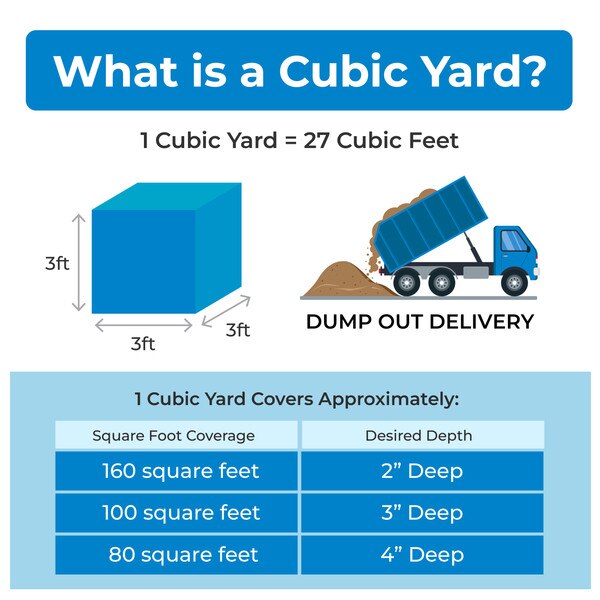
Image Source: www.cumminlandscapesupply.com
Deciphering the Cubic Yard to Square Feet Relationship
At its core, the question “How many square feet does a cubic yard cover?” is a volume to area calculation. We are taking a three-dimensional measurement (volume) and determining how much two-dimensional surface (area) it can cover at a given depth.
A cubic yard is a unit of volume. It represents a cube with sides that are each one yard (3 feet) in length. Therefore, the volume of one cubic yard is:
1 yard × 1 yard × 1 yard = 1 cubic yard
Or, in feet:
3 feet × 3 feet × 3 feet = 27 cubic feet
This means that 1 cubic yard is equal to 27 cubic feet. This is the foundational piece of information for any square footage of a cubic yard calculation.
The Critical Role of Depth in Coverage
The key to understanding how many square feet a cubic yard covers lies in the depth at which the material is spread. You can spread a cubic yard of material thinly over a large area or pile it thickly in a small area. The material volume and coverage are directly linked to this chosen depth.
Let’s break down the calculation:
-
Convert Depth to Yards: Since our volume is in cubic yards, it’s easiest to work with depth in yards.
- 1 inch = 1/12 feet = (1/12) / 3 yards = 1/36 yards
-
Calculate Area Covered: The formula to find the area covered is:
Area (in square yards) = Volume (in cubic yards) / Depth (in yards)
Using our example of 1 cubic yard and a depth of 1 inch (which is 1/36 yards):
Area (in square yards) = 1 cubic yard / (1/36 yards) = 36 square yards
-
Convert Square Yards to Square Feet: Since there are 3 feet in a yard, there are 3 feet × 3 feet = 9 square feet in a square yard.
Area (in square feet) = Area (in square yards) × 9 square feet/square yard
Area (in square feet) = 36 square yards × 9 square feet/square yard = 324 square feet
So, as we established, 1 cubic yard of material spread at a depth of 1 inch covers approximately 324 square feet.
Varying Depths, Varying Coverage
This principle applies to any depth. Let’s look at a few common depths:
-
Depth of 2 inches:
- Depth in yards = 2 inches = 2/36 yards = 1/18 yards
- Area (in square yards) = 1 cubic yard / (1/18 yards) = 18 square yards
- Area (in square feet) = 18 square yards × 9 sq ft/sq yd = 162 square feet
-
Depth of 3 inches:
- Depth in yards = 3 inches = 3/36 yards = 1/12 yards
- Area (in square yards) = 1 cubic yard / (1/12 yards) = 12 square yards
- Area (in square feet) = 12 square yards × 9 sq ft/sq yd = 108 square feet
-
Depth of 4 inches:
- Depth in yards = 4 inches = 4/36 yards = 1/9 yards
- Area (in square yards) = 1 cubic yard / (1/9 yards) = 9 square yards
- Area (in square feet) = 9 square yards × 9 sq ft/sq yd = 81 square feet
-
Depth of 6 inches:
- Depth in yards = 6 inches = 6/36 yards = 1/6 yards
- Area (in square yards) = 1 cubic yard / (1/6 yards) = 6 square yards
- Area (in square feet) = 6 square yards × 9 sq ft/sq yd = 54 square feet
Table: Cubic Yard Coverage at Different Depths
To make this easier to visualize, here’s a table summarizing the coverage:
| Depth (inches) | Depth (feet) | Depth (yards) | Square Yards Covered (per cubic yard) | Square Feet Covered (per cubic yard) |
|---|---|---|---|---|
| 1 | 0.083 | 0.028 | 36 | 324 |
| 2 | 0.167 | 0.056 | 18 | 162 |
| 3 | 0.25 | 0.083 | 12 | 108 |
| 4 | 0.333 | 0.111 | 9 | 81 |
| 6 | 0.5 | 0.167 | 6 | 54 |
| 12 (1 foot) | 1 | 0.333 | 3 | 27 |
Important Note: These are theoretical calculations. Actual coverage can be affected by factors like compaction and the type of material.
Practical Applications: Estimating Coverage Area of Materials
Knowing how to calculate the square footage of a cubic yard is vital for many projects. Whether you’re converting cubic yards of soil to square feet for a garden bed, laying down gravel for a driveway, or spreading mulch, accurate estimation prevents over or under-ordering.
Landscaping Projects
Landscaping often involves calculating the covering area with cubic yard of material for items like topsoil, compost, mulch, and decorative stones.
Topsoil and Compost
When creating new garden beds or amending existing soil, you need to determine how much topsoil or compost to buy. If you need to add 4 inches of topsoil to a garden bed that is 10 feet by 20 feet:
-
Calculate the Area:
- Area = Length × Width
- Area = 10 feet × 20 feet = 200 square feet
-
Determine the Depth Needed in Feet:
- Depth = 4 inches = 4/12 feet = 1/3 feet
-
Calculate the Volume Needed in Cubic Feet:
- Volume = Area × Depth
- Volume = 200 sq ft × (1/3) ft = 66.67 cubic feet
-
Convert Cubic Feet to Cubic Yards:
- Volume (cubic yards) = Volume (cubic feet) / 27 cubic feet/cubic yard
- Volume (cubic yards) = 66.67 / 27 ≈ 2.47 cubic yards
So, you would need approximately 2.5 cubic yards of topsoil for this project.
Mulch
Mulch is typically applied at a depth of 2-3 inches. If you have a garden area that measures 15 feet by 30 feet and you want to apply mulch at a depth of 3 inches:
-
Calculate the Area:
- Area = 15 feet × 30 feet = 450 square feet
-
Determine the Depth Needed in Feet:
- Depth = 3 inches = 3/12 feet = 1/4 feet
-
Calculate the Volume Needed in Cubic Feet:
- Volume = 450 sq ft × (1/4) ft = 112.5 cubic feet
-
Convert Cubic Feet to Cubic Yards:
- Volume (cubic yards) = 112.5 / 27 ≈ 4.17 cubic yards
You would need about 4.25 cubic yards of mulch.
Gravel and Aggregate Projects
Projects like driveways, pathways, and patios often use gravel or crushed stone. The required depth for these applications is usually greater than for landscaping materials.
Driveway Base
A typical driveway base might require 4-6 inches of compacted gravel. Let’s consider a driveway that is 12 feet wide and 50 feet long, requiring a 4-inch base layer.
-
Calculate the Area:
- Area = 12 feet × 50 feet = 600 square feet
-
Determine the Depth Needed in Feet:
- Depth = 4 inches = 4/12 feet = 1/3 feet
-
Calculate the Volume Needed in Cubic Feet:
- Volume = 600 sq ft × (1/3) ft = 200 cubic feet
-
Convert Cubic Feet to Cubic Yards:
- Volume (cubic yards) = 200 / 27 ≈ 7.41 cubic yards
You would need approximately 7.5 cubic yards of gravel for the base.
Using a Gravel Coverage Calculator
Many suppliers offer a gravel coverage calculator or similar tools on their websites. These calculators are designed to simplify the material volume and coverage calculations. You typically input the dimensions of your project (length, width, and depth), and the calculator automatically performs the cubic yard to square feet conversion and provides the total volume needed in cubic yards. This is an excellent resource for ensuring you order the correct amount of material.
Fathoming the Factors Affecting Actual Coverage
While the mathematical calculations are straightforward, real-world coverage can vary due to several factors. It’s important to account for these when planning your project.
Compaction
Many materials, especially soil and gravel, will compact when they are spread, tamped, or driven over. This means the volume you spread initially will reduce as the material settles.
- Soil: Topsoil and compost can compact by 10-25% or more.
- Gravel and Aggregate: These materials also compact, with the degree of compaction depending on the type of aggregate and the method of compaction. A common guideline is 20-30% compaction for gravel bases.
When calculating how much material you need, it’s often wise to add a buffer of 10-20% to account for compaction. For example, if your calculation shows you need 7.5 cubic yards of gravel, ordering 8.5 to 9 cubic yards might be more realistic to ensure you have enough after settling.
Material Type and Consistency
The density and particle size of the material also play a role.
- Fine materials (like sand) may spread more evenly but can also be blown away more easily if not secured.
- Coarser materials (like large decorative stones) won’t fill voids as effectively and might require a slightly greater depth to achieve the desired look.
- Organic materials like mulch can vary in their density and how much air they trap.
Surface Irregularities
If the surface you are covering is not perfectly flat, you will need more material to achieve an even depth. Uneven ground means some areas will be deeper than others if you simply spread the material uniformly.
Application Method
How the material is applied can also influence its final depth and coverage.
- Manual spreading with shovels and rakes can lead to more variation than using specialized spreading equipment.
- The method of tamping or rolling will directly impact the final compacted depth.
Calculating Required Material: A Step-by-Step Guide
To accurately determine how much material you need for a project, follow these steps:
-
Measure Your Project Area:
- Measure the length and width of the area you need to cover in feet.
- Calculate the total square footage: Area = Length × Width.
-
Determine the Desired Depth:
- Decide on the optimal depth for your material (e.g., 3 inches for mulch, 4 inches for gravel).
- Convert this depth into feet by dividing the number of inches by 12. (e.g., 3 inches / 12 = 0.25 feet).
-
Calculate the Volume in Cubic Feet:
- Multiply your calculated area by the desired depth in feet: Volume (cubic feet) = Area (sq ft) × Depth (ft).
-
Convert Volume to Cubic Yards:
- Divide the volume in cubic feet by 27 (since 1 cubic yard = 27 cubic feet): Volume (cubic yards) = Volume (cubic feet) / 27.
-
Add a Buffer for Compaction and Waste:
- For materials that compact (like soil and gravel), add an extra 10-20% to your total cubic yardage.
- Also, consider a small buffer (around 5%) for potential spills or uneven spreading.
Example Scenario: Filling a Sandbox
Let’s say you want to fill a sandbox with sand. The sandbox is 8 feet long and 6 feet wide, and you want to fill it to a depth of 10 inches.
- Area: 8 ft × 6 ft = 48 sq ft
- Depth: 10 inches = 10/12 ft = 0.833 ft
- Volume (cubic feet): 48 sq ft × 0.833 ft = 40 cubic feet
- Volume (cubic yards): 40 cubic feet / 27 = 1.48 cubic yards
Since sand doesn’t compact as much as gravel or soil, and it’s a contained area, you might only add a small buffer. Ordering 1.5 cubic yards should be sufficient.
Why Accurately Calculating Coverage Matters
- Cost Savings: Ordering too much material means wasted money. Ordering too little means costly emergency trips back to the supplier, potentially with delivery fees.
- Project Efficiency: Having the correct amount of material on hand prevents delays and keeps your project moving smoothly.
- Aesthetic Quality: Consistent depth ensures a professional and attractive finish, whether it’s mulch in a garden bed or gravel on a driveway.
- Environmental Impact: Minimizing waste by ordering accurately is a responsible practice.
Frequently Asked Questions (FAQ)
Q1: What is the basic cubic yard to square feet conversion for a common depth?
A1: For a depth of 1 inch, one cubic yard covers approximately 324 square feet.
Q2: How do I calculate square feet from cubic yards if I know the depth?
A2: To calculate the square footage covered by a cubic yard at a specific depth, you can use the formula: Square Feet = 324 / (Depth in inches). For example, at a 2-inch depth, 324 / 2 = 162 square feet.
Q3: Can I use a gravel coverage calculator for mulch?
A3: Yes, most coverage calculators work for various granular materials like gravel, sand, mulch, and soil. The principle of volume to area calculation remains the same.
Q4: How much does soil typically compact?
A4: Soil can compact significantly, often by 10-25% or more, depending on the type of soil and how it’s compacted. Always add a buffer for compaction when ordering soil.
Q5: If I have a 500 square foot area to cover with mulch at 3 inches deep, how many cubic yards do I need?
A5:
1. Depth in feet: 3 inches / 12 = 0.25 feet
2. Volume in cubic feet: 500 sq ft * 0.25 ft = 125 cubic feet
3. Volume in cubic yards: 125 cubic feet / 27 = 4.63 cubic yards.
You would need approximately 4.75 to 5 cubic yards of mulch.
Q6: What does “cubic yard to square feet conversion” mean in practice?
A6: It means translating a measure of volume (how much material there is) into a measure of area (how much surface it will cover), considering a specific depth for that coverage.
Q7: How do I calculate the square footage of a cubic yard for a project?
A7: You need to know the desired depth of the material in inches. Then, divide 324 by that depth in inches to get the approximate square footage one cubic yard will cover at that depth.
In conclusion, mastering the cubic yard to square feet conversion is a fundamental skill for anyone undertaking projects involving bulk materials. By carefully considering the volume measurement for covering surfaces and accounting for factors like depth and compaction, you can ensure your projects are completed efficiently, economically, and with the desired results.