
Figuring out how many bags of mulch you need for your yard can seem tricky. Generally, one standard 2-cubic-foot bag of mulch covers about 12 square feet at a 2-inch depth. However, the exact number depends on the size of your area, the desired depth, and the specific type of mulch. This guide will help you accurately calculate your needs and make informed decisions about your landscaping projects.
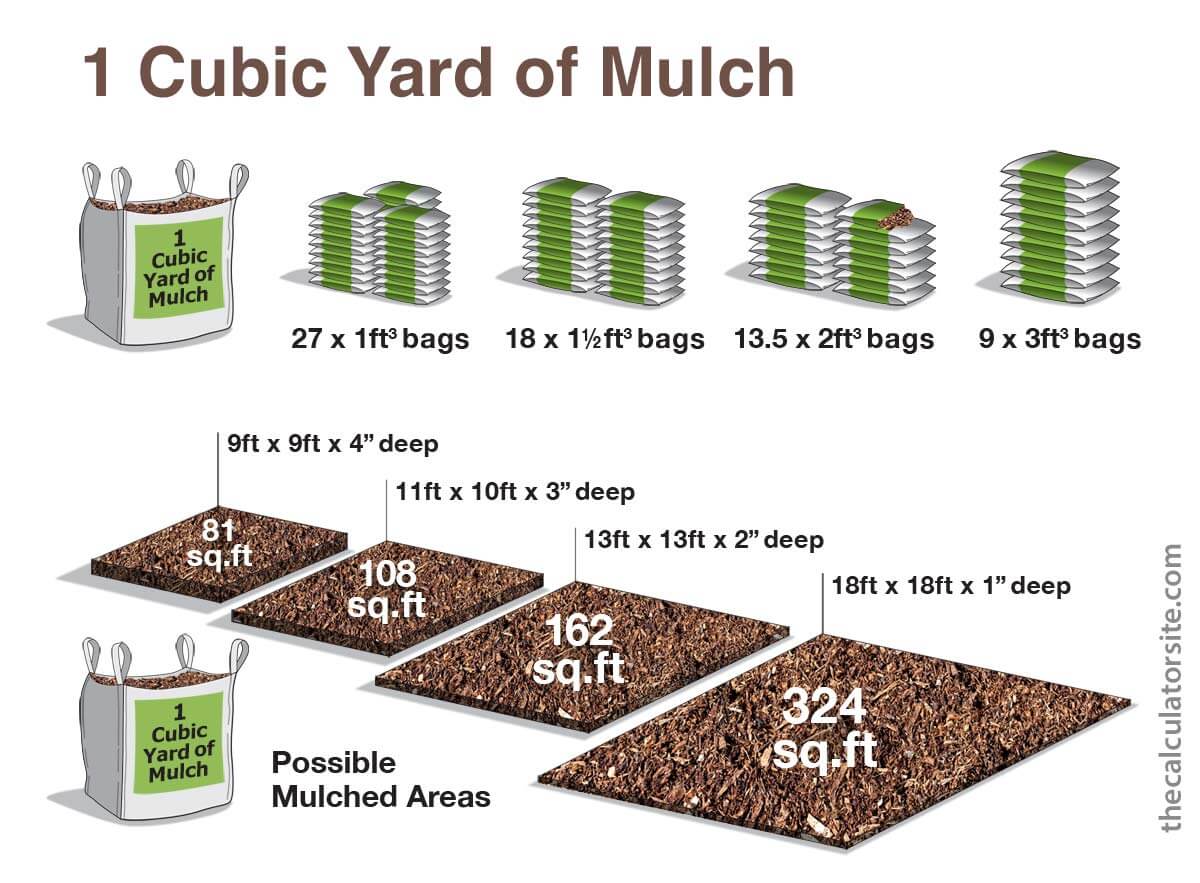
Image Source: www.thecalculatorsite.com
Planning Your Mulch Project
Adding mulch to your garden beds and around trees is a fantastic way to improve your yard’s appearance and health. It helps keep moisture in the soil, suppresses weeds, and adds nutrients as it breaks down. Before you rush to the store, let’s break down how to get it right.
Calculating Your Area: The First Step
The most crucial part of determining how many bags of mulch to buy is knowing the exact area you want to cover. This is where your garden bed calculation comes in.
Measuring Garden Beds and Other Areas
You’ll need a tape measure for this. For simple rectangular or square beds, measure the length and width in feet. Multiply these two numbers to get the square footage.
- Rectangular Bed: Length (ft) × Width (ft) = Square Footage (sq ft)
- Circular Bed: (π × Radius²) = Square Footage (sq ft)
- Remember, the radius is half the diameter. Use 3.14 for π.
- Irregular Shapes: For more complex shapes, break them down into smaller, manageable geometric shapes (rectangles, squares, triangles, circles). Calculate the area of each shape and then add them together.
Mapping Out Your Landscape Design
Your landscape design might involve multiple beds, tree rings, or pathways. Create a simple sketch of your yard and mark the dimensions of each area. This visual aid helps ensure you don’t miss any spots and gives you a clear overview of the total area to be mulched.
Determining the Ideal Mulch Depth
The depth of your mulch layer significantly impacts both its effectiveness and how much you’ll need. Most experts recommend a mulch depth of 2 to 4 inches.
Why Depth Matters
- Weed Suppression: A deeper layer (around 3-4 inches) is more effective at blocking sunlight, which is essential for weed seeds to germinate.
- Moisture Retention: A thicker layer helps the soil retain moisture, reducing the need for frequent watering.
- Temperature Regulation: Mulch acts as an insulator, keeping plant roots cooler in the summer and warmer in the winter.
- Aesthetics: A consistent, even depth looks much tidier and more professional.
Recommended Depths for Different Areas
- General Garden Beds: 2-3 inches is usually sufficient.
- Around Established Trees: 3-4 inches, keeping it away from the trunk itself.
- New Plantings: 2 inches is often best initially to avoid smothering young stems.
- Erosion Control (Slopes): 3-4 inches can help prevent soil from washing away.
The Role of Mulch Type and Bulk Density
Different types of mulch have varying densities, which can slightly affect their coverage of mulch. However, for bag calculations, the primary factor is the volume of the bag.
Common Mulch Bag Sizes
The most common mulch bags sold at garden centers are 2 cubic feet or 3 cubic feet. Always check the bag for its actual volume.
Bag Volume vs. Yardage: Converting to Cubic Yards
While bags are convenient, landscaping projects often involve larger quantities, and pricing might be discussed in cubic yards. One cubic yard is equal to 27 cubic feet.
- If you have a 2 cu ft bag: 27 cubic feet / 2 cubic feet per bag = 13.5 bags per cubic yard.
- If you have a 3 cu ft bag: 27 cubic feet / 3 cubic feet per bag = 9 bags per cubic yard.
Knowing the volume of mulch in each bag is key to accurate calculations.
Calculating How Many Bags You Need
Now that you have your area and desired depth, you can start calculating.
The Formula for Mulch Needs
The basic formula to determine the total cubic feet of mulch needed is:
Total Square Footage × Desired Depth (in inches) / 12 (inches per foot) = Cubic Feet of Mulch Needed
Example Calculation: A Single Garden Bed
Let’s say you have a rectangular garden bed that is 10 feet long and 4 feet wide. You want a mulch depth of 3 inches.
- Calculate the area: 10 ft × 4 ft = 40 sq ft.
- Convert depth to feet: 3 inches / 12 inches/foot = 0.25 feet.
- Calculate total cubic feet needed: 40 sq ft × 0.25 ft = 10 cubic feet of mulch.
Translating Cubic Feet to Bags
Once you know the total cubic feet of mulch required, you can figure out how many bags you need based on the bag size.
Using 2 Cubic Foot Bags
If your bags are 2 cubic feet:
Total Cubic Feet Needed / Cubic Feet Per Bag = Number of Bags
10 cubic feet / 2 cubic feet per bag = 5 bags
So, for this example, you would need 5 bags of 2-cubic-foot mulch.
Using 3 Cubic Foot Bags
If your bags are 3 cubic feet:
Total Cubic Feet Needed / Cubic Feet Per Bag = Number of Bags
10 cubic feet / 3 cubic feet per bag = 3.33 bags. Since you can’t buy a fraction of a bag, you would round up to 4 bags.
This is a fundamental part of how much mulch to buy.
Advanced Calculation Tools and Considerations
While manual calculation is straightforward, several tools can help, and there are other factors to keep in mind.
Utilizing a Mulch Calculator
Many websites offer free mulch calculator tools. These are very convenient. You typically input the length, width, and desired depth of your area, and they do the math for you, often allowing you to select the bag size you plan to purchase. These tools are excellent for double-checking your own calculations.
When Bulk Delivery Makes Sense
If you have a large yard or multiple extensive garden beds, buying mulch in bulk (by the cubic yard) can be more economical and environmentally friendly than buying many individual bags.
Comparing Bagged vs. Bulk Mulch
- Cost: Bulk mulch is often cheaper per cubic yard than bagged mulch.
- Convenience: Bags are easier to transport and handle for smaller jobs. Bulk delivery requires a truck or trailer, and you’ll need to spread it from the delivery point.
- Waste: Bulk delivery can reduce the plastic waste associated with bags.
How to Calculate Bulk Mulch Needs
If you’re considering bulk, you’ll calculate the total cubic yards needed.
Total Square Footage × Desired Depth (in feet) = Cubic Yards of Mulch Needed
Using our previous example of 40 sq ft with a 3-inch (0.25 ft) depth:
40 sq ft × 0.25 ft = 10 cubic feet.
To convert to cubic yards: 10 cubic feet / 27 cubic feet per cubic yard = 0.37 cubic yards.
For a larger area, say 400 sq ft at 3 inches deep:
400 sq ft × 0.25 ft = 100 cubic feet.
100 cubic feet / 27 cubic feet per cubic yard = 3.7 cubic yards. You’d likely order 4 cubic yards.
This process helps you determine your soil per yard or rather, mulch per yard.
Factors Affecting Coverage
- Settling: Mulch will settle over time, especially organic types. You might need to top it up annually or bi-annually.
- Compaction: Walking on mulch can compact it, reducing its effectiveness and requiring a deeper application in those areas.
- Type of Mulch: While bag volume is the main driver, some mulches are fluffier than others. This doesn’t change the volume calculation but might affect how it looks and settles initially.
Common Pitfalls to Avoid
Even with careful planning, some mistakes can lead to buying too much or too little mulch.
The “Too Little” Mistake
- Underestimating Area: Not accurately measuring all areas to be mulched.
- Too Thin a Layer: Applying mulch too thinly, which reduces its benefits and requires more frequent replenishment.
- Forgetting to Account for Settling: Not buying a little extra to account for mulch compressing over time.
The “Too Much” Mistake
- Overbuying: Purchasing significantly more than you need, leading to waste or storage issues.
- Incorrect Depth: Applying a much thicker layer than necessary, which can sometimes harm plants by suffocating roots or encouraging fungal growth.
- Ignoring Bag Size: Assuming all bags are the same size.
Visualizing Mulch Coverage
A good way to visualize coverage of mulch is to imagine spreading it. If you have a 10 sq ft area and want 2 inches of depth, you need to cover that 10 sq ft with a 2-inch-thick layer. A 2 cu ft bag is designed to help you achieve this coverage for roughly 12 sq ft at a 2-inch depth.
Here’s a quick reference table for common bag sizes and depths:
| Bag Size (Cubic Feet) | Coverage at 2″ Depth (sq ft) | Coverage at 3″ Depth (sq ft) | Coverage at 4″ Depth (sq ft) |
|---|---|---|---|
| 2 cu ft | 12 | 8 | 6 |
| 3 cu ft | 18 | 12 | 9 |
This table simplifies the estimation process. For instance, if you have a 100 sq ft area and want 3 inches of mulch, using 2 cu ft bags: 100 sq ft / 12 sq ft per bag = 8.33 bags. Round up to 9 bags.
Materials and Tools You’ll Need
Gathering your landscaping materials and tools beforehand makes the job smoother.
Essential Tools
- Tape Measure: For accurate area measurements.
- Shovel: For scooping and spreading mulch.
- Wheelbarrow: To transport bags from your vehicle or to different areas of the yard.
- Rake: To spread and level the mulch evenly.
- Gloves: To protect your hands.
- Safety Glasses: To protect your eyes from debris.
- Garden Hoe or Edger (Optional): To create a clean border before applying mulch.
Preparing the Area
Before you lay down the new mulch, it’s essential to prepare the area:
- Remove Old Mulch: Rake away old, matted mulch, or any debris.
- Weed the Area: Pull out any existing weeds. It’s much easier to do this before applying new mulch.
- Edge the Beds: Create a clean, crisp edge to give your garden beds a professional look.
- Water the Soil (Optional): Lightly watering the soil before mulching can help it absorb moisture better once the mulch is applied.
Frequently Asked Questions (FAQ)
Q1: How deep should I mulch around my trees?
A: For established trees, a depth of 3-4 inches is generally recommended. However, it’s crucial to keep the mulch a few inches away from the trunk of the tree. This prevents moisture from getting trapped against the bark, which can lead to rot and disease.
Q2: Can I put mulch directly on top of old mulch?
A: Yes, you can, but it’s best to remove any weeds or debris first. If the old mulch is heavily decomposed, adding a fresh layer on top is fine. If it’s still in good condition and you’re just refreshing the look, a light raking and then adding new mulch is a good approach. Avoid applying mulch more than 4 inches deep in total, as this can harm plant roots.
Q3: How often should I reapply mulch?
A: Organic mulches gradually decompose and so will need replenishment. Depending on the type of mulch and your climate, you may need to top up your beds every 6-12 months. Inorganic mulches, like stone or gravel, do not decompose and will last much longer but may need occasional raking to keep them looking tidy.
Q4: What is a good way to estimate mulch for an irregular shape?
A: For irregular shapes, break them down into simpler geometric forms (rectangles, squares, circles, triangles). Measure each section and calculate its area. Add all the individual areas together to get the total square footage. You can then use this total area in your mulch calculation. Alternatively, you can use string or a hose to outline the area and then measure that perimeter, using an online mulch calculator that might allow for perimeter input or more complex shape inputs.
Q5: How do I calculate soil per yard?
A: The term “soil per yard” usually refers to purchasing soil by the cubic yard, much like bulk mulch. To calculate how much soil you need for a raised bed or to amend existing soil, you would use a soil volume calculator. The process is similar to calculating mulch volume: measure the length, width, and desired depth of the area in feet, then multiply them together to get cubic feet, and finally divide by 27 to convert to cubic yards.
Q6: What does the term “mulch per cubic yard” mean?
A: “Mulch per cubic yard” refers to the quantity of mulch needed or available when measured by volume in cubic yards. Since a cubic yard is a standard unit for bulk materials, it’s often used by landscaping suppliers. It helps in comparing prices and quantities between different suppliers or when buying in bulk versus bags.
Q7: What is the typical volume of mulch in a bag?
A: The most common sizes for bagged mulch are 2 cubic feet and 3 cubic feet. Always check the label on the bag for the exact volume. This is critical for accurate calculations.
Q8: How do I know if I need to buy extra landscaping materials like mulch?
A: It’s generally a good idea to buy about 10% more mulch than your calculation suggests. This accounts for settling, areas where you might apply a slightly thicker layer, and ensures you have enough to finish the job without running short. Running out mid-project can be frustrating, and returning partial bags is usually not an option or is impractical.
By following these steps and tips, you can confidently determine exactly how many bags of mulch your yard needs, ensuring a beautiful and healthy landscape. Happy gardening!