
Wondering how many bags of mulch you need to cover your garden beds? Generally, it takes about 12 to 16 bags of standard 2-cubic-foot mulch to cover one cubic yard. This guide will help you figure out your mulch quantities for landscaping projects with precision.
Landscaping projects often require a good amount of mulch. It not only makes your garden beds look neat and tidy but also helps the soil retain moisture, suppress weeds, and regulate soil temperature. But before you head to the garden center, you need to know how much mulch to buy. This is where a mulch calculator and a firm grasp of mulch per cubic yard become essential.
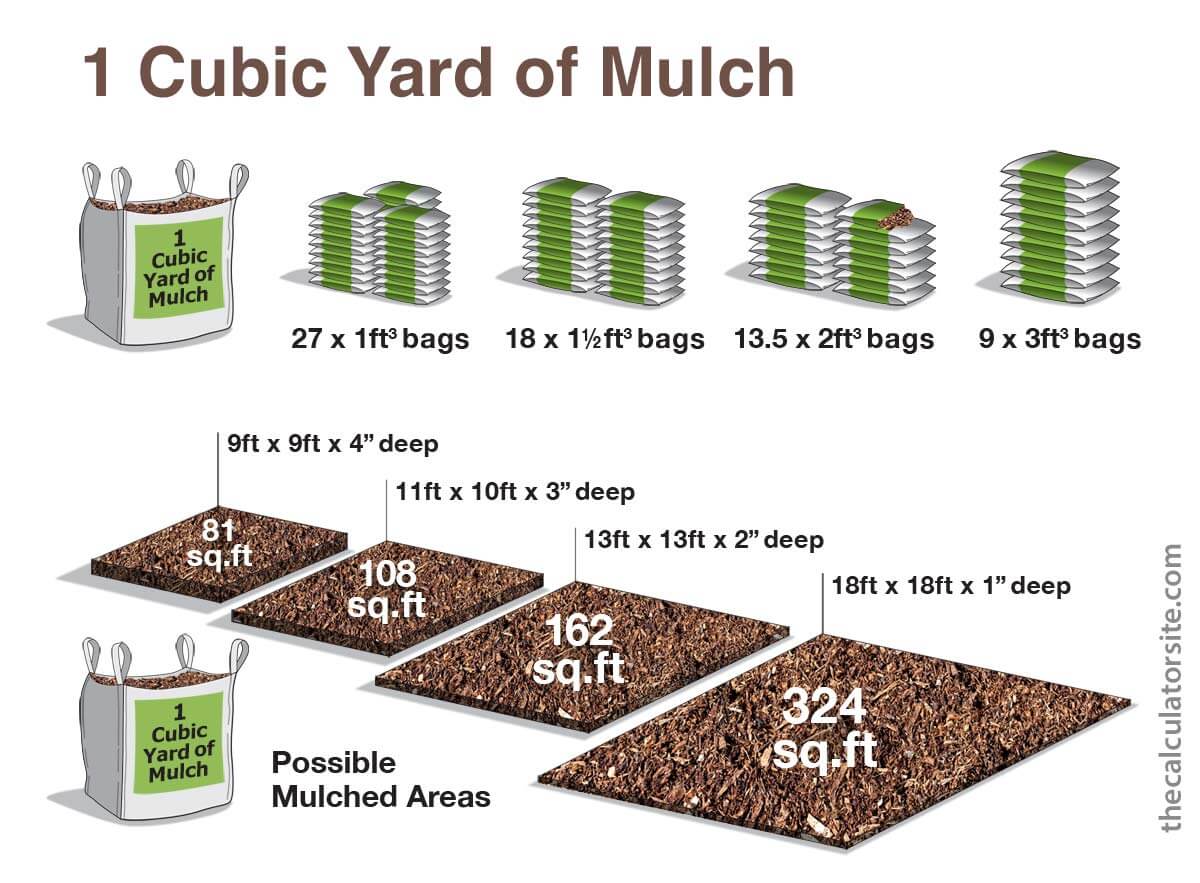
Image Source: www.thecalculatorsite.com
Fathoming Mulch Coverage: The Basics
A “yard of mulch” refers to a cubic yard. This is a standard unit of measurement for bulk materials like soil, gravel, and, of course, mulch. A cubic yard is a cube that measures 3 feet in length, 3 feet in width, and 3 feet in height.
When you buy mulch in bags, you’re typically purchasing it in 2-cubic-foot or 3-cubic-foot sizes. The number of bags you need for a cubic yard will depend on the size of those bags.
Mulch Bag Size Comparison
Let’s break down the common bag sizes:
- 2-cubic-foot bags: These are the most common size.
- 3-cubic-foot bags: These larger bags can offer a cost savings per cubic foot.
It’s crucial to check the volume stated on the bag. Different brands and types of mulch might come in slightly different bag sizes.
Calculating Your Mulch Needs
To determine your mulch quantities for landscaping, you first need to measure the area you want to cover. This involves calculating the square footage of your garden beds. You’ll also need to decide on the desired depth of your mulch layer.
Step 1: Measure Your Garden Beds
You’ll need to measure the length and width of each area you plan to mulch.
- Rectangular or Square Beds: Measure the length and width in feet and multiply them together.
Area (sq ft) = Length (ft) × Width (ft)
- Circular Beds: Measure the diameter (the distance across the center) in feet. Then, divide the diameter by 2 to get the radius. Use the formula for the area of a circle:
Area (sq ft) = π × Radius (ft)²(where π is approximately 3.14)
- Irregularly Shaped Beds: Break down the irregular shape into smaller, manageable geometric shapes (rectangles, squares, triangles, circles). Calculate the area of each shape and then add them together.
Step 2: Determine Your Desired Mulch Depth
The ideal mulch depth is usually between 2 to 4 inches.
- For Weed Suppression: A depth of 3-4 inches is often recommended.
- For Moisture Retention: 2-3 inches can be sufficient.
It’s important not to mulch too deeply, as this can suffocate plant roots. Also, keep mulch a few inches away from the base of trees and shrubs to prevent rot and pest issues.
Step 3: Convert Depth to Feet
Since your area measurements are in square feet, you need to convert your desired mulch depth from inches to feet.
Depth (ft) = Depth (inches) / 12
For example, if you want a 3-inch mulch layer:
Depth (ft) = 3 / 12 = 0.25 feet
Step 4: Calculate Total Cubic Feet of Mulch Needed
Now, multiply your total square footage by your desired mulch depth in feet. This will give you the total cubic feet of mulch you require.
Total Cubic Feet = Total Area (sq ft) × Depth (ft)
Step 5: Convert Cubic Feet to Cubic Yards
Since mulch is often sold by the cubic yard (especially in bulk), you’ll need to convert your total cubic feet to cubic yards. There are 27 cubic feet in 1 cubic yard.
Total Cubic Yards = Total Cubic Feet / 27
This final number tells you how much mulch you need in cubic yards.
Using a Mulch Bag Estimator: Bags Per Cubic Yard
Now that you know your total cubic yard requirement, you can figure out how many bags to buy. This is where the mulch bag estimator comes into play.
The Magic Number: How Many Bags In A Yard Of Mulch?
Let’s revisit the core question: how many bags in a yard of mulch?
-
For 2-cubic-foot bags:
- A cubic yard has 27 cubic feet.
- Number of bags =
27 cubic feet / 2 cubic feet per bag - Number of bags = 13.5 bags
So, for 2-cubic-foot bags, you’ll need approximately 14 bags to equal one cubic yard. It’s always wise to buy an extra bag or two to account for any uneven distribution or spills.
-
For 3-cubic-foot bags:
- Number of bags =
27 cubic feet / 3 cubic feet per bag - Number of bags = 9 bags
For 3-cubic-foot bags, you’ll need about 9 bags to equal one cubic yard.
- Number of bags =
Example Calculation: Mulch Quantities for Landscaping
Let’s say you have a garden bed that is 10 feet long and 5 feet wide. You want to apply a 3-inch layer of mulch.
- Area:
10 ft × 5 ft = 50 sq ft - Depth in feet:
3 inches / 12 = 0.25 ft - Total Cubic Feet:
50 sq ft × 0.25 ft = 12.5 cubic feet - Total Cubic Yards:
12.5 cubic feet / 27 cubic feet per cubic yard = 0.46 cubic yards
Now, how many bags do you need?
- Using 2-cubic-foot bags:
12.5 cubic feet / 2 cubic feet per bag = 6.25 bags. You should buy 7 bags. - Using 3-cubic-foot bags:
12.5 cubic feet / 3 cubic feet per bag = 4.17 bags. You should buy 5 bags.
This shows how crucial the mulch bag size comparison is.
Bulk Mulch vs. Bagged Mulch: A Comparison
When it comes to buying mulch, you have two main options: bulk or bagged. Each has its pros and cons.
Bagged Mulch
- Pros:
- Convenience: Easy to transport in smaller quantities for smaller projects.
- Variety: Often available in a wider range of colors and types.
- Portion Control: You buy exactly what you need for smaller areas.
- Cons:
- Cost: Generally more expensive per cubic yard than bulk mulch.
- Waste: The plastic bags themselves can be a source of waste.
- Labor: You have to carry and open each bag.
Bulk Mulch
- Pros:
- Cost-Effective: Significantly cheaper per cubic yard for larger projects.
- Less Waste: No plastic bags to dispose of.
- Less Labor (Per Volume): Delivered directly to your location, reducing the need to carry individual bags.
- Cons:
- Minimum Purchase: Usually requires a minimum purchase quantity.
- Delivery Fees: May incur delivery charges.
- Storage: Requires space to store the bulk material if not used immediately.
- Quality Variability: Can sometimes be less visually appealing or contain more foreign material than bagged options.
When to Choose Which:
- Small Gardens or Patios: Bagged mulch is usually the best choice.
- Large Yards, Flower Beds, or Tree Lines: Bulk mulch is typically more economical and practical.
To compare prices effectively, always calculate the cost per cubic yard. Divide the bag price by the number of cubic yards in the bag (e.g., Bag Price / (2 cubic feet / 27)) to get the price per cubic yard for bagged mulch.
Factors Affecting Mulch Quantities
Several factors can influence how much mulch you’ll need or how quickly you’ll use it:
Soil Type
- Sandy Soils: Tend to dry out quickly and may require a slightly deeper mulch layer or more frequent replenishment.
- Clay Soils: Retain moisture well. A thinner layer of mulch is generally sufficient.
Climate and Weather
- Hot, Dry Climates: Mulch evaporates moisture faster. A thicker layer can be beneficial.
- Windy Areas: Wind can blow lighter mulches away, potentially requiring deeper application or a heavier mulch type.
- Heavy Rainfall: Excessive rain can sometimes wash away lighter mulches or compact them, necessitating more frequent top-ups.
Mulch Type
- Wood Chips/Bark Mulch: Generally hold their shape and depth well for a longer period.
- Shredded Bark/Fine Mulches: Can compact more readily and may decompose faster, requiring more frequent replenishment.
- Pine Straw: A common option, especially in certain regions, that tends to stay put but might decompose faster than wood-based mulches.
Landscaping Design
- Steep Slopes: Mulch can wash away on slopes. Using a coarser mulch or a mulch netting can help. You might also need a slightly deeper layer to compensate for potential slippage.
- High-Traffic Areas: Paths or areas where people walk frequently might need more robust mulch that doesn’t break down quickly or get easily displaced.
Frequently Asked Questions (FAQ)
Q: What is the standard depth for mulch?
A: The standard mulch depth is typically 2 to 4 inches. For best results in weed suppression and moisture retention, aim for 3 inches.
Q: How do I calculate cubic yards of mulch?
A: Measure the length and width of your area in feet, calculate the square footage, convert your desired mulch depth from inches to feet, and then multiply the square footage by the depth in feet to get cubic feet. Divide the total cubic feet by 27 to get cubic yards.
Q: How many 2 cubic foot bags of mulch are in a cubic yard?
A: There are approximately 13.5 bags of 2-cubic-foot mulch in one cubic yard. It’s recommended to buy 14 bags.
Q: How many 3 cubic foot bags of mulch are in a cubic yard?
A: There are approximately 9 bags of 3-cubic-foot mulch in one cubic yard.
Q: Can I use less mulch if I’m on a budget?
A: While you can use a shallower layer (e.g., 2 inches), be aware that this may offer less weed suppression and moisture retention. It might also require more frequent top-ups as the mulch decomposes or compacts.
Q: What if my garden bed isn’t a simple rectangle?
A: For irregular shapes, break them down into smaller geometric sections, calculate the area of each section, and sum them up to get your total square footage.
Q: Does the type of mulch affect how many bags I need?
A: The volume of the bag is the primary factor. However, different mulches compact differently. Very fine mulches might compact more, effectively reducing the depth slightly, meaning you might need to buy a few extra bags to achieve the desired visual depth initially.
Q: Should I round up when calculating bags needed?
A: Yes, always round up. It’s better to have a little extra mulch for touch-ups or unexpected coverage needs than to run short and have to make another trip.
Q: How do I find the cubic footage on a mulch bag?
A: Look for the volume stated on the bag, usually in cubic feet (e.g., “2 cu. ft.”, “3 cu. ft.”).
Q: Is bulk mulch always cheaper per cubic yard?
A: Generally, yes, especially for larger quantities. However, factor in delivery fees and consider if you have a large enough project to meet any minimum purchase requirements.
By carefully measuring your space and using this guide, you can accurately determine your mulch quantities for landscaping projects, ensuring you buy just the right amount of mulch without overspending or coming up short. Happy mulching!