
A cubic yard of concrete typically weighs between 3,500 and 4,000 pounds. This weight can vary depending on the mix design, moisture content, and the specific aggregates used.
If you’re planning a construction project, knowing the weight of concrete is crucial. Whether you’re pouring a small patio, a large foundation, or a substantial driveway, understanding how much concrete weighs helps with everything from ordering the right amount to ensuring your project is structurally sound. This guide will help you grasp the concrete weight per cubic yard, essential for accurate project planning.
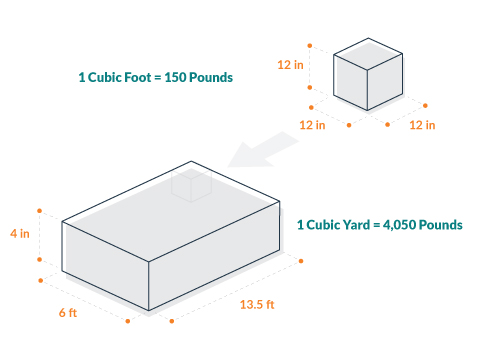
Image Source: www.dumpsters.com
The Weight of Concrete: A Deep Dive
When we talk about “how much does concrete weigh,” we’re generally referring to its density. Concrete is a composite material, meaning it’s made up of several components: cement, aggregates (like sand and gravel), water, and sometimes admixtures. Each of these ingredients contributes to the final weight of the concrete.
What Determines Concrete’s Weight?
The primary factor influencing the weight of concrete is its density. Concrete density per yard is not a fixed number; it changes based on the ingredients and their proportions.
Here are the key factors:
- Aggregate Type: The type of stone or gravel used as aggregate is a major determinant. Denser aggregates will lead to heavier concrete. For example, granite and basalt are denser than limestone or pumice.
- Aggregate Size: Larger aggregates can sometimes create more air pockets, potentially making the concrete slightly lighter for its volume, though density plays a bigger role.
- Water-Cement Ratio: While water is necessary for hydration, too much water can create more voids in the hardened concrete, slightly reducing its density.
- Admixtures: Some admixtures, like air-entraining agents, can introduce small air bubbles, making the concrete lighter. Others might increase density.
- Reinforcement: If the concrete is reinforced with steel rebar or mesh, this will add significantly to the overall weight of the structure, but not to the weight of the concrete itself per cubic yard.
Concrete Weight Per Cubic Yard: The Numbers
The widely accepted range for the concrete weight per cubic yard is between 3,500 and 4,000 pounds. This is often cited as the average weight of standard concrete mixes used in most construction applications.
To break this down further:
- Average Weight: Many contractors and engineers use an average of 3,800 pounds per cubic yard for estimations.
- Lighter Mixes: Some specialized mixes, perhaps with lighter aggregates or air entrainment, might fall closer to the 3,500-pound mark.
- Heavier Mixes: High-strength concrete or mixes using very dense aggregates could push the weight towards the 4,000-pound mark or even slightly higher.
It’s important to remember that these are general figures. For critical structural calculations, obtaining the exact density from the concrete supplier for your specific mix is recommended.
Calculating the Weight of Concrete Volume
When you need to determine how much does concrete weigh for a specific project, you’ll need to calculate the volume of concrete required and then multiply it by the density.
Converting Project Measurements to Cubic Yards
Most construction measurements are taken in feet (length, width, depth). To find the volume in cubic yards, follow these steps:
- Measure Length, Width, and Depth: Ensure all measurements are in feet.
- Calculate Volume in Cubic Feet:
Volume (cubic feet) = Length (ft) × Width (ft) × Depth (ft) - Convert Cubic Feet to Cubic Yards: There are 27 cubic feet in 1 cubic yard (3 ft × 3 ft × 3 ft = 27 cu ft).
Volume (cubic yards) = Volume (cubic feet) / 27
Estimating Concrete Weight for Your Project
Once you have the volume in cubic yards, you can estimate the total weight.
- Estimated Weight (lbs) = Volume (cubic yards) × Concrete Weight Per Cubic Yard (lbs/cu yd)
Example Calculation:
Let’s say you need to pour a concrete slab that is 10 feet long, 10 feet wide, and 4 inches deep.
- Convert Depth to Feet: 4 inches / 12 inches/foot = 0.333 feet
- Calculate Volume in Cubic Feet: 10 ft × 10 ft × 0.333 ft = 33.3 cubic feet
- Convert to Cubic Yards: 33.3 cu ft / 27 cu ft/cu yd = 1.23 cubic yards
- Estimate Weight: Using an average of 3,800 lbs/cu yd:
1.23 cu yd × 3,800 lbs/cu yd = 4,674 pounds
So, a slab of those dimensions would weigh approximately 4,674 pounds.
Cubic Yard Concrete Weight: Factors Affecting It
The cubic yard concrete weight can be influenced by more than just the basic mix design. Understanding these nuances can help you make more informed decisions.
The Role of Aggregates
Aggregates make up the bulk of concrete – typically 60% to 80% of its volume.
- Density of Aggregates:
- Gravel/Crushed Stone: Common aggregates like crushed limestone or gravel typically have a density around 150-165 pounds per cubic foot.
- Sand: Sand, also an aggregate, usually has a similar density to gravel.
- Lightweight Aggregates: Materials like expanded shale, clay, or slate can be used to create lightweight concrete, significantly reducing the overall weight. These can have densities as low as 90-120 pounds per cubic foot.
- Proportion of Aggregates: The ratio of coarse aggregate (gravel) to fine aggregate (sand) also affects the density and therefore the weight.
Water Content and the Water-Cement Ratio
The water-cement ratio is critical for concrete strength and durability, but it also impacts weight.
- Hydration Process: Water reacts with cement to form a paste that binds the aggregates.
- Excess Water: While some water is essential, adding too much water beyond what’s needed for hydration creates more pores (voids) within the hardened concrete. This makes the concrete less dense and therefore lighter, but it also typically reduces its strength.
- Standard Ratios: Typical water-cement ratios range from 0.4 to 0.6. A lower ratio generally means denser, stronger concrete.
Admixtures and Their Impact
Admixtures are added to concrete to modify its properties.
- Air-Entraining Admixtures: These create microscopic air bubbles, improving freeze-thaw resistance and workability. However, they can reduce the density of the concrete, making it slightly lighter.
- Water-Reducing Admixtures: These allow for a lower water-cement ratio while maintaining workability. This can lead to denser, stronger, and potentially slightly heavier concrete due to reduced void content.
- Other Admixtures: Pozzolans like fly ash or silica fume can affect density and strength.
Concrete Slab Weight Per Yard: Practical Considerations
When dealing with a concrete slab weight per yard, practical applications and structural integrity come into play.
Load-Bearing Capacity
The weight of concrete is a significant factor when designing structures that need to support heavy loads.
- Foundation Design: The weight of a concrete foundation contributes to the overall load on the soil beneath it. Engineers must consider this when calculating soil bearing capacity.
- Slab Support: For elevated slabs or structures where the slab’s weight is a major component, accurate weight calculations are essential for designing appropriate supporting beams and columns.
Transporting and Handling Concrete
The weight of concrete is also a logistical consideration.
- Truck Capacity: Ready-mix concrete trucks have weight limits. Knowing the weight of the concrete you’re ordering helps ensure you don’t exceed these limits. A standard concrete truck can carry around 8 to 11 cubic yards.
- Delivery Costs: While delivery is usually by volume (cubic yards), understanding the weight can sometimes be relevant for specialized deliveries or if there are weight restrictions on access routes.
Understanding Concrete Weight: Estimating and Calculations
Accurate estimating concrete weight is vital for project success. Let’s look at how to refine these calculations.
Density Variations in Ready-Mix Concrete
Weight of ready-mix concrete can vary even between batches from the same plant.
- Supplier Specifications: The best approach is to ask your ready-mix concrete supplier for the specific density of the mix you are ordering. They can provide data based on their mix designs.
- Typical Mix Densities:
- Standard Concrete (e.g., 3000-4000 psi): 3,500 – 4,000 lbs/cu yd
- Lightweight Concrete: 2,500 – 3,500 lbs/cu yd (using lightweight aggregates)
- High-Density Concrete: 4,000+ lbs/cu yd (using dense aggregates like barite for radiation shielding)
Concrete Load Calculations: Why They Matter
Concrete load calculations are fundamental in structural engineering.
- Dead Load: The weight of the concrete itself is considered a “dead load” – a permanent, fixed weight on a structure.
- Live Load: The weight of people, furniture, or vehicles using the concrete structure is considered a “live load.”
- Total Load: The combined dead and live loads determine the structural requirements.
Table: Approximate Weight of Common Concrete Structures (per cubic yard)
| Structure Type | Typical Mix Strength | Approximate Weight (lbs/cu yd) | Notes |
|---|---|---|---|
| Standard Foundation | 3000 psi | 3,800 | Common for residential buildings. |
| Driveway/Sidewalk | 3500 psi | 3,800 | Durable mix for moderate traffic. |
| High-Strength Slab | 5000 psi | 3,900 | Used where higher load-bearing capacity is needed. |
| Lightweight Deck | Not Applicable | 2,800 – 3,200 | Utilizes lightweight aggregates, reducing dead load on supporting structures. |
| Pervious Concrete | 3000 psi | 3,400 – 3,600 | Lower density due to larger void spaces allowing water to pass through. |
| Reinforced Concrete | Varies | ~3,900 (concrete only) | Steel rebar adds significant weight to the structure, but the concrete itself remains within its density range. |
Fathoming Concrete Density Per Yard
To get a precise figure for concrete density per yard, you need to consider the specific gravity of its components.
- Specific Gravity: This is the ratio of the density of a substance to the density of water.
- Calculation Example: If a mix uses aggregates with an average specific gravity of 2.65 and the water-cement ratio results in a certain paste density, a complex calculation can yield the precise concrete density. However, for most practical purposes, the 3,500-4,000 lbs/cu yd range is sufficient.
Frequently Asked Questions (FAQ)
Q1: How much does a cubic yard of concrete weigh in tons?
A: Since 1 ton = 2,000 pounds, a cubic yard of concrete weighing between 3,500 and 4,000 pounds will weigh between 1.75 and 2 tons.
Q2: What is the weight of concrete per square foot for a standard slab?
A: This depends on the thickness of the slab. For a 4-inch thick slab (which is 0.333 cubic yards per 100 sq ft), using an average of 3,800 lbs/cu yd:
(3,800 lbs/cu yd * 0.333 cu yd) / 100 sq ft = approximately 12.65 lbs per square foot.
Q3: Can I calculate the weight of concrete myself?
A: Yes, by measuring the volume of your project in cubic yards and multiplying it by the estimated weight per cubic yard (typically 3,500-4,000 lbs). For critical applications, get the exact density from your concrete supplier.
Q4: Does the color of concrete affect its weight?
A: Typically, no. While some integral colorants are mineral-based and have their own densities, the small quantities used usually have a negligible impact on the overall weight per cubic yard compared to the aggregates and cement.
Q5: How does the weight of concrete compare to other building materials?
A: Concrete is significantly heavier than materials like wood or standard asphalt. For instance, a cubic yard of asphalt typically weighs around 2,000-2,500 pounds. Wood’s weight varies greatly by species and moisture content but is much lighter than concrete.
By grasping these details about how heavy is a yard of concrete, you can approach your construction projects with greater confidence and precision. Remember to always consult with professionals for structural designs and critical calculations.