
A yard of mulch, which is equivalent to 27 cubic feet, typically covers about 100 square feet with a 3-inch layer, or 200 square feet with a 1.5-inch layer, but the exact mulch coverage can vary based on the type of mulch and the desired mulch depth. Knowing this is crucial when planning your landscaping projects and deciding how much mulch to buy. This guide will help you understand mulch coverage and maximize its use in your garden.
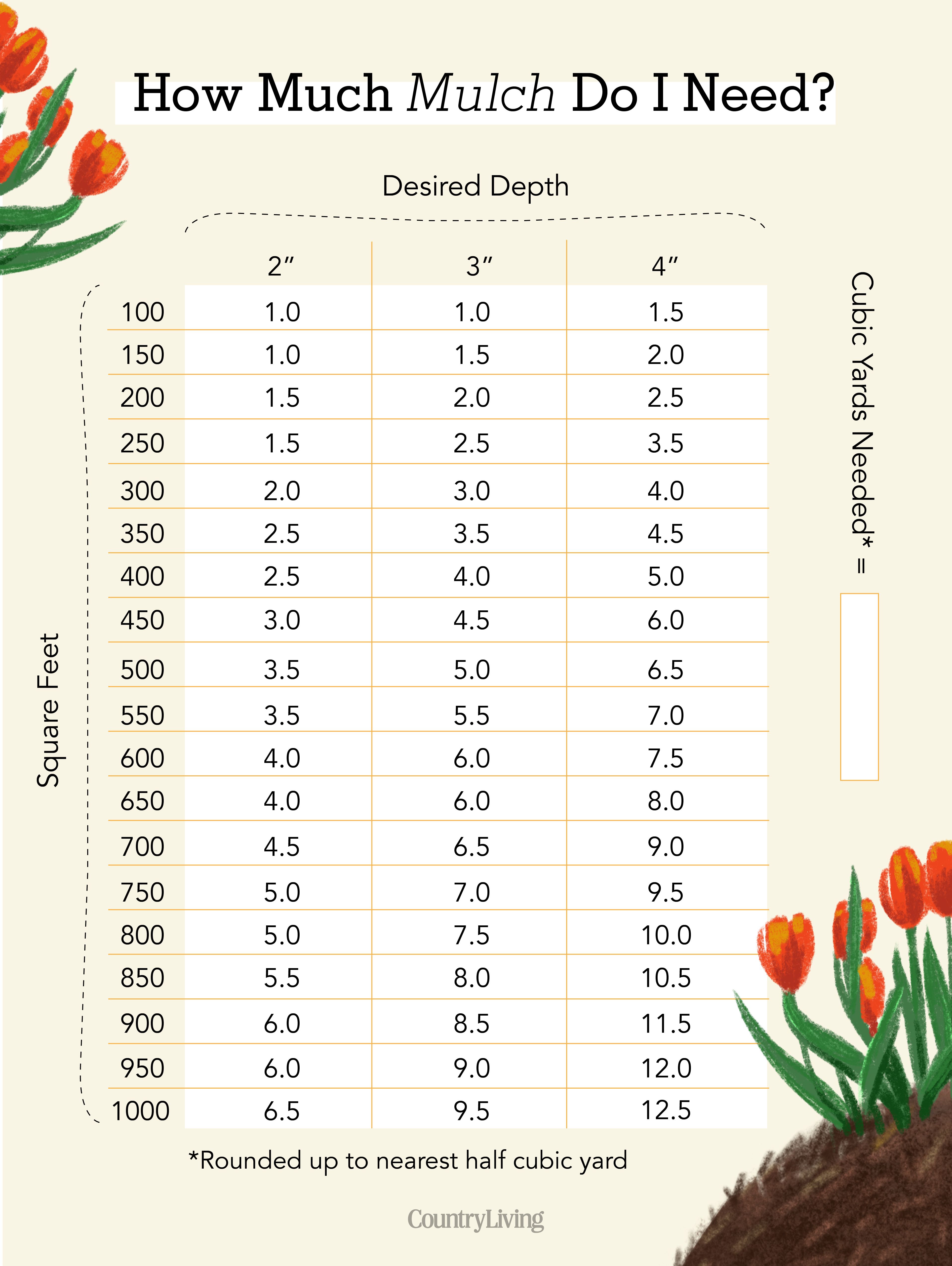
Image Source: hips.hearstapps.com
Deciphering Mulch Coverage: Your Guide to Buying Mulch
When you’re out buying mulch, you’ll often see it sold by the cubic yard. This is the standard unit of volume for mulch. A single cubic yard might seem like a lot, but gardens come in all shapes and sizes, and the depth you apply makes a big difference. Let’s break down the math behind mulch coverage and help you figure out exactly how much mulch to buy for your needs.
The Math Behind Mulch Coverage
At its core, calculating mulch coverage is about volume. You need to know the area you want to cover and the desired depth of your mulch layer. This allows for accurate cubic yards mulch calculation.
Calculating Your Area: Square Footage is Key
The first step is to determine the square footage mulch needs to cover. For simple shapes like rectangles or squares, this is straightforward:
- Rectangles/Squares: Length (in feet) × Width (in feet) = Square Footage
For more complex or irregular shapes, break them down into smaller, manageable sections. You can measure each section and add the square footage together.
Desired Mulch Depth: A Crucial Factor
The recommended mulch depth is generally between 2 to 4 inches for most landscaping applications.
- Benefits of Proper Depth:
- Weed Suppression: A thicker layer of mulch is more effective at blocking sunlight, which is essential for weed seed germination.
- Moisture Retention: It helps keep the soil moist by reducing evaporation, meaning you water less often.
- Temperature Regulation: Mulch insulates the soil, keeping it cooler in summer and warmer in winter, protecting plant roots from extreme temperatures.
- Soil Improvement: As organic mulches break down, they add nutrients and improve soil structure.
Too little mulch might not provide these benefits effectively, while too much mulch can sometimes lead to problems like suffocation of plant roots or an increased risk of fungal diseases.
Converting Inches to Feet for Calculation
Since mulch is sold in cubic yards (which are cubic feet), you’ll need to convert your desired mulch depth from inches to feet.
- To convert inches to feet, divide by 12 (because there are 12 inches in a foot).
- 2 inches = 2/12 feet = 0.167 feet
- 3 inches = 3/12 feet = 0.25 feet
- 4 inches = 4/12 feet = 0.333 feet
The Universal Mulch Coverage Formula
Once you have your area in square footage mulch needs to cover and your depth in feet, you can calculate the total cubic feet of mulch required.
Cubic Feet Needed = Square Footage × Depth (in feet)
Let’s say you have a garden bed that is 10 feet long and 5 feet wide. That’s 50 square feet. If you want a 3-inch mulch depth (0.25 feet):
Cubic Feet Needed = 50 sq ft × 0.25 ft = 12.5 cubic feet
Converting Cubic Feet to Cubic Yards
Since mulch is typically sold by the cubic yard, you need to convert your cubic feet calculation to cubic yards. There are 27 cubic feet in 1 cubic yard.
Cubic Yards Needed = Cubic Feet Needed / 27
Using our example:
Cubic Yards Needed = 12.5 cubic feet / 27 = 0.46 cubic yards
This means for a 50 sq ft bed with a 3-inch depth, you’d need just under half a cubic yard of mulch.
How Far Does A Yard Of Mulch Really Go?
This is the million-dollar question, and as we’ve seen, the answer depends on your application. A standard mulch spread for a 3-inch layer is the most common recommendation.
-
1 Cubic Yard of Mulch Coverage (3-inch depth):
- Calculated as: 27 cubic feet / 0.25 feet (3 inches) = 108 square feet.
- So, a yard of mulch typically covers around 100-110 square feet at the recommended 3-inch depth.
-
1 Cubic Yard of Mulch Coverage (1.5-inch depth):
- Calculated as: 27 cubic feet / 0.125 feet (1.5 inches) = 216 square feet.
- At a shallower 1.5-inch depth, a yard of mulch can cover around 200-220 square feet. This is often suitable for established beds or as a top-up layer.
Practical Application: Making Your Mulch Go Further
To make your mulch go further, consider these strategies:
- Targeted Application: Focus on areas that need it most. For instance, new plantings or areas with significant weed pressure might benefit from a deeper layer.
- Layering: If you’re topping up existing mulch, you might only need a thinner layer (1-2 inches) to refresh the look and benefits.
- Type of Mulch: Some mulches, like shredded bark or wood chips, can be fluffed up to appear deeper, while finer mulches like compost might compact more.
- Using a Mulch Calculator: Many garden centers and online resources offer a mulch calculator. These tools are incredibly helpful for precise cubic yards mulch calculation and can prevent over or under-buying. Simply input your dimensions and desired depth, and it will tell you how much to buy.
Common Mulch Depths and Their Coverage
Let’s visualize how different mulch depths affect the coverage from one cubic yard.
| Mulch Depth (inches) | Mulch Depth (feet) | Square Footage Covered per Cubic Yard |
|---|---|---|
| 1 | 0.083 | ~324 sq ft |
| 1.5 | 0.125 | ~216 sq ft |
| 2 | 0.167 | ~162 sq ft |
| 3 | 0.25 | ~108 sq ft |
| 4 | 0.333 | ~81 sq ft |
This table clearly illustrates the impact of mulch depth on mulch coverage. Applying a deeper layer means you’ll need more mulch for the same area.
What is the Ideal Mulch Depth?
The ideal mulch depth depends on the plant type and purpose:
- For most perennial beds and shrubs: 2-3 inches is typically recommended. This balances weed suppression, moisture retention, and root aeration.
- For new plantings (trees and shrubs): Aim for 3-4 inches, extending out to the drip line of the plant, but crucially, keep mulch away from the immediate trunk or stem (a few inches clearance) to prevent rot and pest issues.
- For vegetable gardens: 2-3 inches is generally good. It helps with moisture and weed control.
- For slopes: A slightly deeper layer (3-4 inches) can help prevent erosion and keep the mulch in place. Using a coarser mulch can also aid in this.
When to Apply a Lighter Layer
There are times when a lighter layer of landscaping mulch is appropriate:
- Annual flower beds: Where plants are replanted frequently, a thinner layer might suffice.
- Top-ups: If your mulch is still in good condition but a bit faded or thin, a 1-2 inch layer can refresh it.
- Around delicate plants: Some plants, especially those prone to rot in wet conditions, may prefer a shallower mulch application or a more porous mulch type.
Types of Mulch and Their Spreading Characteristics
Different types of mulch have varying densities and expand differently when spread. This can subtly affect how far a cubic yard goes.
Organic Mulches
These are derived from plant or animal materials and decompose over time, enriching the soil.
- Wood Chips/Bark Mulch: These are common and can be shredded, chipped, or in nugget form. They offer good aeration and moisture retention. They tend to stay in place well and fluff up nicely, giving good visual coverage.
- Spread: Generally easy to spread evenly. Deeper layers can be applied without compacting too much.
- Shredded Bark: Similar to wood chips, but often finer and more uniform in size. Offers excellent moisture retention and a tidy appearance.
- Spread: Spreads easily, can sometimes appear to compact more than coarser chips.
- Compost: Excellent for soil improvement. It’s rich in nutrients but can be denser and heavier than wood products.
- Spread: Can be a bit heavier to spread, and its tendency to settle might mean a slightly shallower effective depth over time compared to wood mulches.
- Straw/Hay: Good for vegetable gardens, offering moisture retention and weed suppression. Hay can sometimes introduce unwanted seeds.
- Spread: Can be bulky and a bit trickier to spread evenly in a thin layer. Prone to blowing away if not secured or if applied too thinly on windy sites.
- Pine Needles (Pine Straw): Lightweight and acidic, ideal for plants that prefer acidic soil like azaleas and blueberries.
- Spread: Spreads easily, excellent for creating a uniform mat.
Inorganic Mulches
These do not decompose and are typically used for decorative purposes or specific functions.
- Gravel/Stone: Very durable, excellent for pathways or areas with low water needs. Does not improve soil.
- Spread: Requires careful spreading to achieve an even layer. Can be heavy.
- Rubber Mulch: Made from recycled tires. Durable and long-lasting, but can have an odor and is not eco-friendly for soil.
- Spread: Easy to spread, but can sometimes clump.
When considering how much mulch to buy, the type might influence your decision. For instance, if you know wood chips fluff up more, you might feel confident applying a slightly less precise depth.
Calculating Mulch Needs for Common Landscaping Scenarios
Let’s work through some real-world examples to solidify your cubic yards mulch calculation.
Scenario 1: A Raised Garden Bed
- Dimensions: 8 feet long, 4 feet wide.
- Desired Depth: 3 inches.
- Area: 8 ft × 4 ft = 32 sq ft.
- Depth in feet: 3 inches / 12 = 0.25 ft.
- Cubic feet needed: 32 sq ft × 0.25 ft = 8 cubic feet.
- Cubic yards needed: 8 cubic feet / 27 = 0.30 cubic yards.
Conclusion: For this raised bed, you would need to buy approximately 0.3 cubic yards of mulch. It’s often wise to round up slightly when buying mulch, so ordering 0.5 cubic yards (half a yard) would give you a little extra.
Scenario 2: A Circular Flower Bed
- Diameter: 6 feet.
- Desired Depth: 2 inches.
- Radius: Diameter / 2 = 6 ft / 2 = 3 ft.
- Area (Circle): π × radius² = 3.14159 × (3 ft)² = 3.14159 × 9 sq ft = 28.27 sq ft.
- Depth in feet: 2 inches / 12 = 0.167 ft.
- Cubic feet needed: 28.27 sq ft × 0.167 ft = 4.72 cubic feet.
- Cubic yards needed: 4.72 cubic feet / 27 = 0.17 cubic yards.
Conclusion: For this circular bed, you need about 0.17 cubic yards. Ordering 0.25 cubic yards (a quarter yard) should be sufficient.
Scenario 3: A Long, Narrow Border Planting
- Length: 20 feet.
- Width: 2 feet.
- Desired Depth: 4 inches.
- Area: 20 ft × 2 ft = 40 sq ft.
- Depth in feet: 4 inches / 12 = 0.333 ft.
- Cubic feet needed: 40 sq ft × 0.333 ft = 13.32 cubic feet.
- Cubic yards needed: 13.32 cubic feet / 27 = 0.49 cubic yards.
Conclusion: For this border, you’ll need approximately 0.49 cubic yards. Ordering 0.5 cubic yards (half a yard) is the most practical choice.
Maximizing Your Mulch Purchase: Tips for Smart Buying
Knowing how much mulch to buy is only part of the equation. Here’s how to get the most out of your mulch purchase.
Utilizing a Mulch Calculator
As mentioned, a mulch calculator is your best friend. They are readily available on the websites of landscaping supply companies and garden centers.
- How they work:
- Input the dimensions of your garden beds (length, width, or diameter).
- Enter your desired mulch depth.
- The calculator will instantly provide the cubic yards mulch calculation you need.
This removes guesswork and ensures you have the right amount for your landscaping mulch project.
Buying in Bulk vs. Bags
- Bulk Mulch: Usually sold by the cubic yard.
- Pros: More cost-effective per cubic yard, less plastic waste, often higher quality material. Delivery is usually available for larger quantities.
- Cons: Requires a way to transport it (truck, trailer), you might need to spread it from a pile.
- Bagged Mulch: Typically contains 2 to 3 cubic feet of mulch.
- Pros: Convenient for smaller projects, easy to transport in a car, already portioned out.
- Cons: More expensive per cubic yard, generates more waste, sometimes the quality can be lower or it can be drier.
To figure out how many bags you need, divide the total cubic feet required by the cubic feet per bag.
- Example: If you need 8 cubic feet and bags contain 2 cubic feet: 8 / 2 = 4 bags.
When in doubt, and for larger projects, bulk is almost always the better option.
Consider Delivery Options
If you’re buying mulch in bulk, delivery services are invaluable. Most suppliers charge a fee, but for several cubic yards, it’s often worth the cost compared to renting a truck or trying to haul it yourself.
Timing Your Mulch Purchase
- Spring: The most popular time for landscaping mulch projects, so supplies can be high. Order in advance if possible.
- Fall: Another great time to mulch. It protects plant roots over winter and helps suppress perennial weeds that might try to emerge early in spring.
- Mid-Season: If you notice areas needing a refresh, don’t hesitate to top up.
What to Look for in Quality Mulch
When buying mulch, consider the quality:
- Appearance: Does it look fresh? Avoid mulch that looks overly aged, moldy, or has excessive debris mixed in.
- Particle Size: Uniformity can be good, but some natural variation is normal. Extremely fine mulch might compact quickly, while very large chunks might not spread evenly.
- Source: Reputable suppliers will often tell you the type of wood or material used.
Frequently Asked Questions About Mulch Coverage
Here are some common questions people have when planning their mulch applications.
Q1: How much mulch do I need for a 100 square foot garden bed?
For a 100 sq ft area with a 3-inch mulch depth (0.25 ft):
Cubic feet needed = 100 sq ft × 0.25 ft = 25 cubic feet.
Cubic yards needed = 25 cubic feet / 27 = 0.93 cubic yards.
You should buy 1 cubic yard to ensure you have enough.
Q2: Can I use a thinner layer of mulch?
Yes, you can use a thinner layer of garden mulch, such as 1.5 to 2 inches. This will extend the mulch coverage of a cubic yard further. However, remember that a thinner layer may be less effective at suppressing weeds and retaining moisture. It’s a trade-off between coverage and efficacy.
Q3: What if I want a very deep layer of mulch, say 6 inches?
A 6-inch mulch layer (0.5 ft) will significantly reduce your mulch coverage.
For 100 sq ft at 6 inches:
Cubic feet needed = 100 sq ft × 0.5 ft = 50 cubic feet.
Cubic yards needed = 50 cubic feet / 27 = 1.85 cubic yards.
You would need almost 2 cubic yards of mulch for just 100 sq ft at this depth. While beneficial for certain applications like extreme erosion control, it’s generally more than needed for typical landscaping mulch and can harm plants if applied too close to the base.
Q4: How do I calculate mulch for a driveway or path?
For pathways or driveways where you might use gravel or stone mulch, the calculation is the same: Area in square feet multiplied by depth in feet, then divided by 27 for cubic yards. However, the desired depth for these applications might be different, often 2-4 inches depending on use.
Q5: Should I refresh my mulch every year?
It’s a good practice to check your mulch annually. If it has decomposed significantly, looks thin, or is no longer providing the desired benefits, it’s time to refresh it with another layer. You don’t necessarily need to remove the old mulch; you can simply add a new layer on top.
Conclusion: Your Mulching Strategy
Effectively planning your mulch application requires a clear grasp of mulch coverage, desired mulch depth, and accurate cubic yards mulch calculation. By using a mulch calculator and following these guidelines, you can confidently determine how much mulch to buy, ensuring your garden beds are beautifully and beneficially covered. Whether you’re using it as landscaping mulch or garden mulch, the right amount makes all the difference. Happy mulching!