
You’re likely asking, “How many tons are in a square yard?” The answer isn’t a simple number because it entirely depends on the material you’re referencing. There is no fixed number of tons in a square yard; it’s a calculation based on the material’s density and thickness. This guide will delve into the intricacies of tons per square yard and how to approach converting tons to square yards or vice versa, especially in construction and landscaping contexts.
When discussing material weight per square yard, we’re essentially trying to understand the mass of a material spread over a specific area. This is crucial for many industries, from determining how much gravel is needed for a driveway to calculating the load-bearing capacity of a foundation. The key to answering this question lies in two primary factors: the density of materials and the thickness or depth of the material.
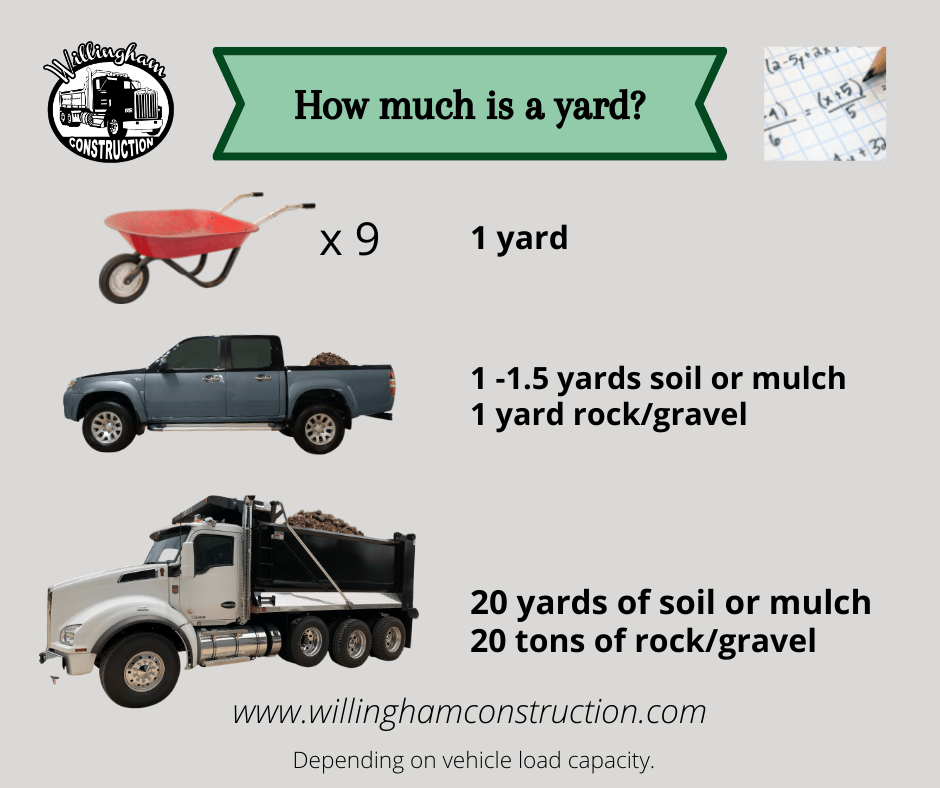
Image Source: lirp.cdn-website.com
Deciphering Material Weight per Square Yard
The concept of weight of material by area is fundamental in many practical applications. Imagine you’re paving a patio. You need to know how many tons of pavers to order, but pavers are often sold by the square yard. Similarly, if you’re laying a gravel path, the thickness of the gravel layer directly impacts the total weight.
The Role of Density
Density is a property of matter that describes how much mass is contained in a given volume. It’s typically expressed in units like pounds per cubic foot (lb/ft³) or kilograms per cubic meter (kg/m³). Different materials have vastly different densities. For instance, a cubic yard of sand will weigh significantly more than a cubic yard of mulch.
- Density = Mass / Volume
When we talk about tons per square yard, we’re moving from a three-dimensional measure (volume) to a two-dimensional measure (area). This transition requires us to account for the depth or thickness of the material.
Incorporating Thickness
The thickness is the missing piece that connects volume and area. If you know the density of a material and the volume it occupies, you can easily calculate its weight. When dealing with area, you must specify the thickness to determine the volume.
- Volume = Area × Thickness
Therefore, to calculate the tonnage per square yard, you need to know:
- The density of the material.
- The thickness of the layer of material.
Calculating Tonnage from Area: A Step-by-Step Approach
Let’s break down the process of calculating tonnage from area. This is a common requirement in construction material weight estimations.
Step 1: Determine Material Density
First, you must identify the specific material you are working with. Common construction materials include gravel, sand, asphalt, concrete, topsoil, and various aggregates. Each has a characteristic density. You can usually find this information from suppliers, material safety data sheets (MSDS), or reliable online resources.
Example Densities (Approximate):
| Material | Density (lbs/ft³) | Density (kg/m³) |
|---|---|---|
| Gravel (dry) | 90 – 100 | 1442 – 1602 |
| Sand (dry) | 90 – 105 | 1442 – 1682 |
| Asphalt | 145 – 150 | 2323 – 2403 |
| Concrete | 140 – 150 | 2243 – 2403 |
| Topsoil (loose) | 70 – 90 | 1122 – 1442 |
| Crushed Stone | 95 – 105 | 1522 – 1682 |
Note: These are approximate values and can vary based on moisture content, compaction, and specific composition.
Step 2: Define the Area
You know you need to cover a certain area, which you’ll express in square yards. Let’s say you’re calculating the weight of gravel for a driveway.
Step 3: Specify the Thickness
This is a critical step. You need to decide how thick the layer of material will be. This is often specified in inches.
Step 4: Convert Units to Be Consistent
To perform calculations, all your units must be compatible. The most common scenario involves converting inches of thickness to feet and then calculating volume in cubic feet or cubic yards. Since we’re aiming for tons (which are related to pounds), working with pounds and feet is often easiest.
- 1 yard = 3 feet
- 1 square yard = 9 square feet
- 1 ton = 2000 pounds
If your thickness is in inches, convert it to feet:
- Thickness in feet = Thickness in inches / 12
Step 5: Calculate Volume
Now, calculate the volume of the material needed.
- Volume (cubic feet) = Area (square feet) × Thickness (feet)
Remember, if your area is in square yards, first convert it to square feet:
- Area (square feet) = Area (square yards) × 9
Step 6: Calculate Weight
Using the density and the calculated volume, find the total weight in pounds.
- Weight (lbs) = Volume (cubic feet) × Density (lbs/ft³)
Step 7: Convert Weight to Tons
Finally, convert the weight from pounds to tons.
- Weight (tons) = Weight (lbs) / 2000
Putting It Together: An Example Calculation
Let’s say you need to cover a patio area of 100 square yards with 4 inches of gravel. We’ll use an average gravel density of 95 lbs/ft³.
- Area: 100 square yards.
- Thickness: 4 inches.
- Convert Area to Square Feet: 100 sq yards * 9 sq ft/sq yard = 900 sq ft.
- Convert Thickness to Feet: 4 inches / 12 inches/ft = 0.333 ft.
- Calculate Volume in Cubic Feet: 900 sq ft * 0.333 ft = 300 cubic feet.
- Calculate Weight in Pounds: 300 cubic feet * 95 lbs/ft³ = 28,500 lbs.
- Convert Weight to Tons: 28,500 lbs / 2000 lbs/ton = 14.25 tons.
So, for this specific scenario, you would need approximately 14.25 tons of gravel. This demonstrates the square yard to ton conversion is entirely dependent on the material’s depth and density.
Common Scenarios and Considerations
The weight of material by area is a critical metric in many industries. Let’s explore some common scenarios.
Landscaping and Driveways
When planning landscaping projects, such as laying gravel for a driveway or topsoil for a garden bed, estimating material quantities is essential.
- Gravel Driveway: Driveways typically require a base layer of compacted gravel, often 4 to 8 inches thick. The type of gravel (e.g., crushed stone, river rock) will affect the density.
- Topsoil for Gardens: Garden beds often need 4 to 12 inches of topsoil. The moisture content of topsoil can significantly impact its weight. Dry, loose topsoil is lighter than wet, compacted soil.
- Mulch: While often sold by the cubic yard, mulch is also considered in terms of area coverage. A typical application might be 3 to 4 inches deep. Mulch density varies greatly depending on the wood type.
Construction and Paving
In construction, accurately calculating construction material weight is vital for structural integrity, logistics, and cost management.
- Asphalt Paving: The thickness of asphalt layers in roads or parking lots is precisely controlled. Asphalt weight is often specified in tons per square yard for specific thicknesses (e.g., 2 inches of asphalt).
- Concrete Slabs: The thickness of concrete slabs for foundations, sidewalks, or patios will determine the overall weight. Concrete density is relatively consistent, but the thickness is the primary variable.
- Aggregate Bases: For roads and buildings, compacted layers of crushed stone or aggregate are used as a base. The required thickness and density of these materials are crucial for load-bearing capacity.
Cubic Yards to Tons Conversion
Often, materials like gravel, sand, and mulch are sold by the cubic yard. This makes the conversion process slightly different, but still relies on the same principles.
If you have a volume in cubic yards and want to convert it to tons, you’ll need the material’s density, typically expressed in pounds per cubic yard or kilograms per cubic meter.
- 1 cubic yard = 27 cubic feet
To find the weight in tons from cubic yards:
- Find the density in pounds per cubic yard. If you have density in lbs/ft³, multiply by 27 (since 1 yd³ = 27 ft³).
- Density (lbs/yd³) = Density (lbs/ft³) × 27
- Calculate Weight in Pounds:
- Weight (lbs) = Volume (yd³) × Density (lbs/yd³)
- Convert to Tons:
- Weight (tons) = Weight (lbs) / 2000
Example: You need 10 cubic yards of gravel with a density of 2700 lbs/yd³.
- Calculate Weight in Pounds: 10 yd³ * 2700 lbs/yd³ = 27,000 lbs.
- Convert to Tons: 27,000 lbs / 2000 lbs/ton = 13.5 tons.
This highlights how converting tons to square yards or vice versa is a multi-step process involving density, thickness, and unit conversions.
Factors Affecting Material Weight
Several factors can influence the actual weight of a material, even when dealing with the same general type.
Moisture Content
This is perhaps the most significant variable. Wet materials are always heavier than dry materials of the same volume.
- Gravel/Sand: Moisture can add a substantial percentage to the weight.
- Topsoil: Wet topsoil can be significantly heavier, making it harder to handle and affecting calculations.
- Mulch: Wet mulch absorbs water and becomes much denser.
Compaction
The degree to which a material is compacted also affects its density.
- Loose vs. Compacted: A ton of loosely piled gravel will occupy a much larger volume than a ton of compacted gravel. In construction, materials are often compacted to achieve specific densities and strengths.
- Rolled Asphalt: The rolling process compacts asphalt, increasing its density and weight per square yard.
Particle Size and Shape
The size and shape of the particles in aggregates can influence how tightly they pack together, affecting the overall density.
- Crushed Stone vs. River Rock: Crushed stone, with its angular edges, tends to interlock better, potentially leading to a slightly higher density than rounded river rock when compacted.
Creating a Handy Reference Table
To simplify the process, we can create tables that provide tons per square yard for common materials at specific thicknesses. These are approximations, but they can be very useful for quick estimates.
Let’s assume a standard gravel density of 100 lbs/ft³ for these examples.
Tons per Square Yard for Gravel (Density ≈ 100 lbs/ft³)
| Thickness (inches) | Thickness (feet) | Volume per sq yd (ft³) | Weight per sq yd (lbs) | Tons per sq yd |
|---|---|---|---|---|
| 1 | 0.0833 | 0.75 | 75 | 0.0375 |
| 2 | 0.1667 | 1.50 | 150 | 0.0750 |
| 3 | 0.2500 | 2.25 | 225 | 0.1125 |
| 4 | 0.3333 | 3.00 | 300 | 0.1500 |
| 5 | 0.4167 | 3.75 | 375 | 0.1875 |
| 6 | 0.5000 | 4.50 | 450 | 0.2250 |
Note: To use this table, multiply the “Tons per sq yd” value by the total number of square yards you need to cover.
Example: For 100 square yards needing 4 inches of gravel:
100 sq yards * 0.1500 tons/sq yard = 15 tons.
(This is close to our previous calculation of 14.25 tons, the difference being the exact density used).
Tons per Square Yard for Asphalt (Density ≈ 150 lbs/ft³)
| Thickness (inches) | Thickness (feet) | Volume per sq yd (ft³) | Weight per sq yd (lbs) | Tons per sq yd |
|---|---|---|---|---|
| 1 | 0.0833 | 0.75 | 112.5 | 0.05625 |
| 1.5 | 0.1250 | 1.125 | 168.75 | 0.084375 |
| 2 | 0.1667 | 1.50 | 225 | 0.1125 |
| 3 | 0.2500 | 2.25 | 337.5 | 0.16875 |
Note: These figures are common in paving specifications.
Frequently Asked Questions (FAQ)
Q1: How do I convert tons to square yards?
A1: You cannot directly convert tons to square yards without knowing the material’s density and the desired thickness. The conversion is always “tons per square yard at X thickness.”
Q2: What is a typical tonnage for a square yard of concrete?
A2: For a 4-inch thick concrete slab (approximately 0.333 feet) with a density of 150 lbs/ft³, the weight would be:
Area = 1 sq yd = 9 sq ft
Volume = 9 sq ft * 0.333 ft = 3 cubic feet
Weight = 3 cubic feet * 150 lbs/ft³ = 450 lbs
Tons = 450 lbs / 2000 lbs/ton = 0.225 tons per square yard.
Q3: How do I calculate the weight of material for a large area?
A3: Multiply the calculated “tons per square yard” for your specific material and thickness by the total number of square yards you need to cover.
Q4: Does the type of gravel matter for weight calculations?
A4: Yes, different types of gravel (crushed stone, rounded gravel, engineered fill) can have slightly different densities, affecting the final weight. Always try to get the specific density from your supplier.
Q5: Why is it important to know the weight of material by area?
A5: Knowing the weight of material by area is crucial for ordering the correct quantities, ensuring structural stability, managing project costs, and understanding load requirements in construction and landscaping. It helps in accurate material procurement and prevents over or under-ordering.
Conclusion
The question “How many tons in a square yard?” is a gateway to a more complex but essential calculation in many practical fields. By grasping the concepts of material density and the critical role of thickness, you can accurately estimate tons per square yard for any material. Whether you’re calculating construction material weight, planning a landscaping project, or simply trying to comprehend material weight per square yard, this guide provides the framework. Remember to always use precise figures for density and thickness, and when in doubt, consult with your material supplier for the most accurate data. This detailed approach to calculating tonnage from area will save you time, money, and ensure your projects are built on solid ground – both literally and figuratively.