
Yard dice, also known as large dice or dice for the lawn, are a fantastic way to bring classic dice games and outdoor games to your backyard. These oversized dice are perfect for lawn games that everyone, from young children to adults, can enjoy. So, how do you play yard dice? It’s simple! You can play a variety of games with them, from simple roll-and-score challenges to more complex party games that will liven up any game night.
Yard dice are more than just oversized novelties; they are versatile tools for creating engaging family games and social gatherings. Their sheer size makes them visible from across the yard, adding a visual spectacle to the fun. The satisfying thud they make when landing adds to the tactile experience of dice rolling and dice throwing. This guide will walk you through the basics and introduce you to several popular yard game rules to get your outdoor fun started.
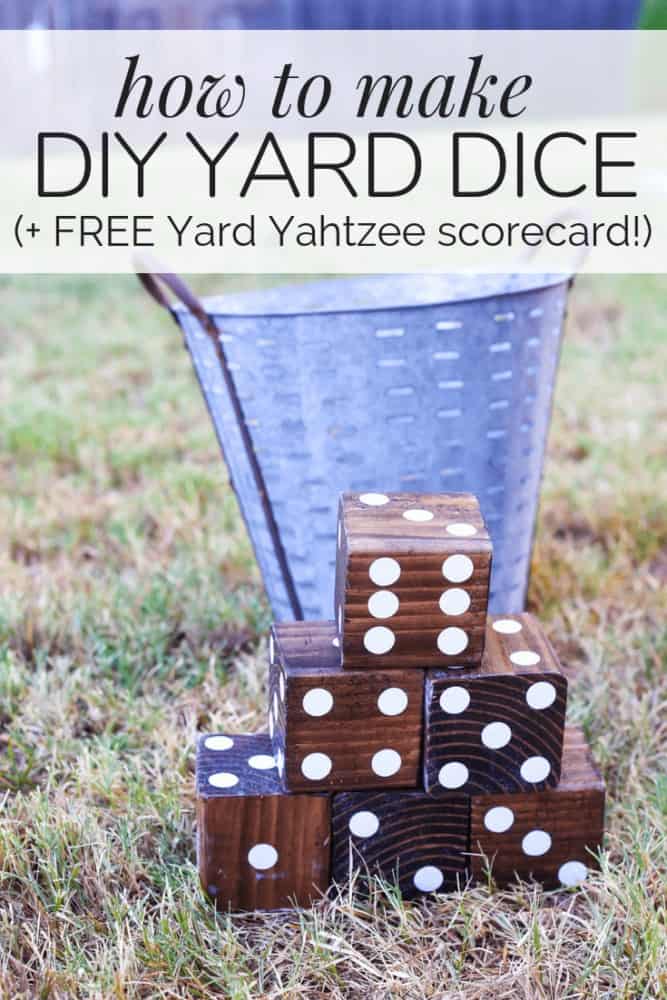
Image Source: www.loveandrenovations.com
The Charm of Large Dice for Outdoor Fun
There’s something inherently engaging about playing with large dice. They transform simple dice games into lively spectacles. Imagine a sunny afternoon, the smell of barbecue in the air, and the clatter of giant dice echoing across the lawn. These are the ingredients for memorable lawn games.
The appeal of yard game rules is their accessibility. Many are adaptations of popular board games or card games, made even more enjoyable by the sheer scale of the dice. They encourage participation, get people moving, and are a refreshing alternative to screen time. Whether you’re looking for family games to bond over or energetic party games to entertain guests, yard dice deliver.
Getting Started with Your Yard Dice
Before diving into specific games, let’s cover the essentials. Most yard dice sets come with six large dice, typically made from wood or durable plastic. They often resemble standard six-sided dice, with pips (dots) representing numbers 1 through 6. Some sets might include a score sheet or a bucket for rolling, but these are usually optional additions.
What’s Included in a Yard Dice Set?
- Six Large Dice: Usually made of wood or sturdy plastic, these dice are significantly larger than standard dice, making them easy to see and handle outdoors.
- Carry Bag or Bucket (Optional): Many sets come with a bag or bucket for easy storage and transport, and sometimes for rolling the dice.
- Score Sheet or Game Ideas (Optional): Some manufacturers include printed rules or score sheets to get you started.
Essential Yard Game Rules to Keep in Mind
While each game has its specific rules, some general principles apply to most yard game rules:
- Fair Play: Ensure all players understand the rules before starting.
- Designated Rolling Area: Establish a clear area for dice rolling to avoid confusion.
- Scorekeeping: Decide on a method for keeping score – a whiteboard, a printed sheet, or even just tally marks in the dirt!
- Respect the Dice: While durable, try to avoid excessive force when dice throwing to prolong their lifespan.
Popular Yard Dice Games and Their Rules
The beauty of yard dice lies in their versatility. You can adapt many classic dice games or invent your own. Here are a few favorites to get you playing:
1. Yahtzee (Yardzee)
This classic dice game is a perennial favorite and translates perfectly to the larger scale.
Yardzee Basics
- Objective: Score as many points as possible by rolling specific combinations of dice over 10 rounds.
- Players: 2 or more.
- Equipment: Six large dice, score sheet.
Yardzee Yard Game Rules
- Starting the Game: Decide who goes first, perhaps by having each player roll one die – the highest roll goes first.
- Player’s Turn: On your turn, you have three rolls to try and achieve a scoring combination.
- First Roll: Roll all six dice.
- Second Roll: You can re-roll any or all of the dice. Choose which ones to keep and which to re-roll.
- Third Roll: You can re-roll again, keeping any dice from the second roll that you wish.
- Scoring: After your third roll, you must assign your dice combination to one of the available scoring categories on the score sheet. Once a category is filled, it cannot be used again.
- Upper Section:
- Aces (1s): Score the sum of all 1s.
- Twos (2s): Score the sum of all 2s.
- Threes (3s): Score the sum of all 3s.
- Fours (4s): Score the sum of all 4s.
- Fives (5s): Score the sum of all 5s.
- Sixes (6s): Score the sum of all 6s.
- Upper Section Bonus: If the sum of your upper section scores is 63 or more, you get a 35-point bonus.
- Lower Section:
- Three of a Kind: Score the sum of all dice if at least three dice show the same number.
- Four of a Kind: Score the sum of all dice if at least four dice show the same number.
- Full House: Score 25 points for three of one number and two of another.
- Small Straight: Score 30 points for a sequence of four dice (e.g., 1-2-3-4, 2-3-4-5, 3-4-5-6).
- Large Straight: Score 40 points for a sequence of five dice (e.g., 1-2-3-4-5, 2-3-4-5-6).
- Yardzee (Five of a Kind): Score 50 points for all five dice showing the same number. If you roll a Yahtzee in the upper section, it counts as 5 times the face value of the dice.
- Chance: Score the sum of all five dice. This is a catch-all if no other category is desirable.
- Upper Section:
- End of Game: After 10 rounds, all players have filled their score sheets. The player with the highest total score wins.
2. Farkle
Farkle is a thrilling game of risk and reward that’s perfect for family games or party games.
Farkle Basics
- Objective: Be the first player to reach a target score (e.g., 10,000 points) by accumulating points with each roll.
- Players: 2 or more.
- Equipment: Six large dice, score sheet.
Farkle Yard Game Rules
- Starting the Game: Players decide on a target score (e.g., 10,000). The first player is determined by the highest single die roll (highest wins).
- Player’s Turn: On your turn, you roll all six large dice.
- Scoring Dice: Certain dice are worth points:
- Single 1s: 100 points each.
- Single 5s: 50 points each.
- Three of a Kind:
- 1s: 1000 points
- 2s: 200 points
- 3s: 300 points
- 4s: 400 points
- 5s: 500 points
- 6s: 600 points
- Other Combinations:
- Straight (1-6): 1500 points (using all six dice).
- Three Pairs: 750 points.
- Four of a Kind: Double the points of three of a kind (e.g., four 2s = 400 points).
- Five of a Kind: Triple the points of three of a kind (e.g., five 2s = 600 points).
- Six of a Kind: Quadruple the points of three of a kind (e.g., six 2s = 800 points).
- Continuing to Roll: After you score points with one or more dice, you can choose to stop and bank your points, or continue rolling with the remaining dice. If you score with all six dice, you get to roll all six again and add those points to your current roll’s total.
- Farkle! If you roll the dice and none of the scoring combinations are present, you “Farkle.” Your turn ends immediately, and you score zero points for that turn.
- Minimum Score to Start: Some variations require a player to accumulate a certain number of points (e.g., 500 or 1000) before they can “bank” any points. If they Farkle before reaching this minimum, their points for that turn are lost.
- Winning: The first player to reach or exceed the target score wins the game. If multiple players reach the target score in the same round, the player with the highest score wins.
3. Pig (Pig Out!)
A simple yet exciting game that emphasizes the thrill of dice rolling.
Pig Basics
- Objective: Be the first player to reach a target score (e.g., 100 points).
- Players: 2 or more.
- Equipment: Two large dice.
Pig Yard Game Rules
- Starting the Game: Decide who goes first by rolling one die – highest roll goes first.
- Player’s Turn: On your turn, you roll the two large dice.
- If you roll a 1 on either die, your turn ends, and you score zero points for that turn.
- If you roll two 1s, your turn ends, and your total score becomes zero (you lose all accumulated points from previous turns). This is the “Pig Out!”
- If you roll any other combination, add the numbers on both dice to your turn’s score.
- Decision to Continue: After each successful roll (where no 1s appear), you have a choice:
- Hold: Stop rolling for that turn and add your turn’s accumulated points to your total score.
- Roll Again: Continue dice throwing to accumulate more points for that turn. Be aware of the risk of rolling a 1!
- Winning: The first player to reach or exceed the target score (e.g., 100 points) wins the game.
4. Bunco
While traditionally played with smaller dice, Bunco can be adapted for yard dice, making it a lively party game.
Bunco Basics
- Objective: Score points by rolling specific combinations of dice. The game is played in rounds, with each round focusing on a different number.
- Players: 6 or more, divided into teams.
- Equipment: Six large dice, score sheets, a “Bunco Buzzer” (optional, can be a noise maker).
Bunco Yard Game Rules
- Setup: Players form teams, typically of two or three people. One player is designated the “Scorekeeper.” Each team has a designated “Table Captain” who rolls the dice.
- Rounds: The game consists of 6 rounds.
- Round 1: Players attempt to roll 1s.
- Round 2: Players attempt to roll 2s.
- Round 3: Players attempt to roll 3s.
- …and so on, up to Round 6 (rolling 6s).
- Player’s Turn: The Table Captain for the current team rolls the dice.
- Bunco! If the team rolls three of the current round’s number (e.g., three 1s in Round 1), they score a “Bunco” (usually 21 points). They immediately get another turn.
- Successive Wins: If the team rolls at least one die with the current round’s number, they score 1 point for each matching die and get to roll again.
- Farkle (No Match): If the team rolls the dice and none of the dice show the current round’s number, their turn ends, and they score zero points for that turn.
- Passing the Dice: The dice are passed to the next team’s Table Captain.
- End of Round: A round ends when one team reaches a predetermined point total for that round (e.g., 50 points) or when the traveling team (the team that is behind) rolls a “Bunco.”
- Winning: The team with the most points at the end of all 6 rounds wins the game.
Tips for Hosting a Yard Dice Game Night
Making your yard game rules a success involves more than just knowing how to play. Consider these tips for a fantastic game night:
- Comfortable Seating: Provide chairs or blankets for players to relax on.
- Adequate Lighting: If playing into the evening, ensure good lighting for visibility.
- Refreshments: Keep players fueled with snacks and drinks.
- Music: Background music can enhance the festive atmosphere.
- Involve Everyone: Encourage participation from all ages and skill levels.
- Variations: Don’t be afraid to modify yard game rules to suit your group.
Creating Your Own Yard Dice Games
The joy of large dice extends to the freedom of creation. You can invent entirely new lawn games or adapt your favorite dice games.
Brainstorming Game Mechanics
Think about what makes dice games fun:
- Probability: The chance of rolling certain numbers.
- Strategy: Deciding when to re-roll, when to hold, and which scoring category to aim for.
- Risk vs. Reward: The decision to push your luck or play it safe.
- Competition: The drive to outscore opponents.
Simple Game Ideas
- Target Score: Roll all six dice and try to hit a specific sum (e.g., exactly 25).
- Highest Roll Wins: Players roll all six dice, and the player with the highest single die wins the round.
- Consecutive Rolls: Try to roll a specific number or combination a certain number of times in a row.
The Social Aspect of Yard Games
Yard dice are more than just a way to pass the time; they are catalysts for connection. They bring people together in a relaxed, informal setting, fostering laughter and friendly competition. These outdoor games are perfect for barbecues, family reunions, or just a casual afternoon gathering. The shared experience of dice rolling and dice throwing creates lasting memories.
As family games, they offer opportunities for intergenerational bonding. Grandparents can share their love of dice games with grandchildren, teaching them new skills and reinforcing the importance of teamwork and sportsmanship. The large size of the dice makes them easy for everyone to handle, ensuring inclusivity.
For party games, yard dice add a unique and engaging element. They break the ice and provide a focal point for guests to interact. The visual appeal of large dice adds a touch of whimsy and fun to any event, making your game night a memorable occasion.
Frequently Asked Questions (FAQ)
Q: What are yard dice?
A: Yard dice are oversized dice, typically larger than standard table dice, designed for playing lawn games and outdoor games in a backyard or open space.
Q: How many dice usually come in a set?
A: Most yard dice sets include six large dice.
Q: What are the most popular yard dice games?
A: Popular yard game rules include Yardzee (a version of Yahtzee), Farkle, Pig, and Bunco.
Q: Can children play yard dice games?
A: Yes, yard dice are great for family games. Many dice games are simple enough for children to learn, and the large size of the dice makes them easy for little hands to manage.
Q: Do I need any special equipment besides the dice?
A: While not always necessary, a score sheet can be helpful for games like Yardzee and Farkle. Some people also use a bucket or a designated rolling mat for cleaner dice rolling.
Q: Are there any specific safety considerations for yard dice?
A: Ensure the playing area is free of hazards. When dice throwing, be mindful of where they might land to avoid hitting people or fragile objects.
Q: Can I play these games with regular dice?
A: Absolutely! The core dice games can be played with standard dice, but the large dice add a unique tactile and visual experience to lawn games.
Q: How do I clean yard dice?
A: For wooden dice, a damp cloth is usually sufficient. For plastic dice, mild soap and water can be used. Always dry them thoroughly before storing.
Q: What makes yard dice good for party games?
A: Their size makes them highly visible and engaging for groups, encouraging participation and creating a lively atmosphere for game night. They are excellent party games that are easy to learn.
Q: Where can I find yard dice?
A: Yard dice can be found at many large retail stores, specialty game stores, and online marketplaces. They are readily available for anyone looking to enjoy outdoor games.